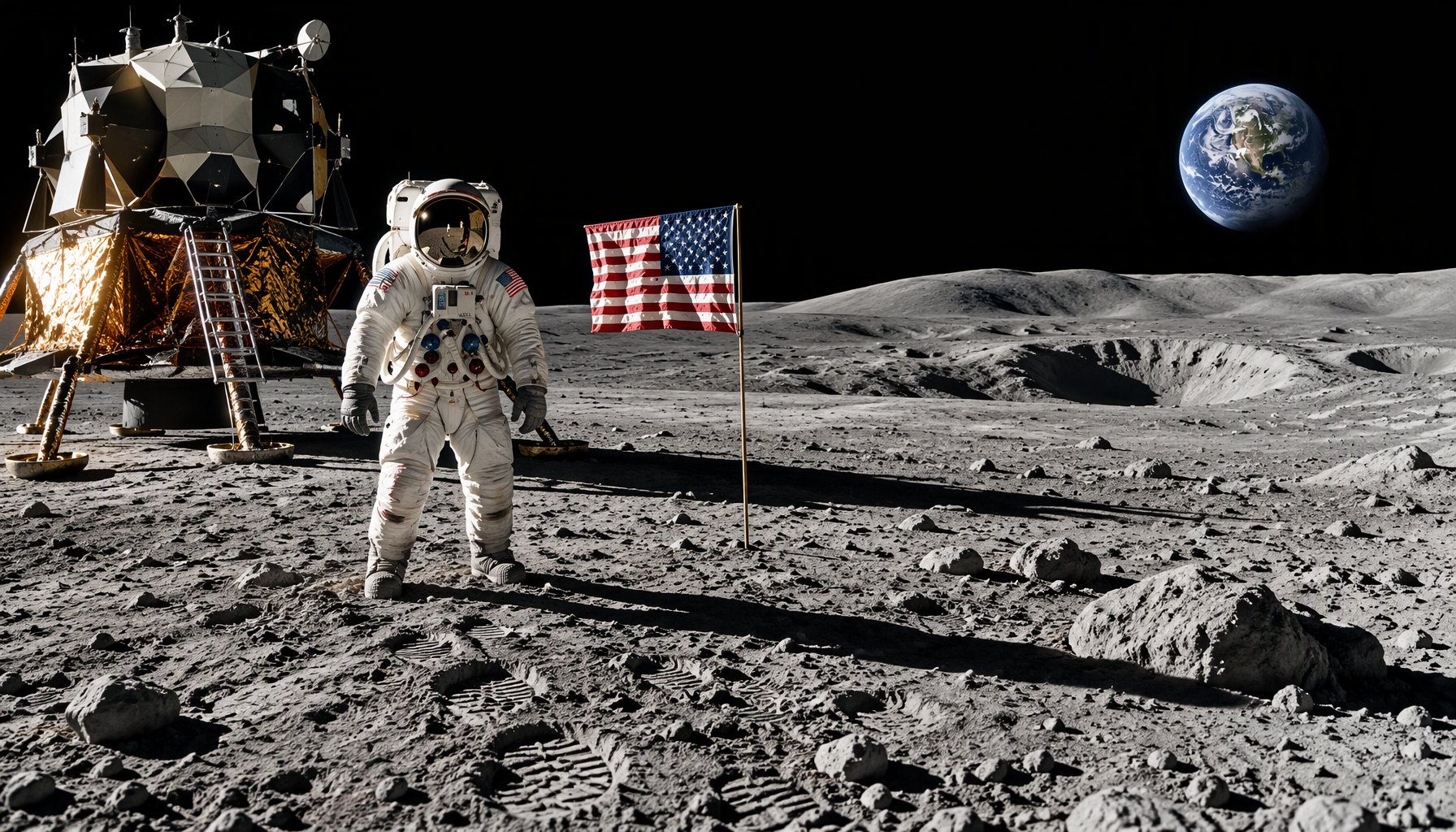
Race to the Moon
In 1961, President John F. Kennedy announced the national goal of sending humans to the Moon before the end of the decade. The announcement came amid the Cold War rivalry with the Soviet Union, which had already sent the first Sputnik satellite and the first human into space. The Moon became a symbol of technological and political superiority.
The Apollo program involved thousands of scientists, engineers, and contractors. After the success of the Apollo 8 mission orbiting the Moon in December 1968, NASA prepared Apollo 11 as the first landing mission. The crew consisted of Neil Armstrong as commander, Edwin "Buzz" Aldrin as lunar module pilot, and Michael Collins as command module pilot.
Lessons from Apollo 1
The Apollo program was not without tragedy. In January 1967, three astronauts—Gus Grissom, Ed White, and Roger Chaffee—died in a fire during the Apollo 1 test. The accident revealed design and safety issues, including flammable materials and a difficult-to-open door.
After the accident, NASA redesigned the capsule and safety procedures. The lessons from Apollo 1 became part of the safety culture that helped the following missions. However, the risks remained high, and each Apollo mission was an unprecedented technical experiment.
Saturn V Launch
Apollo 11 was launched on July 16, 1969, from the Kennedy Space Center, Florida, with the Saturn V rocket. The rocket was the most powerful launch vehicle ever flown at the time, over 110 meters tall with enormous thrust. The launch was witnessed by thousands of people around the site and millions more via television.
The journey to the Moon took about three days. The crew performed trajectory corrections and system checks. On July 19, the spacecraft entered lunar orbit. The next day, the lunar module Eagle separated from the command module Columbia and began its descent to the surface.
Landing at Mare Tranquillitatis
On July 20, 1969, Eagle descended to an area called Mare Tranquillitatis, or the Sea of Tranquility. The navigation computer sent an alarm that made the crew and mission control tense, but the problem was overcome. Armstrong then took manual control as the automatic landing trajectory headed toward a rocky area.
Eagle landed with very little fuel remaining. Armstrong reported a successful landing with the now-famous words: "Houston, Tranquility Base here. The Eagle has landed." On Earth, mission control and the public celebrated, although the mission was not yet complete.
First Step
A few hours later, Armstrong descended from the module and became the first human to set foot on the Moon. His statement, "That's one small step for man, one giant leap for mankind," was broadcast to hundreds of millions of people. Aldrin followed and described the lunar surface as "magnificent desolation".
The two astronauts planted the American flag, placed experimental equipment, collected rock samples, and spoke with President Richard Nixon via radio. They also left a plaque and medals to honor astronauts who died in space missions. Approximately 21.5 kilograms of lunar samples were brought back to Earth.
Return to Earth
After about 21 hours on the lunar surface, Eagle took off and rendezvoused with Columbia in orbit. The crew then began the journey home and landed in the Pacific Ocean on July 24, 1969. They were welcomed as heroes and underwent quarantine to prevent possible contamination from the Moon.
The Apollo 11 mission fulfilled Kennedy's goal before the end of the decade. Its success was supported by thousands of people, including scientists, technicians, and industrial workers. However, the mission was also part of a broader geopolitical competition, not just scientific exploration.
Controversy and False Theory Denial
Since 1969, theories have emerged that the Moon landing was a fake recording made in a studio. These theories usually point to the flag appearing to wave, misaligned shadows, or the absence of stars in the photos. However, physical explanations and mission documentation answer most of these claims.
The flag appears to move because of the support rod and vibrations when it was installed, not because of the wind. Shadows are influenced by the sun's angle and uneven surfaces. Stars are not visible because the camera was set for very bright objects on the surface. Additionally, hundreds of kilograms of lunar rocks have been analyzed by scientists in various countries, and Soviet missions and independent observations confirm the presence of human activity on the Moon.
Legacy
Apollo 11 became a symbol of humanity's ability to achieve the seemingly impossible. The mission drove the development of technology, materials science, computers, and space medicine. However, after Apollo 17 in 1972, humans have not returned to the Moon for several decades.
In the 21st century, various countries and private companies have again targeted the Moon. The legacy of Apollo 11 remains relevant not only as a technical achievement but also as a reminder of the ambition, risk, and cooperation required for space exploration.



Discussion
Comments
Comments are reviewed by an editor before they appear. Include sources when correcting facts.
No comments yet. Be the first to respond to this article.