Two Brothers from Dayton
Wilbur Wright was born in 1867 and Orville Wright in 1871 in Dayton, Ohio. Neither completed formal university education, but they possessed strong curiosity and high technical skills. They worked in their family's bicycle shop and also published a small newspaper.
Experience with bicycles was crucial to them. Bicycles taught balance, control, and the importance of testing. The brothers were also accustomed to working with their hands, designing tools, and repairing machines. The combination of practical skills and systematic thinking became the key to their success.
Bicycles and Aviation
The Wrights' interest in aviation grew after reading about Otto Lilienthal, the German glider pioneer who died in an accident in 1896. They also studied the works of Samuel Langley and Octave Chanute. However, they realized that knowledge about aircraft control was still very limited.
The Wright brothers did not immediately attempt to build a powered aircraft. They started with a glider and conducted research on aerodynamics. They read books, observed birds, and performed simple experiments. Their approach differed from many other inventors who tried to fly large engines straight away.
Glider at Kitty Hawk
In 1900, the Wright brothers went to Kitty Hawk, North Carolina, to test their glider. They chose that location because of its strong winds and soft sand. Their first glider had wider wings and better control than previous designs, but it was still unsatisfactory.
In 1901, they returned with a larger glider, but the results were disappointing. The lift produced was less than their calculations. They realized that existing aerodynamic data, including Lilienthal's tables, were not entirely accurate. They then built a simple wind tunnel to test wings and propellers.
Control Problems
The Wright brothers' greatest contribution was the three-axis control system: pitch, roll, and yaw. They used an elevator to control ascent and descent, wing warping to adjust wing tilt, and a rudder to control direction. That system allowed the aircraft to be actively controlled, not merely to follow the wind.
In 1902, their glider performed more than a thousand flights and demonstrated that the three-axis control worked. They also developed an efficient propeller based on aerodynamic principles. That success became the foundation for the powered aircraft they would build in 1903.
Engine and Propeller
The Wright brothers could not find a suitable engine on the market, so they designed one themselves. The engine had four cylinders, weighed about 90 kilograms, and produced roughly 12 horsepower. It was lighter and strong enough to lift a small aircraft.
The propeller was also designed in-house. They realized that a propeller works like a rotating wing, and designed blades that produced maximum thrust. Two propellers were mounted behind the wings and driven by chains. The combination of engine, propeller, and control made the Flyer ready for testing.
December 17, 1903
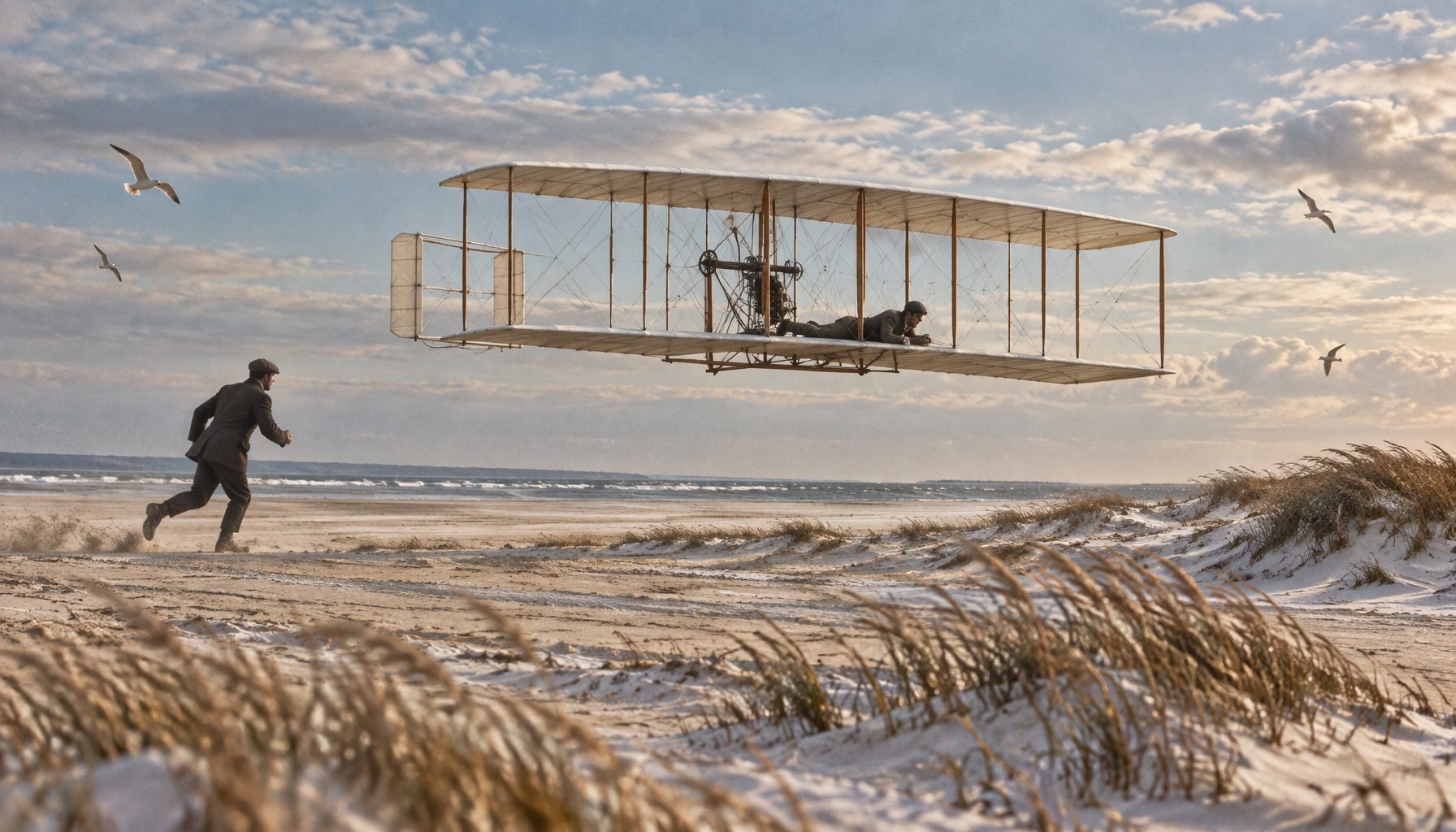
On December 17, 1903, the Wright brothers made four flights at Kitty Hawk. The first flight was conducted by Orville and lasted 12 seconds, covering about 120 feet. The last flight was conducted by Wilbur and lasted 59 seconds, covering about 852 feet.
The flight was not spectacular compared to modern aircraft, but it was crucial because it was a controlled and sustained powered flight. Several witnesses from the beach guard station observed it. The Wright brothers sent a telegram to their father to report the success.
After the First Flight
After 1903, the Wright brothers continued refining their aircraft. They faced skepticism from the public and the American government, but continued experiments at Huffman Prairie near Dayton. In 1908, Wilbur performed a demonstration in France that shocked the European aviation world.
They founded a company, filed patents, and became involved in legal disputes over intellectual property rights. Competition with the Smithsonian Institution also influenced the history of recognition of their achievements. Nevertheless, the 1903 flight remains recognized as a milestone.
Legacy
The Wright brothers paved the way for modern aviation. The three-axis control principles they developed are still used in modern aircraft. Their flight inspired a generation of inventors and opened a new era in transportation, commerce, and warfare.
The Wright Flyer is now displayed at the National Air and Space Museum in Washington, D.C. The Wright brothers' story shows that great innovation can arise from curiosity, hard work, and systematic testing. They did not merely dream of flying, but solved the technical problems that made flight possible.


Discussion
Comments
Comments are reviewed by an editor before they appear. Include sources when correcting facts.
No comments yet. Be the first to respond to this article.