The Cuban Revolution and Tensions
In 1959, Fidel Castro overthrew the government of Fulgencio Batista and took power in Cuba. Relations with the United States deteriorated after Cuba nationalized American companies and moved closer to the Soviet Union. In April 1961, the CIA-backed Bay of Pigs invasion failed to overthrow Castro's government, embarrassing the United States and strengthening Cuba's position in the communist bloc.
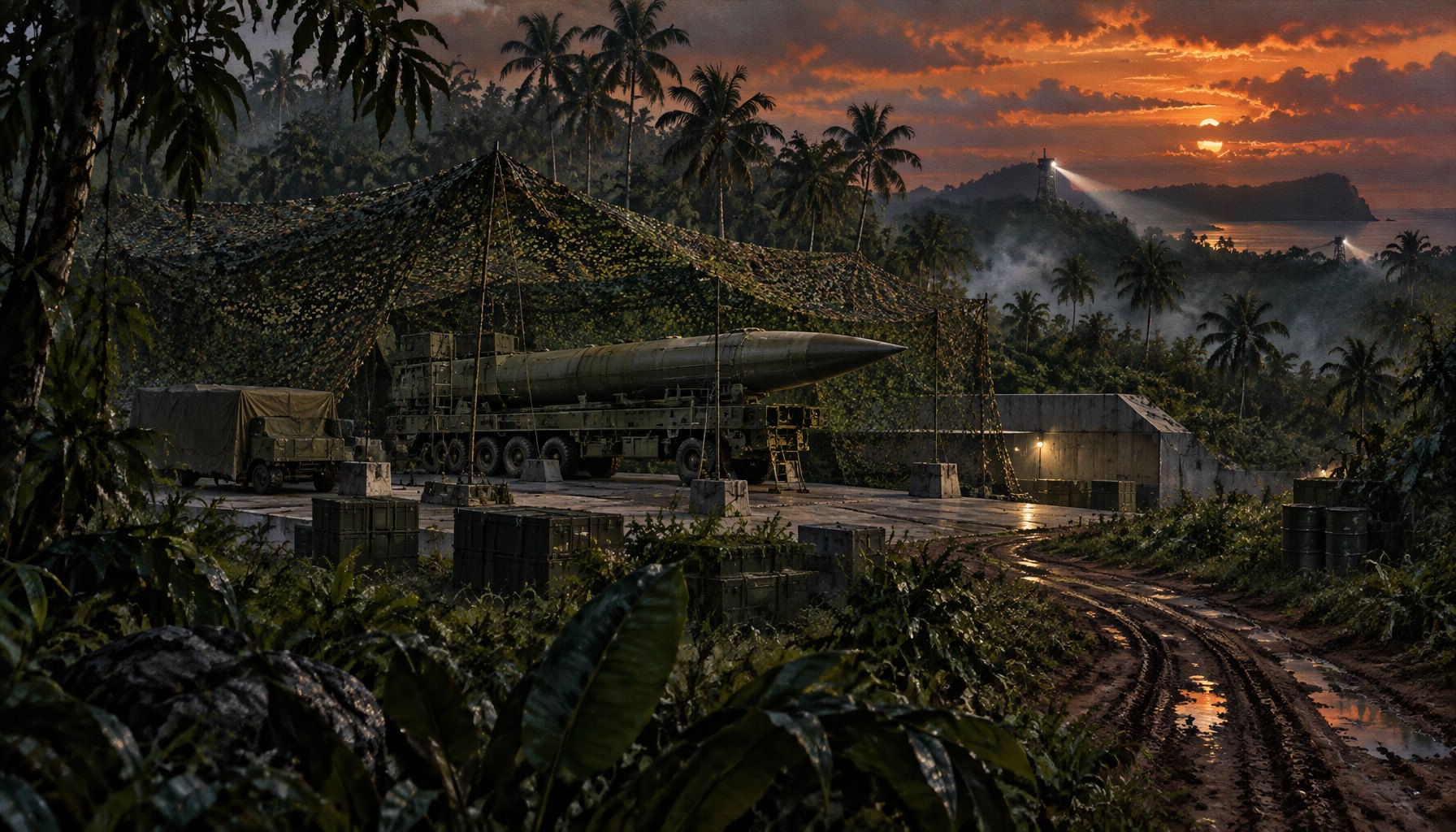
The Soviet Union saw Cuba as a strategic ally in the Western Hemisphere. Soviet leader Nikita Khrushchev decided to send nuclear missiles to Cuba to protect the island from American invasion and to balance the American missile advantage placed in Turkey. The operation was code-named Anadyr and was carried out in secret.
Discovery from the Air
On October 14, 1962, an American U-2 spy plane took photographs showing the construction of missile launch sites in Cuba. Analysis of the photos confirmed that the Soviet Union was installing intermediate-range ballistic missiles, capable of reaching most of the United States in a short time. President John F. Kennedy was informed on October 16.
Kennedy formed an executive committee, known as ExComm, to discuss options. Some members supported air strikes and invasion, while others supported a naval blockade. After several days of debate, Kennedy chose a quarantine, a blockade legally referred to as a quarantine because a full blockade was considered an act of war.
The October 22 Speech
On October 22, 1962, Kennedy delivered a television speech revealing the presence of Soviet missiles in Cuba. He announced a quarantine on shipments of weapons to the island and demanded that the Soviet Union withdraw all missiles. He also warned that a missile attack from Cuba would be considered an attack by the Soviet Union and would be met with a full response.
The speech shocked the American public and the world. In Cuba, Castro mobilized troops and declared readiness to face an invasion. In the Soviet Union, Khrushchev condemned the American action as a violation of international law. Soviet ships heading to Cuba were ordered to continue their voyage, while Soviet submarines approached the quarantine line.
Tensions at Sea
On October 24, Soviet ships carrying missiles began approaching the quarantine line. The world waited to see if the Americans would fire on the Soviet ships. At the last moment, the ships turned around or stopped, avoiding direct confrontation. However, tensions remained high as Soviet submarines were underwater and could not always communicate with Moscow.
On October 27, later known as Black Saturday, an American U-2 spy plane was shot down over Cuba and its pilot, Major Rudolf Anderson, was killed. Kennedy considered retaliatory strikes but delayed the decision to allow for negotiations. On the same day, Castro urged Khrushchev to use nuclear weapons if the United States attacked Cuba.
Secret Negotiations
Amidst the tension, Khrushchev sent a letter to Kennedy offering to withdraw the missiles if the United States promised not to invade Cuba. Kennedy responded by accepting the condition but also demanding that the Soviet missiles in Cuba be dismantled immediately. Negotiations took place through diplomatic channels and intermediaries, including Robert Kennedy and Soviet Ambassador Anatoly Dobrynin.
The final agreement included two parts. Publicly, the United States promised not to invade Cuba and the Soviet Union agreed to withdraw its missiles. Secretly, the United States agreed to withdraw Jupiter missiles from Turkey within a few months. The secret agreement was not announced at the time to avoid the impression that the United States was making concessions to the Soviets.
The End of the Crisis
On October 28, Khrushchev announced that the Soviet Union would dismantle and withdraw its missiles from Cuba. The crisis ended without war, but the world realized how close it had come to nuclear annihilation. Some historians estimate that if one different decision had been made, nuclear conflict could have occurred within hours.
After the crisis, the United States and the Soviet Union established a direct communication line between Washington and Moscow, later known as the hotline. The two countries also agreed to the Limited Nuclear Test Ban Treaty in 1963. The Cuban Missile Crisis became an important lesson about the importance of direct communication and escalation control in nuclear conflict.
The Legacy of the Crisis
The Cuban Missile Crisis is often studied in international relations as a case study in crisis management. Researchers highlight the role of communication, misperception, and time pressure in decision-making. Some declassified documents later showed that the military on both sides had less control over the situation than previously thought.
For Cuba, the crisis strengthened Castro's position but also showed that the interests of a small nation could become a tool in a larger conflict. For the world, the crisis served as a reminder that nuclear war was not an abstract scenario but a real possibility that had to be prevented through diplomacy and arms control.

Discussion
Comments
Comments are reviewed by an editor before they appear. Include sources when correcting facts.
No comments yet. Be the first to respond to this article.