The Aging Empire
The Soviet Union in the early 1980s was one of the world's largest military powers, but its economy faced structural problems. The central planning system struggled to meet consumer needs, falling oil prices in the 1980s reduced national income, and the war in Afghanistan strained the budget. A large and rigid bureaucracy slowed innovation.
The aging leadership and the gap between the state and society were also issues. Corruption, alcoholism, and distrust of institutions grew. When Mikhail Gorbachev became leader in March 1985, he faced a system in need of change, but also vested interests that did not want to lose power.
Perestroika and Glasnost
Gorbachev launched perestroika, a series of economic reforms aimed at improving efficiency and giving room for local initiatives. He also introduced glasnost, greater openness of information. The policy opened up public discussion about social issues, corruption, and history, including acknowledgment of the victims of Stalin's repression.
Glasnost unleashed energy that was not easy to control. The media began to report on problems that had previously been hidden. The Chernobyl nuclear disaster in 1986 was an example of how openness changed the way the government and society talked about state mistakes. However, economic reforms did not produce quick improvements, and dissatisfaction grew.
Rising Nationalism
The Soviet Union was a multi-ethnic state consisting of many republics. As central control weakened, demands for nationalism and independence increased. In the Baltic states—Estonia, Latvia, and Lithuania—separatist movements grew stronger. In the Caucasus and Central Asia, ethnic conflicts and demands for autonomy also emerged.
In 1989, the Eastern European countries that had previously been under Soviet influence began to abandon communism one by one. The Berlin Wall fell in November 1989. Gorbachev refused to use military force to maintain the communist regime in Eastern Europe, a decision that changed the political map of the continent.
Republics and the Center
In March 1990, Article 6 of the constitution, which guaranteed the monopoly of power of the Communist Party, was abolished. Boris Yeltsin, who had left the Communist Party, was elected chairman of the Russian parliament and later became president of the Russian Republic in June 1991. He demanded greater power for the republics and criticized the slow pace of reform.
Relations between the central government and the republics became increasingly strained. Some republics declared sovereignty or independence. Negotiations on a new union treaty were underway, but not all parties agreed. Gorbachev tried to maintain the Soviet Union as a reformed federation.
The August 1991 Coup
On August 19, 1991, a group of high-ranking officials opposed to reform formed the State Emergency Committee and announced a coup. Gorbachev, who was on vacation in Crimea, was isolated. Tanks were deployed to Moscow. The coup was led, among others, by Gennady Yanayev, Vladimir Kryuchkov, and Dmitry Yazov.
Yeltsin led the resistance. He climbed onto a tank in front of the White House in Moscow and called for a general strike and defense of the legitimate government. Thousands of people gathered. The coup failed within a few days because it did not receive sufficient military support and faced public resistance. Gorbachev returned to Moscow, but his authority had already weakened.
Belovezha and the CIS
After the coup, the republics became bolder in taking their own steps. On December 8, 1991, the leaders of Russia, Ukraine, and Belarus met in Belovezha and declared that the Soviet Union no longer existed as an international legal subject. They formed the Commonwealth of Independent States (CIS).
On December 21, 1991, eleven republics signed the Alma-Ata Declaration supporting the CIS. The Baltic states and Georgia did not join at that time. The Soviet Union lost its legal and political basis, although Gorbachev still tried to find a transitional formula.
December 25, 1991
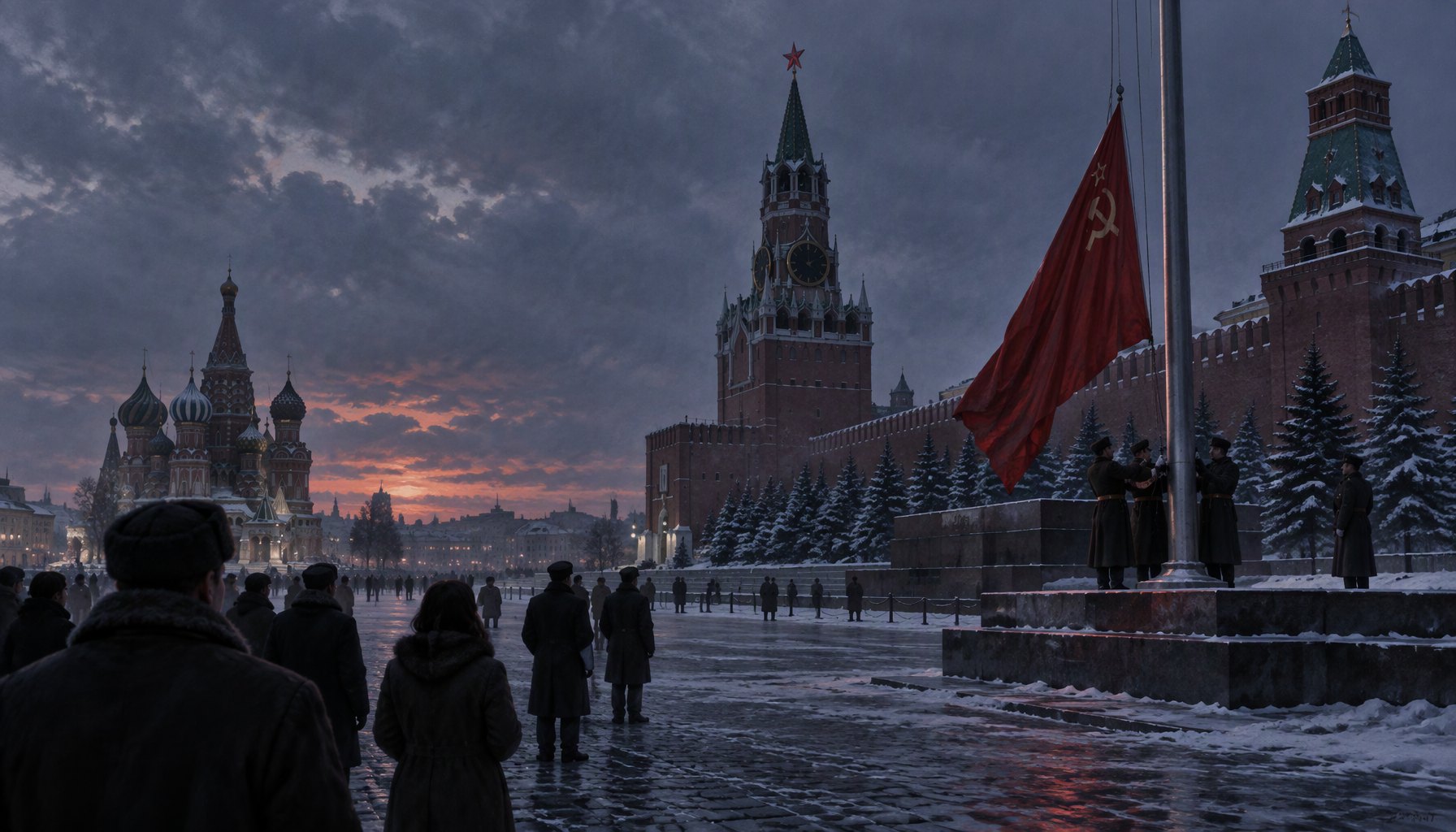
On December 25, 1991, Gorbachev resigned as president of the Soviet Union. The Soviet flag was lowered from the Kremlin and replaced by the Russian flag. The next day, the Soviet parliament officially dissolved the Soviet Union. After 69 years, the country that had once been one of the world's power poles came to an end.
The end of the Soviet Union was not accompanied by a major war, but it left a power vacuum, economic crisis, and conflict in some regions. Russia inherited a permanent seat on the UN Security Council and most of the Soviet nuclear arsenal, while the other republics built their own countries.
Legacy
The collapse of the Soviet Union ended the Cold War and changed the world order. The United States became the sole superpower, while Eastern Europe moved towards integration with the European Union and NATO. However, the transition in Russia and the former Soviet countries was difficult, with poverty, corruption, and political uncertainty.
For historians, the collapse shows that a seemingly strong system can crack when reforms cannot address structural problems and when political legitimacy erodes. The case of the Soviet Union is a lesson about the relationship between the economy, national identity, and leadership.
Discussion
Comments
Comments are reviewed by an editor before they appear. Include sources when correcting facts.
No comments yet. Be the first to respond to this article.