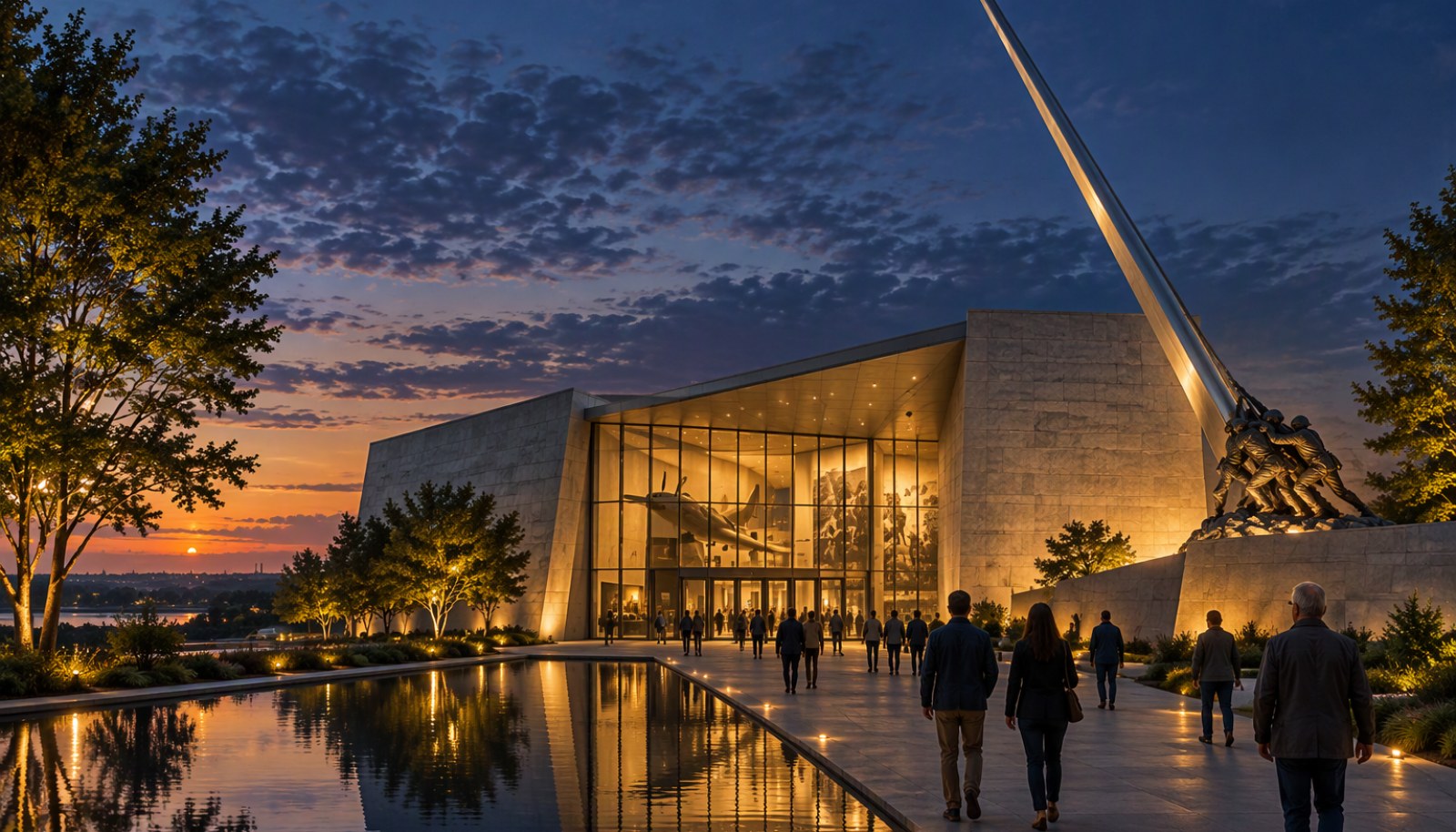
On November 10, 2006, coinciding with the 231st anniversary of the United States Marine Corps, the National Museum of the Marine Corps opened in Triangle, Virginia, near Marine Corps Base Quantico. The approximately 11,000 square meter building showcases the history of the corps from 1775 to modern operations, and serves as an educational center for the public and military personnel.
Old Museum and New Plans
Before this museum was established, the Marine Corps collection was housed in a building at Quantico that had been open since the mid-20th century. The space became increasingly cramped to accommodate vehicles, aircraft, uniforms, and personal archives of soldiers. Veterans then pushed for the construction of a larger national museum open to the public.
The project was carried out by the Marine Corps Heritage Foundation together with the Marine Corps and Congress. Its construction cost approached 90 million US dollars, mostly from private donations and partly from federal funds. Its location was chosen near Quantico to remain connected with the corps' training and education center.
A Building That Mimics the Iwo Jima Photo
The building design was done by Fentress Bradburn Architects from Denver. The roof lines and pillars are arranged so that from a distance they form a silhouette reminiscent of the flag-raising photo at Iwo Jima, one of the most well-known images from World War II. The analogy was intentional: the museum wanted to unite the story of battle with the story of ordinary soldiers.
Inside, a large atrium called the Leatherneck Gallery serves as the opening space. Aircraft and vehicles are hung and displayed at different heights, allowing visitors to view them from multiple angles. Natural light from high windows gives a spacious feel, while text panels and sound recordings guide visitors to the next gallery.
Galleries and Collections
The permanent exhibitions are arranged in chronological order. The "Making Marines" gallery showcases the basic training process, from the arrival of recruits to the closing ceremony. Visitors then pass through the Legacy Walk honoring Medal of Honor recipients, followed by galleries on World War II, Korea, Vietnam, the Cold War, and conflicts after September 11, 2001.
The collection includes fighter aircraft, armored vehicles, cannons, uniforms, personal letters, and combat art. Many objects are accompanied by the stories of their owners, not just technical descriptions. The museum also records veteran interviews so that their experiences can be learned by future generations.
In addition to exhibitions, the museum runs educational programs for schools, provides teaching materials for teachers, and manages a theater and multipurpose room. Because it is connected to Marine Corps University, the museum serves as a reference source for officer education, not just a weekend recreation spot.
Opening on November 10, 2006
The museum's opening was deliberately scheduled on the Marine Corps' anniversary, which is celebrated every year with a banquet and cake cutting. The ceremony was attended by corps leaders, veterans from various generations, government officials, and families of soldiers. By choosing that date, the museum affirmed that the corps' history is part of a living identity.
Since its opening, the museum has become a destination for school groups, military families, and tourists interested in military history. For many veterans, the place serves as a space to remember fallen comrades; for other visitors, the museum provides an explanation of how the corps evolved from a small force on ships into a power that fights on land, sea, and air.
The museum's management follows historical museum standards: objects are cared for in climate-controlled storage rooms, documents are archived, and exhibition narratives are checked by historians. The balance between commemorating soldiers' service and explaining the context of war is a challenge in itself, especially for wars that are still debated by the public.
Quantico and Meaning
Quantico itself has a long history. The base was opened in 1917 and later became the Marine Corps' education center, where young officers undergo Officer Candidates School and The Basic School. The FBI Academy is also located nearby, making the area known as one of the centers for law enforcement and military training in the United States.
The presence of the museum in the area strengthens the connection between tradition and training. Future officers can learn from the decisions of their predecessors, while the public gains an understanding of the costs and consequences of military operations. Thus, the museum is not just a monument, but also a learning space about history, discipline, and responsibility.

Discussion
Comments
Comments are reviewed by an editor before they appear. Include sources when correcting facts.
No comments yet. Be the first to respond to this article.