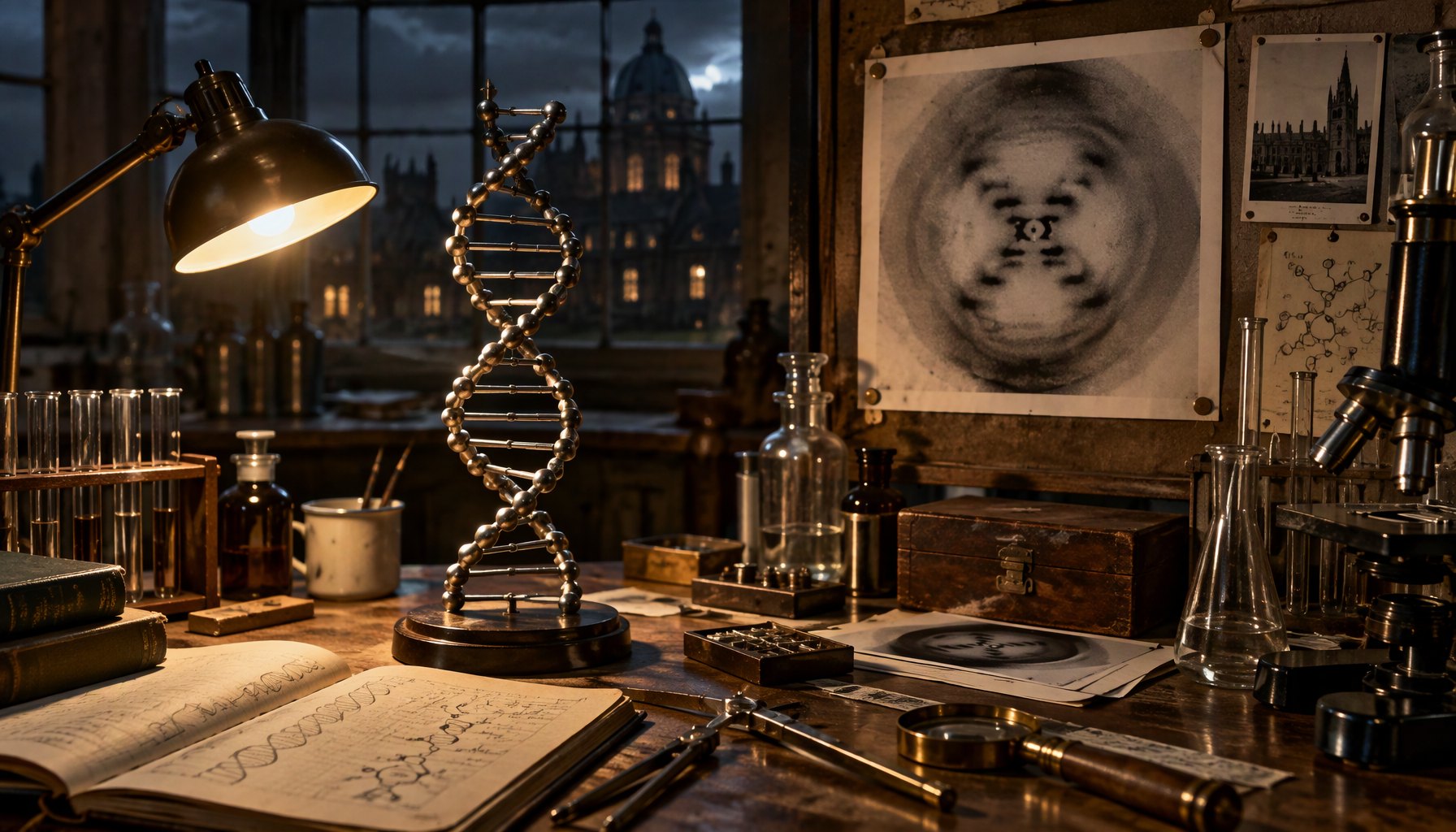
The Race to Discover the Secret of Life
In the mid-20th century, scientists already knew that DNA carries genetic information. Research by Oswald Avery and colleagues in 1944 showed that DNA, not protein, is the substance of hereditary traits. However, the physical structure of DNA that allows it to store and replicate information remained a mystery.
Several researchers competed to crack that structure. At King's College London, Maurice Wilkins and Rosalind Franklin used X-ray crystallography to study DNA fibers. At the University of Cambridge, Francis Crick and James Watson built models based on available data. Linus Pauling in the United States also pursued the same structure.
Franklin and Photo 51
Rosalind Franklin was a highly skilled crystallographer. Together with her doctoral student, Raymond Gosling, she produced very sharp X-ray diffraction images of DNA. One of the most famous images, later called Photo 51, was taken in 1952 and showed a pattern consistent with a helical structure.
Franklin also calculated important parameters, such as the distance between bases and the sugar-phosphate arrangement. Her conclusions supported a helical structure with bases on the inside. However, her working relationship with Wilkins was tense, and the data was not always shared openly. Photo 51 was later shown to Watson without Franklin's knowledge.
Watson and Crick
Watson and Crick worked at the Cavendish Laboratory, Cambridge. They built a three-dimensional model from metal pieces and cardboard. Their first model, which placed sugar-phosphates in the middle, was wrong. After seeing Franklin's data and obtaining information from Wilkins, they revised the model.
By the end of February 1953, Watson and Crick assembled a double helix model with two sugar-phosphate backbones on the outside and paired bases inside. They realized that adenine-thymine and guanine-cytosine base pairs had complementary shapes. The structure immediately explained how DNA could replicate itself.
The Double Helix Structure
The DNA model consists of two antiparallel polynucleotide strands forming a helix. Deoxyribose sugar and phosphate form the outer framework, while nitrogenous bases are inside. Adenine pairs with thymine through two hydrogen bonds, and guanine pairs with cytosine through three hydrogen bonds.
The structure is about 20 angstroms wide and has one full turn every 34 angstroms. Base pairs are arranged like a staircase inside the helix. The base sequence carries genetic information, while specific base pairing allows accurate replication.
The 1953 Publication
On April 25, 1953, the journal Nature published three papers about the structure of DNA. Watson and Crick's paper titled "Molecular Structure of Nucleic Acids" became the most famous. The paper ended with the famous sentence: "It has not escaped our notice that the specific pairing we have postulated immediately suggests a possible copying mechanism for the genetic material."
Two other papers were included: one from Wilkins and colleagues, and one from Franklin and Gosling. Franklin's paper presented X-ray diffraction data supporting the helical model. The three papers were published as a series, showing that the discovery of the DNA structure was the result of the work of several groups.
Nobel Prize and Belated Recognition
In 1962, Watson, Crick, and Wilkins received the Nobel Prize in Physiology or Medicine. Franklin did not receive the award because she died in 1958 from ovarian cancer at the age of 37. The Nobel Prize is not awarded posthumously, so her name could not be included.
For several decades, the popular narrative often portrayed Franklin as an assistant whose data was "taken" by Watson and Crick. Brenda Maddox's biography in 2002 and subsequent historical research provided a more balanced picture: Franklin was an independent scientist who produced key data, although her contributions were not always acknowledged at the time.
Impact on Medicine
The double helix structure became the foundation for almost all modern molecular biology. Understanding of DNA enabled the discovery of the genetic code, DNA recombinant technology in the 1970s, and DNA sequencing methods. In 2003, the Human Genome Project completed the reading of almost the entire human DNA sequence.
The discovery also paved the way for genetic diagnosis, drug development, gene therapy, and CRISPR technology. mRNA-based vaccines, widely used during the COVID-19 pandemic, also rely on understanding of DNA, RNA, and protein synthesis. Its impact is felt in almost all fields of medicine.
Ethics and Legacy
Knowledge of DNA raises serious ethical questions. Gene editing, genetic privacy, discrimination based on genetic information, and the potential for eugenics are issues that continue to be debated. The history of science also reminds us of the importance of giving fair credit to all researchers, including women who are often marginalized.
The story of the discovery of DNA is a story of collaboration, competition, ambition, and injustice. Rosalind Franklin is now remembered as one of the most important scientists of the 20th century. Her legacy is not only Photo 51, but also the lessons about how science works and how history records it.


Discussion
Comments
Comments are reviewed by an editor before they appear. Include sources when correcting facts.
No comments yet. Be the first to respond to this article.