The World Before Household Electricity
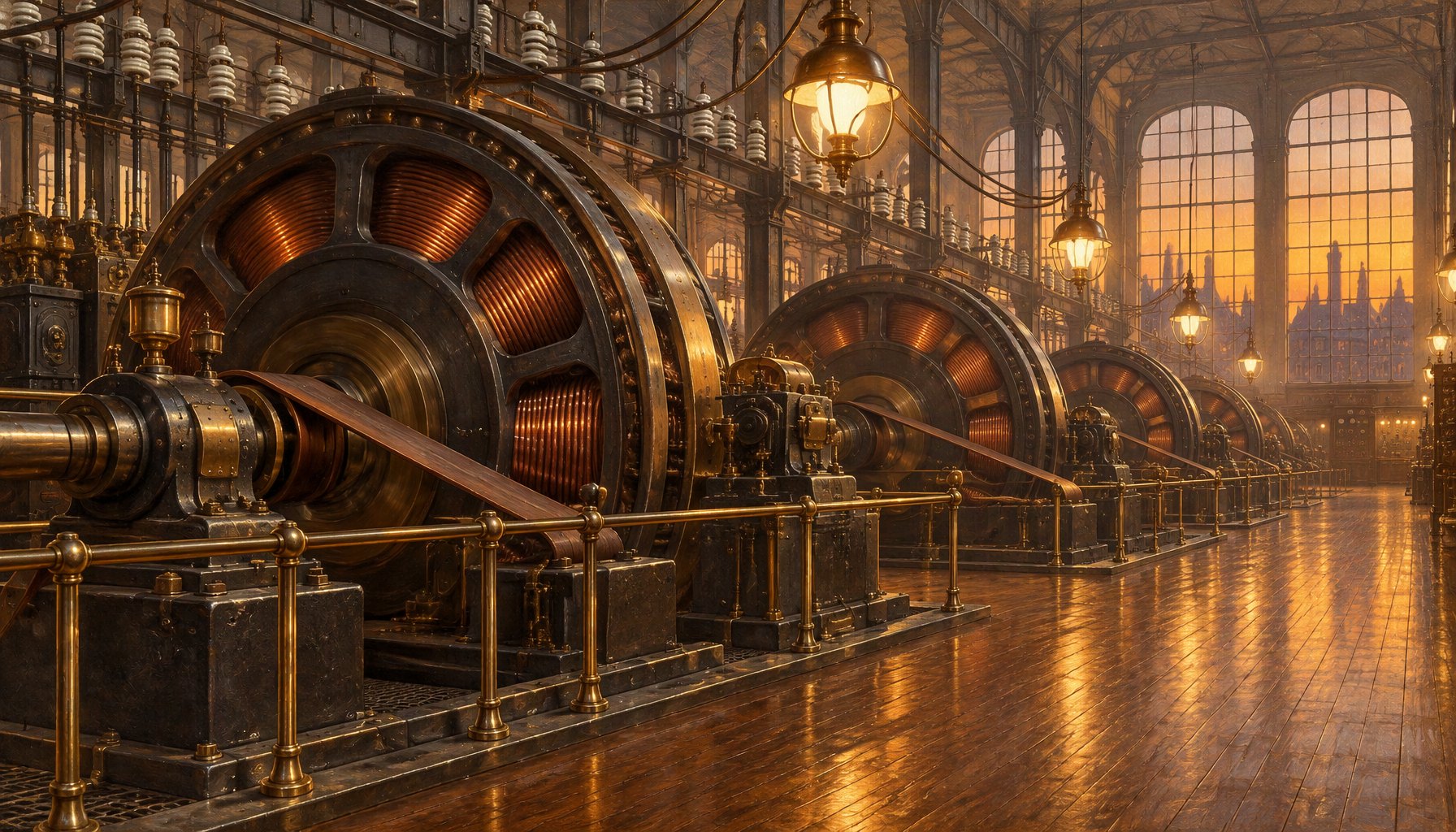
At the end of the 19th century, electricity began to replace gas and oil as a source of illumination. Thomas Edison, an American inventor and entrepreneur, built the first power plant system on Pearl Street, New York, in 1882. That system used direct current, which flows in one direction from the plant to the user.
Direct current has limitations: electricity can only be transmitted over a few kilometers before its voltage drops. To serve large cities, plants had to be built at many locations. Edison developed a system integrated with lamps, generators, and its own cables, but infrastructure costs became a major obstacle.
Tesla's Idea of Alternating Current
Nikola Tesla, a Serbian-American engineer, developed an induction motor that operates with alternating current. Alternating current can have its voltage changed using a transformer, allowing electricity to be transmitted over long distances with less energy loss. In 1888, Tesla patented his system and licensed it to George Westinghouse.
Westinghouse was an entrepreneur who already had experience in electrical systems. He saw the great potential of alternating current for city lighting and industry. With Tesla's support, Westinghouse began building an AC system that directly competed with Edison's DC system.
The Propaganda War
The competition between the two systems became known as the Current War. Edison and his supporters launched a campaign to convince the public that alternating current was dangerous. They staged demonstrations in which animals were killed by AC electricity to show the risks of the system. Harold P. Brown, an engineer who worked with Edison, became one of the main figures in that campaign.
In 1890, William Kemmler became the first person to be executed in an electric chair, which used alternating current. Edison's supporters used the incident to associate AC with death. However, many scientists and engineers considered the campaign to be more commercial than scientific, because direct current was also dangerous at high voltages.
The 1893 Chicago Exposition
The turning point occurred at the 1893 Columbian World's Fair in Chicago. The fair required a large lighting system for hundreds of buildings and attractions. Westinghouse won the contract with a cheaper offer using an AC system. The fair successfully lit millions of visitors without major incidents, proving that AC could be used safely and efficiently.
That success increased public confidence in AC and paved the way for subsequent large projects. Edison and his company remained influential, but DC's position as the sole standard began to weaken. Electric utilities began switching to AC for economic and reach reasons.
Niagara Falls
The Niagara Falls power plant project became the biggest test for the AC system. The plant was designed to harness large-scale water energy and transmit electricity to the city of Buffalo, about 40 kilometers away. Westinghouse and Tesla were involved in designing the transmission system, which began operating in 1895.
In 1896, electricity from Niagara was successfully transmitted to Buffalo via AC transmission lines. That success became tangible proof that AC could transmit electricity over long distances efficiently. Since then, AC has become the standard for power grids worldwide.
Legacy of the Current War
The Current War was not only a technological battle but also a business and reputation fight. Edison lost his dominant position in the electrical system, even though his name remains remembered as one of the most productive inventors. Tesla was recognized as a key figure in AC development, even though he died in poverty in 1943.
Today, the world's power grids use alternating current for long-distance transmission, while direct current remains used in electronics and modern high-voltage transmission. The story of the Current War shows how technology choices are not only determined by science but also by economic interests, politics, and public opinion.
Lessons for Innovation
The competition between Edison and Tesla demonstrates the importance of openness to new ideas and adaptability. Edison was a skilled entrepreneur who built systems, but he was too attached to the technology he had already developed. Tesla had a forward-looking technical vision but was less able to manage business and investor relations.
The combination of technical vision and commercial ability proved decisive for innovation success. The Current War became one of the most famous examples of how better technology does not necessarily win without business support, and how cheaper and more practical technology can change the world.


Discussion
Comments
Comments are reviewed by an editor before they appear. Include sources when correcting facts.
No comments yet. Be the first to respond to this article.