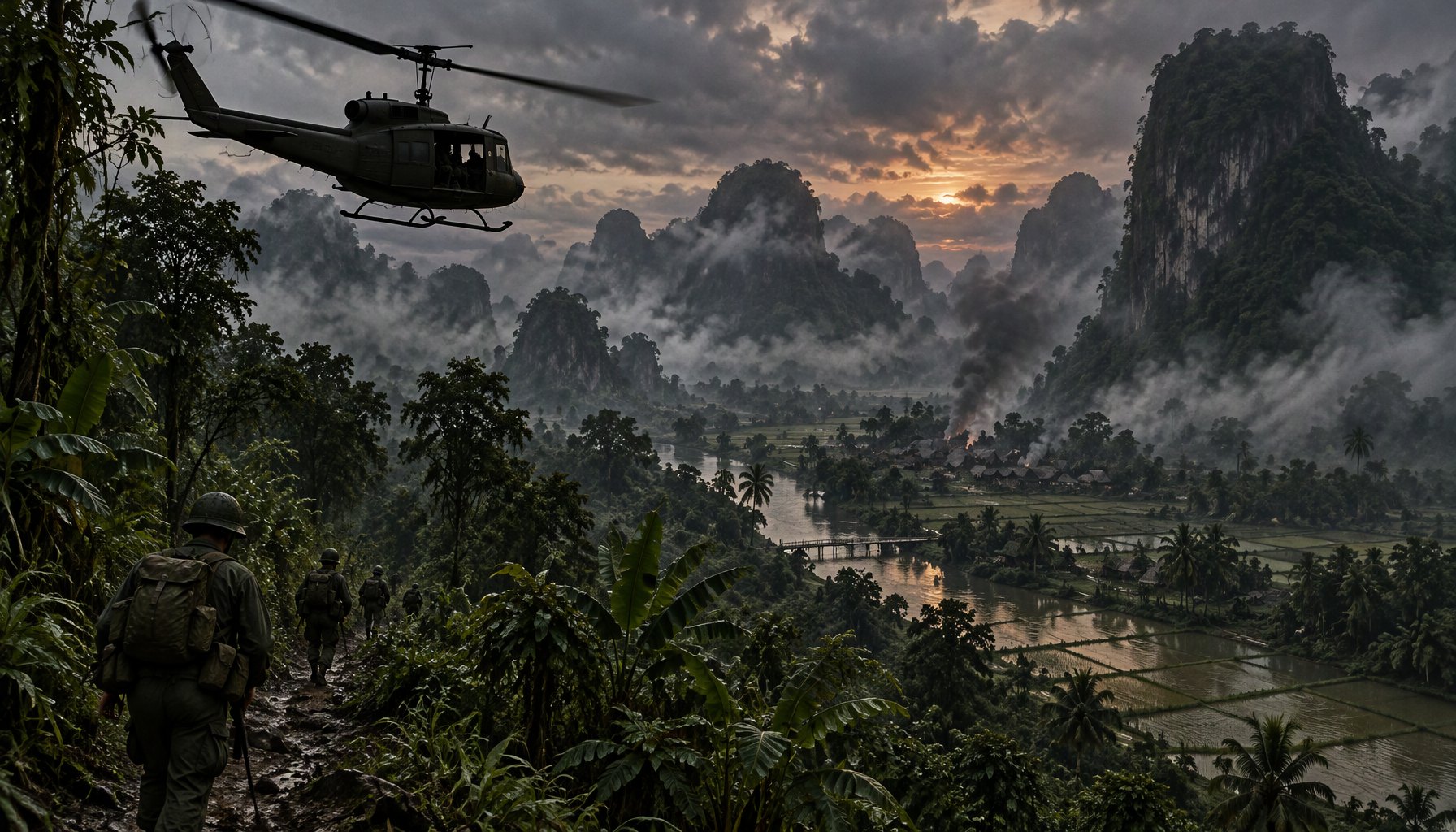
Legacy of the Indochina War
The Vietnam War did not begin in the 1960s. Its roots lie in French colonization of Indochina, Japanese occupation during World War II, and the independence struggle led by the Viet Minh League under Ho Chi Minh. In 1954, Viet Minh forces defeated the French in the Battle of Dien Bien Phu.
The Geneva Conference in July 1954 divided Vietnam along the 17th parallel as a temporary arrangement. National elections were scheduled for 1956 to reunify the country. However, the elections never took place, and both sides built their own nations: communist North Vietnam and U.S.-backed South Vietnam.
Two Vietnams
In the north, Ho Chi Minh's government carried out harsh land reforms and built a socialist state with support from China and the Soviet Union. In the south, President Ngo Dinh Diem faced opposition from communist groups, religious organizations, and discontented society. Government repression strengthened armed resistance.
In 1960, the National Liberation Front was formed in the south, with its military wing known as the Viet Cong. Under international and American pressure, Diem was overthrown and killed in a coup in November 1963. Political instability in Saigon continued, while guerrilla warfare spread.
Increasing American Involvement
The Gulf of Tonkin incident in August 1964 provided the basis for the U.S. Congress to give broad powers to President Lyndon B. Johnson. In March 1965, American marines landed in Da Nang. The Rolling Thunder air bombing campaign began, and the number of American troops in Vietnam increased to more than 500,000 by 1968.
The American strategy focused on air power, artillery, and enemy casualty counts. However, South Vietnam was not a conventional battlefield. The Viet Cong moved among the population, using tunnels, booby traps, and small attacks that were difficult to counter with advanced technology. Large American forces faced a war that drained patience.
People's War and Human Cost
North Vietnam sent troops and supplies through the Ho Chi Minh Trail, a network of roads and mountain paths through Laos and Cambodia. America bombed the trail and sprayed herbicides like Agent Orange to clear the forests. Napalm and carpet bombing destroyed many villages and caused civilian casualties.
Operation "Search and Destroy" moved populations to government-controlled camps, while American troops searched for enemies in villages. In March 1968, the mass killing of civilians in My Lai by American troops shocked the world and strengthened the anti-war movement. Vietnamese civilian casualties were estimated to exceed one million.
The 1968 Tet Offensive
At the end of January 1968, communist forces launched a massive, simultaneous attack on cities in South Vietnam, including Saigon, Hue, and Da Nang. The Tet Offensive caught Americans and the South Vietnamese government by surprise. Militarily, the attack failed and resulted in heavy losses for the communist side.
However, politically, the impact was enormous. Images of fighting at the American embassy and the execution of a Viet Cong prisoner in Saigon entered American living rooms. Public confidence in government statements about war progress collapsed. President Johnson announced that he would not seek re-election, and peace negotiations began in Paris.
Vietnamization and War Expansion
President Richard Nixon introduced the policy of Vietnamization: strengthening the South Vietnamese army to take over the war, while American troops were gradually withdrawn. In 1970, America attacked Cambodia to destroy communist bases, sparking a new wave of protests on American campuses.
In 1972, North Vietnam launched the Easter Offensive. America responded with massive bombing and mining of the Haiphong harbor. The Paris Agreement was signed in January 1973, ending direct U.S. military involvement. However, fighting between the two Vietnams continued, and American aid to Saigon declined.
The Fall of Saigon
In early 1975, North Vietnam launched a major offensive. South Vietnamese forces quickly collapsed. On April 30, 1975, North Vietnamese tanks entered Saigon, and the last American evacuation took place hastily from the embassy roof. The city was later renamed Ho Chi Minh City.
The war left deep scars. America lost more than 58,000 soldiers, while South Vietnam lost hundreds of thousands of troops. The number of Vietnamese, Laotian, and Cambodian civilian casualties was enormous. Agent Orange left lasting health and environmental impacts for decades.
Legacy
The Vietnam War changed how America viewed military intervention and relations with the world. In Vietnam, the war was followed by reunification in 1976, economic difficulties, and then the Doi Moi reforms in 1986. Diplomatic relations between America and Vietnam were restored in 1995.
The war also served as a lesson about the limits of military power in facing nationalist movements, the importance of understanding local contexts, and the price paid by civilians. To this day, Vietnam is a reminder that victory on the battlefield does not necessarily mean political victory.
Discussion
Comments
Comments are reviewed by an editor before they appear. Include sources when correcting facts.
No comments yet. Be the first to respond to this article.