Southern-Directed Attacks
In the summer of 1942, Germany launched Operation Blau, a major offensive to the south of the Soviet Union. The aim was to seize the oil fields of the Caucasus and destroy Soviet forces before the winter. Stalingrad, an industrial city on the western bank of the Volga River, was initially not the main target, but its name made the city an inescapable symbol for both sides.
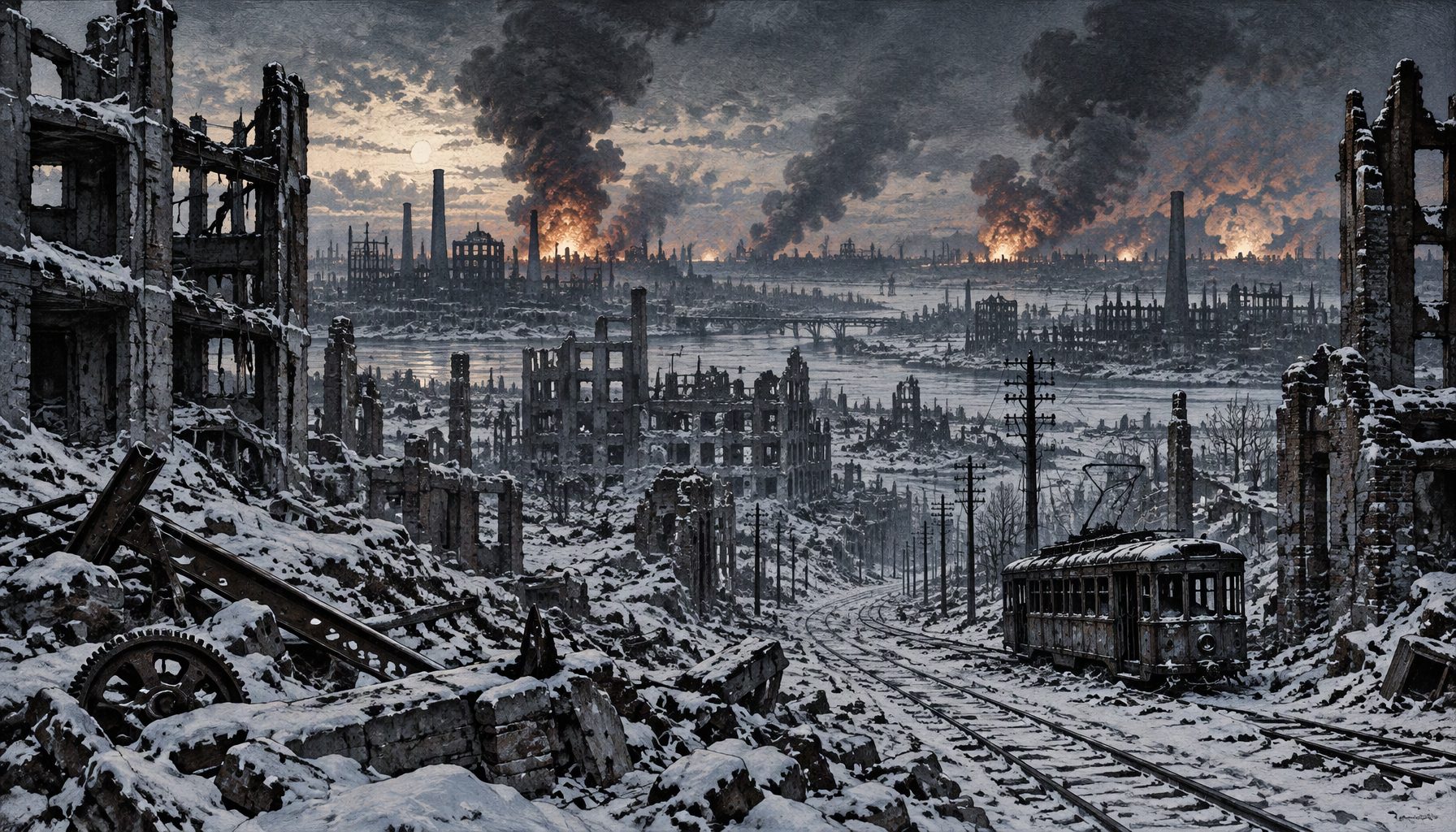
On 23 August 1942, German armored units reached the Volga north of the city. Massive air raids turned much of Stalingrad into rubble. However, the rubble proved advantageous for the defending forces: firing ranges became short, tanks struggled to move, and combat shifted to the ruins of buildings.
War in the Ruins of the City
On 12 September 1942, General Vasily Chuikov took command of the Soviet 62nd Army. He ordered his troops to hold as close as possible to the German positions so that the Luftwaffe could not bomb freely without hitting their own troops. The fighting moved from house to house, floor to floor, and sometimes from room to room.
One famous point was the "Pavlov's House", an apartment building defended by a small group of Soviet soldiers for about two months. The story illustrates the nature of the combat: control over a single building could be big news because the front line barely moved. On the other hand, the German 6th Army under Friedrich Paulus continued to deplete its strength to capture the ruined city.
Operation Uranus
The Soviet leadership prepared a different kind of attack. Instead of adding troops to the city, Marshal Georgy Zhukov and Chief of the General Staff Aleksandr Vasilevsky planned Operation Uranus: a large-scale attack on the flanks of the German forces, which were guarded by weaker allied troops. The attack began on 19 November 1942 and met at Kalach on 23 November, encircling about 300,000 Axis troops within and around Stalingrad.
Germany attempted to break the encirclement through Operation Winter Storm in December 1942, but failed. Efforts to supply the besieged troops by air were also insufficient. Airfields still under German control became the main target of the Soviets, and supplies of food, ammunition, and medicine continued to dwindle.
Surrender in Mid-Winter
On 30 January 1943, Hitler promoted Paulus to Field Marshal. In the German military, this rank had never been held by an officer who surrendered, so the appointment was seen as an incentive to hold out until death. The next day, Paulus surrendered along with his staff. The northern part of the pocket held out until 2 February 1943, when the last commander surrendered.
About 91,000 German soldiers became prisoners of war. Most never returned to Germany due to prisoner conditions, disease, and forced labor. Casualties on both sides were enormous: hundreds of thousands of Axis troops were killed, wounded, or captured, while Soviet losses exceeded one million. The civilian population of Stalingrad also suffered as the fighting took place in their city.
Why Stalingrad Matters
The Soviet victory at Stalingrad did not end World War II, but it changed the course of the Eastern Front. Germany lost its entire 6th Army, prestige, and strategic initiative. After Stalingrad, Soviet forces advanced almost without pause until Berlin. For many historians, this battle was the turning point that made Germany's defeat in the East a matter of time, not possibility.
Stalingrad also demonstrated that industrial strength and the ability to mobilize reserves could determine the outcome of a prolonged war. The ruined city was not just a battlefield, but also a symbol that defensive lines could hold even if almost entirely leveled to the ground.

Discussion
Comments
Comments are reviewed by an editor before they appear. Include sources when correcting facts.
No comments yet. Be the first to respond to this article.