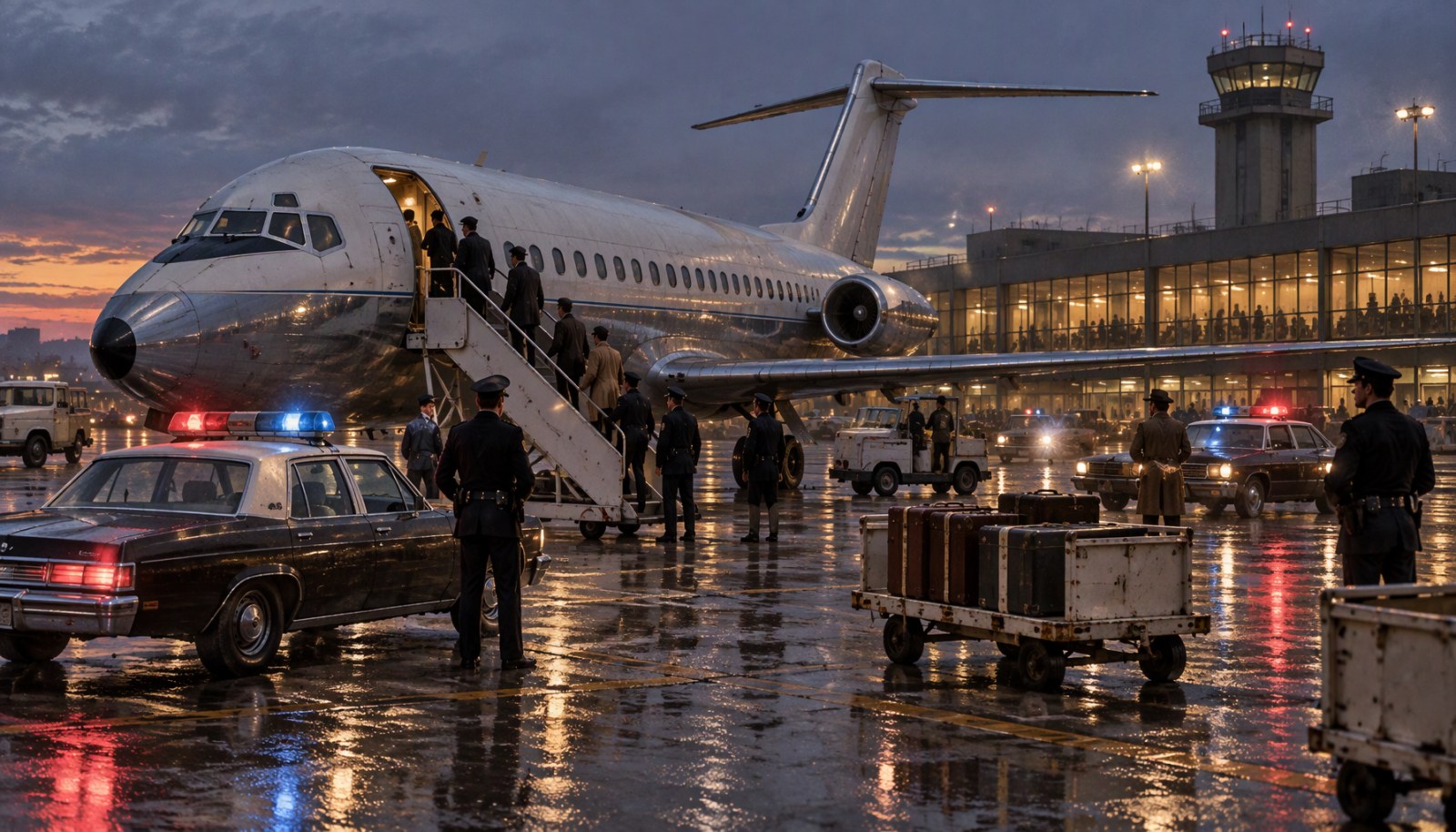
On November 10, 1972, three men hijacked a Southern Airways Douglas DC-9 aircraft flying from Memphis, Tennessee, to Miami, Florida, with stops in Birmingham and Montgomery, Alabama, and Orlando, Florida. The plane carried 35 people, consisting of 31 passengers and four crew members. The hijacking lasted over 30 hours, crossed three countries, and covered a distance of approximately 4,000 miles before ending in Havana, Cuba, the following night.
Background
Southern Airways was founded in 1944 and began operations in 1949 as a regional airline serving small towns in the southern United States. In the early 1970s, the airline operated routes such as Memphis–Birmingham–Montgomery–Orlando–Miami, a network that used light jets like the DC-9.
The three hijackers, Melvin Cale, Louis Moore, and Henry D. Jackson Jr., were each facing unrelated criminal charges. They brought firearms and hand grenades into the cabin and demanded a ransom of 10 million US dollars. The amount far exceeded the cash that authorities could gather in a short time.
The Course of the Hijacking
The aircraft took off from Birmingham at around 19:20 local time. The hijackers forced the crew to fly the plane to several cities in the United States and Canada, including Cleveland in Ohio, Detroit in Michigan, Lexington in Kentucky, and Toronto, while formulating their demands.
Tensions peaked when the plane was over Oak Ridge, Tennessee. The hijackers threatened to crash the plane into the High Flux Isotope Reactor at Oak Ridge National Laboratory if their ransom demands were not met. Negotiations took place with several officials, including the FBI, who could only gather between 2 million and 2.5 million dollars. The plane then landed at Lovell Field, Chattanooga, Tennessee, to collect the ransom money, part of which was distributed to the passengers.
From Chattanooga, the plane flew to Havana. However, Fidel Castro refused to accept the hijackers, so they ordered the plane to return to the United States. While stopping to refuel at Orlando Jetport in McCoy, the FBI shot two of the four main tires of the plane. The hijackers retaliated by shooting the co-pilot, First Officer Harold Johnson, and forcing Captain William Haas to take off. The plane returned to Havana and landed on Saturday, November 11, marking the first time a hijacked plane left Cuba with the hijackers still on board.
Capture and Legal Consequences
Cuban authorities removed the hijackers from the plane at gunpoint and arrested them after an attempted escape. All three served an eight-year prison sentence in Cuba, then were returned to the United States to serve additional sentences of 20 to 25 years. Cuba returned the plane, crew, passengers, and ransom money to the United States.
This incident led to a short-lived agreement between the United States and Cuba regarding the extradition of hijackers, although the agreement was never renewed. The case is also recorded in the list of plane hijackings between the two countries, along with the Delta Air Lines Flight 821 and TWA Flight 106 incidents.
Impact on Aviation Security
The threat to the Oak Ridge nuclear reactor directly triggered the policy of physical passenger screening by US airlines. Screening began on January 5, 1973, and became the basis for airport security procedures still in use today, including baggage scanning and body checks before boarding.
For the aviation world, this event showed that hijackings not only threatened passenger safety but also strategic facilities on the ground. Airlines and airports tightened crew training, communication procedures with authorities, and security access to the cockpit and cabin.
The story of the hijacking of Flight 49 was later featured in the National Geographic documentary series, I Am Rebel, in the premiere episode titled "Jacked" by Lana Wilson, which aired on June 5, 2016.
This article was automatically compiled by the HISTORYX editorial team from Wikipedia data licensed under CC BY-SA 4.0 on November 10, 2026. Corrections can be sent via the Contact page.



Discussion
Comments
Comments are reviewed by an editor before they appear. Include sources when correcting facts.
No comments yet. Be the first to respond to this article.