Return from Vacation
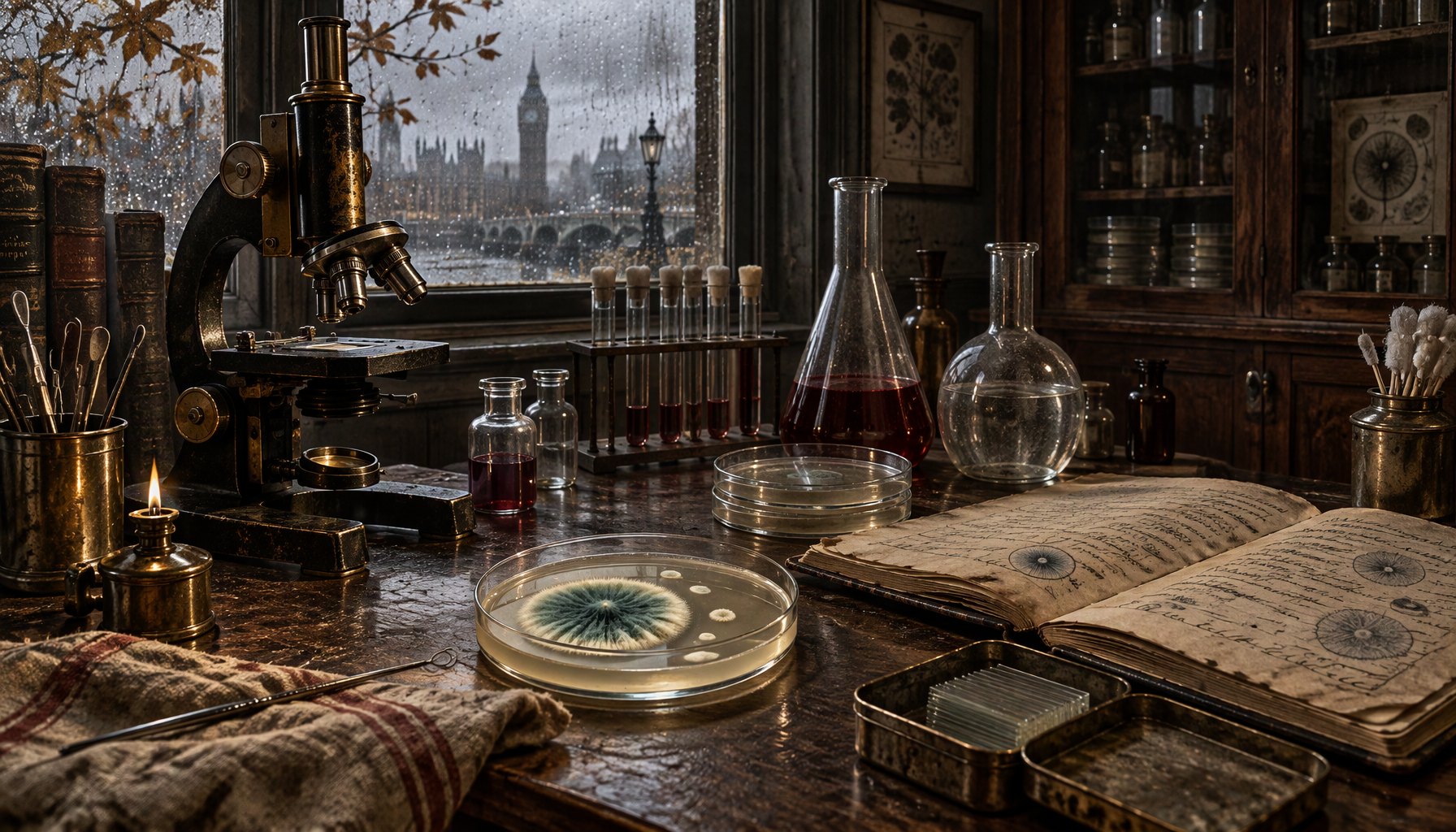
Alexander Fleming was born in Scotland in 1881 and worked as a bacteriologist researcher at St Mary's Hospital, London. In early September 1928, he returned from vacation and examined petri dishes containing cultures of the bacterium Staphylococcus that had been left in his laboratory. One of the dishes was contaminated with mold.
An unusual thing happened: around the mold colony, bacteria did not grow. There was a clear zone forming a circle. Fleming realized that the mold produced a substance that inhibited bacterial growth. He then named the substance penicillin, taken from the name of the mold's genus, Penicillium.
Not the First Discovery
Fleming was not the first to observe that mold can kill bacteria. In 1896, Ernest Duchesne, a French medical student, reported that the mold Penicillium glaucum could neutralize certain bacteria. However, his research was not continued. Fleming was different because he recorded the observation systematically and published it.
In 1929, Fleming published his research results in the British Journal of Experimental Pathology. He showed that fluid from the mold culture could inhibit the growth of various bacteria, including some disease-causing bacteria. However, he was not successful in purifying the active substance in a stable and sufficiently strong form for treatment.
Purification Difficulties
The penicillin produced by Fleming was very unstable and only lasted a short time. Efforts to purify it in large quantities failed, so the research was almost forgotten. Fleming himself moved on to other topics and did not develop penicillin as a drug in the 1930s.
It was not until 1939 that Howard Florey and Ernst Chain at the University of Oxford began studying the antibacterial substance from the mold. Together with Norman Heatley, they developed a method to purify penicillin and tested it on animals and humans. In 1941, penicillin was given to a patient named Albert Alexander who suffered from a severe infection. The patient improved, but the drug supply ran out and he died.
Mass Production
The need for penicillin increased rapidly during World War II. The American and British governments supported mass production. Pharmaceutical companies developed more efficient fermentation methods, and by 1944, large quantities of penicillin were available for Allied troops. The drug saved many lives from war wound infections.
The success of penicillin changed the way doctors viewed infectious diseases. Previously, a small wound could lead to death due to sepsis. After antibiotics became available, infections that were once fatal became treatable.
Nobel Prize and Warning
In 1945, Fleming, Florey, and Chain received the Nobel Prize in Physiology or Medicine. In his speech, Fleming had already warned that the overuse of penicillin or too low a dose could cause bacteria to become resistant. This warning proved to be very accurate.
Since then, antibiotic resistance has become a global health issue. Bacteria that no longer respond to penicillin and other antibiotics have emerged due to natural selection and improper drug use. Fleming openly mentioned this risk long before the world realized its magnitude.
Fleming's Legacy
Fleming is still remembered as the figure who opened the era of antibiotics. However, the history of penicillin also shows that major discoveries are rarely the result of one person's work. Fleming's observations were important, but it was Florey, Chain, Heatley, and many other researchers who turned it into a drug that saved millions of lives.
In the St Mary's laboratory, the contaminated petri dish is now a symbol of the importance of curiosity. Fleming did not discard the dish that was considered a failure, but asked why the bacteria around it died. From this simple question arose one of the greatest breakthroughs in medical history.

Discussion
Comments
Comments are reviewed by an editor before they appear. Include sources when correcting facts.
No comments yet. Be the first to respond to this article.