Masterpiece in Central Java
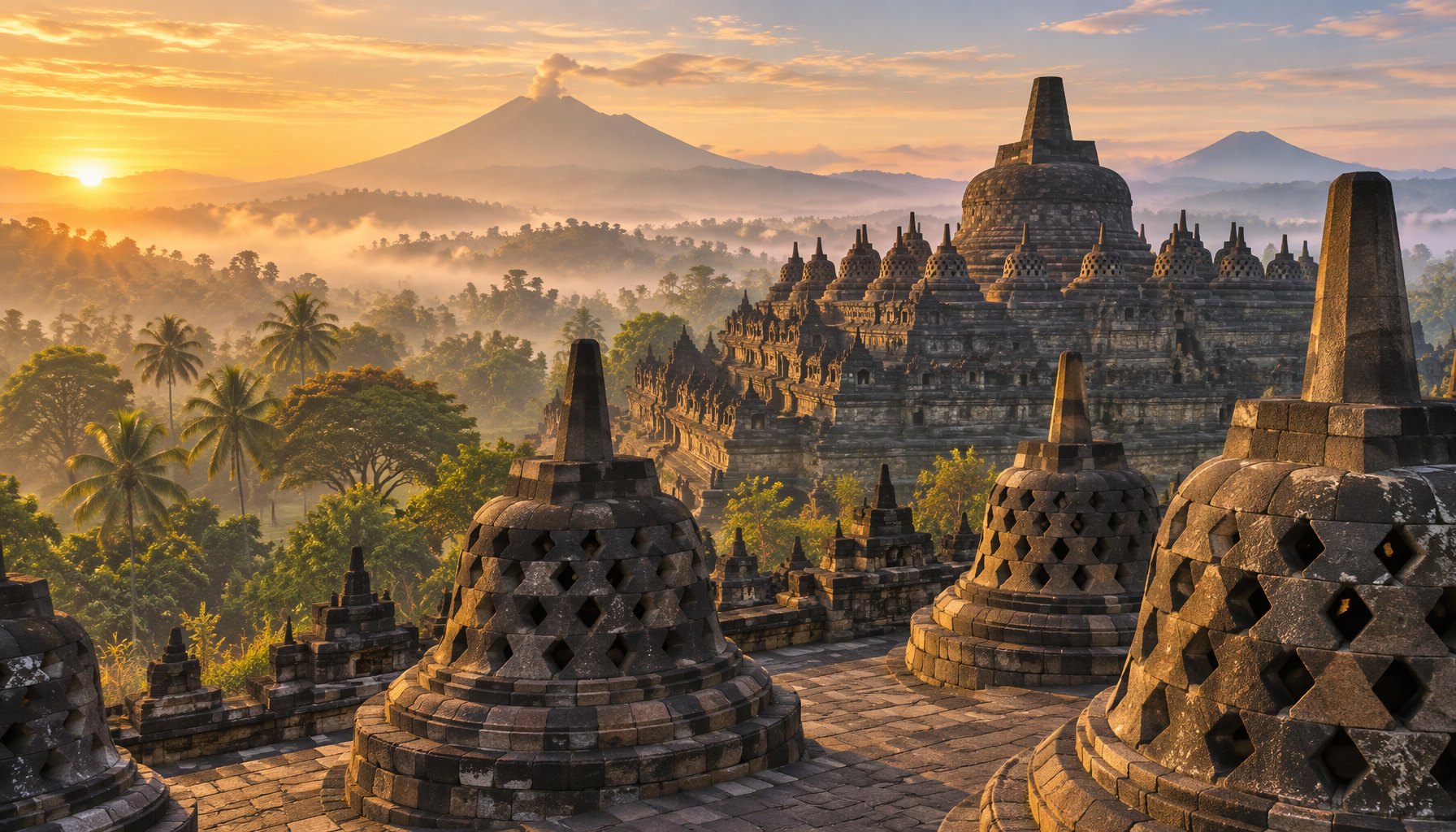
The Borobudur Temple is located in Magelang Regency, Central Java, on a plateau surrounded by hills and mountains. The monument was built from andesite stone in the form of a tiered pyramid. Its base measures approximately 123 meters square, and its height is approximately 35 meters before the top part underwent changes.
Borobudur has more than 2,600 relief panels and 504 Buddha statues. At the top level, there are 72 perforated stupas surrounding the main stupa. The building is not a temple with a worship space inside, but rather an open structure designed for pilgrims to walk around level by level.
Who Built It?
Borobudur was built during the Sailendra Dynasty, which ruled Central Java between the 8th and 9th centuries. The dynasty is known as a patron of Mahayana Buddhism. The Karangtengah Inscription from 824 mentions a Sailendra king and the construction of a sacred building, although it does not explicitly mention Borobudur.
No founding inscription has been found at the site itself. Archaeologists estimate that construction took place gradually over several decades, possibly starting around 780 and completed around 840. The lack of written records makes many details about who designed and funded the building still a mystery.
Mandala Architecture
Borobudur was designed as a mandala, a representation of the cosmos in Buddhist teachings. The building has three main levels representing three realms: Kamadhatu, the realm of desires; Rupadhatu, the realm of forms; and Arupadhatu, the formless realm. Pilgrims move from the lower level filled with reliefs to the upper level that becomes increasingly empty and serene.
The lower part is square-shaped with corridors bounded by relief walls. The middle part is also square, but Buddha statues are placed in wall niches. The upper part is circular with perforated stupas. The transition from square to circular shape symbolizes the spiritual journey towards liberation.
Reliefs and Stories
The reliefs of Borobudur are divided into several story groups. The Jataka and Avadana reliefs depict the previous lives of the Buddha. Lalitavistara tells the story of the Buddha's life from birth to enlightenment. Gandavyuha depicts Sudhana's journey in search of spiritual knowledge.
At the base of the building is the Karmawibhangga relief, which illustrates the law of cause and effect and various human actions. Some of the reliefs are covered by additional layers of stone, possibly for religious or structural reasons. Other reliefs depict daily life, ships, markets, and music, providing a valuable glimpse into ancient Javanese society.
Pilgrimage Route
Pilgrims enter Borobudur from the east side and walk around the building in a clockwise direction. The path is several kilometers long and must be traversed repeatedly at each level. While walking, pilgrims read the reliefs and contemplate Buddhist teachings.
Each Buddha statue on all sides has a different mudra or hand gesture, symbolizing certain aspects of the teachings. At the top level, the statues are placed inside perforated stupas. The main stupa at the peak symbolizes perfect enlightenment. The experience of walking through Borobudur is designed as a spiritual journey, not just a tourist visit.
Mystery of Function
Whether Borobudur functioned as a worship temple, relic stupa, or meditation mandala is still debated. No main room or clear relics were found inside the building. Some experts suggest that the building was used for pilgrimage rituals and meditation, not for ceremonies led by priests in an enclosed space.
Borobudur was abandoned around the 14th century, when the center of power in Java shifted eastward and part of the population converted to Islam. Eruptions of Mount Merapi, earthquakes, and forest growth covered the building for centuries. Local residents still knew of the site, but its meaning gradually changed into legend.
Restoration
Borobudur began to be rediscovered after Thomas Stamford Raffles, Lieutenant Governor of Java, sent an expedition in 1814. In the early 20th century, the colonial government carried out the first restoration under Theodoor van Erp. However, structural damage and poor drainage continued to threaten the building.
A major restoration was carried out between 1973 and 1983 with the support of UNESCO and various countries. Thousands of stones were dismantled, cleaned, and reassembled with a new drainage system. In 1991, Borobudur was designated as a UNESCO World Heritage Site. The restoration became one of the largest cultural heritage conservation projects in the world.
Legacy
Borobudur is now one of the most important tourist and pilgrimage destinations in Indonesia. Every year, Buddhists hold the Vesak celebration at the site. The government limits the number of visitors and monitors the impact of tourism, pollution, and climate change.
Borobudur is not just an ancient building, but a symbol of the meeting between religion, art, and Nusantara society. Its reliefs contain stories about life, morality, and spirituality. As a world heritage site, Borobudur reminds us that Indonesian civilization has produced amazing cultural works long before the modern era.
Discussion
Comments
Comments are reviewed by an editor before they appear. Include sources when correcting facts.
No comments yet. Be the first to respond to this article.