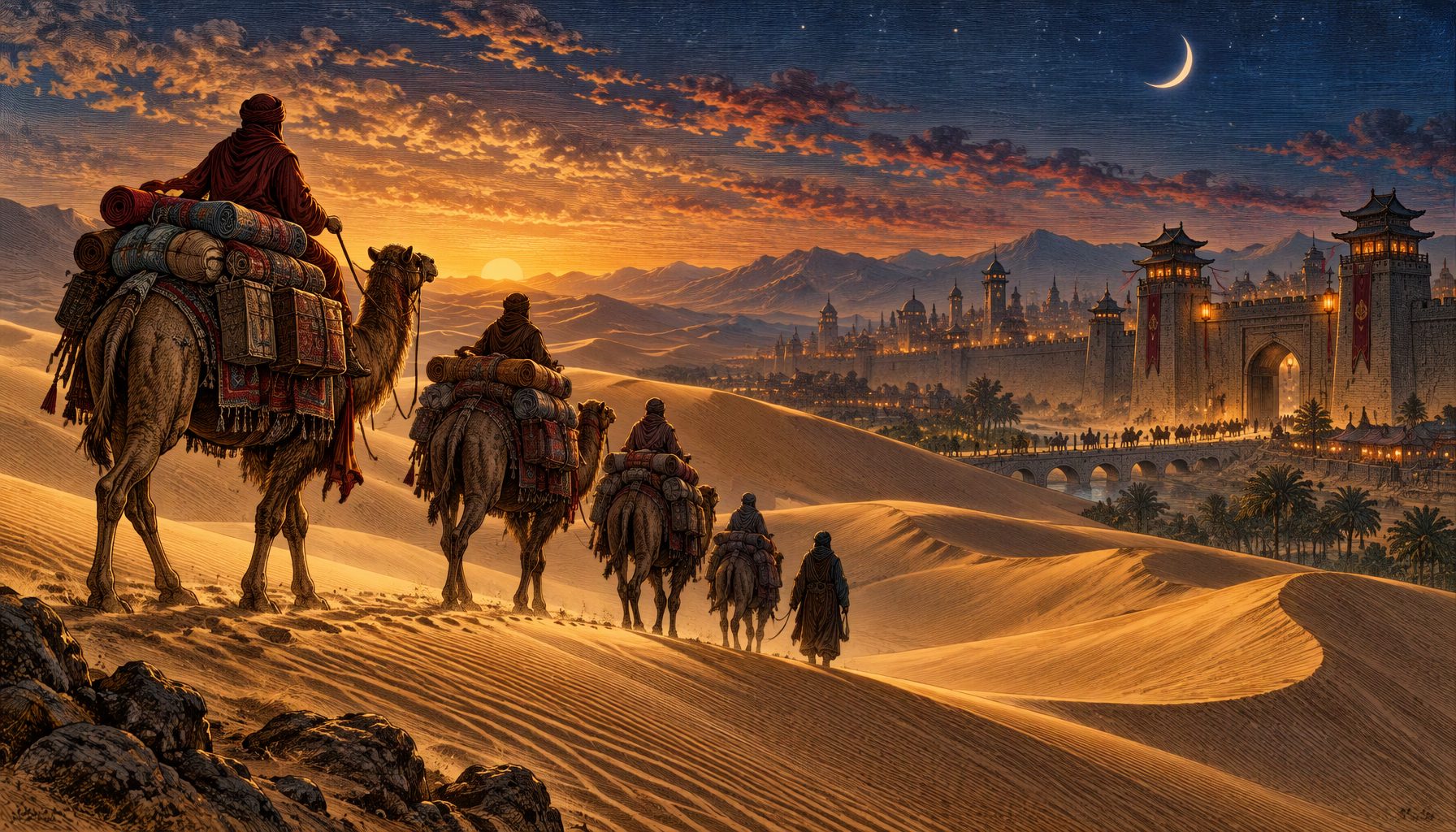
A New Name, An Old Network
The term "Silk Road" actually does not originate from ancient times. German historian Ferdinand von Richthofen introduced it in 1877 to describe a network of trade routes connecting China with Central Asia, Persia, and the Mediterranean. The network itself had been functioning long before, and it was never a single straight road.
The Silk Road is more accurately understood as a system of interconnected land and sea routes. Goods changed hands repeatedly, passing through oasis towns, grasslands, and ports. Alongside goods, ideas, religions, technologies, and diseases also moved.
Early East‑West Relations
In 138 BC, Emperor Han Wudi sent Zhang Qian to Central Asia to seek allies against the Xiongnu. Zhang Qian was captured and held for years, but eventually returned with reports about western lands, including Ferghana and Bactria. That report opened the Han court’s eyes to trade and diplomatic opportunities.
Afterwards, Chinese envoys and merchants began moving westward, while goods from Central Asia and the Middle East entered China. Silk became the most famous commodity, but it was not the only one: horses, glass, gems, spices, and metals were also traded.
Oasis Cities and Intermediaries
The land routes passed through oasis towns such as Dunhuang, Kashgar, Samarkand, and Merv. Those cities became places of rest, markets, and cultural centers. Sogdian merchants from Central Asia played a major intermediary role, carrying goods and languages across great distances.
Trade did not go directly from China to Rome. Goods changed hands several times, raising prices at each stage. Thus, the Silk Road also created a network of cities and merchant groups that prospered because of their position between great civilizations.
Religion and Technology That Travelled Along
Buddhism spread from India to Central Asia and China along this route. The monk Xuanzang traveled to India from 629‑645 to study Buddhist teachings and brought manuscripts back to China. His travel notes became a valuable source on Central Asian cities and societies in the 7th century.
Technology also moved. The Chinese paper‑making technique spread to the Islamic world and then to Europe. Knowledge of medicine, astronomy, and mathematics flowed in various directions. However, the same route also carried disease; the 14th‑century plague spread through Eurasian trade networks.
Peak and Decline
In the 13th and 14th centuries, Mongol rule created relatively safe conditions for cross‑Eurasian travel. Venetian trader Marco Polo journeyed to China and wrote a tale that introduced Asia to European readers. This period is often called the Pax Mongolica, although violence and conquest remained part of its history.
After the Mongol power weakened, land routes faced political disruptions and rising costs. Maritime trade grew, especially after European sailors discovered a direct route to Asia at the end of the 15th century. The Silk Road did not disappear instantly, but its role changed.
Legacy of the Silk Road
The Silk Road left a legacy of multicultural cities, artistic traditions, and knowledge exchange that shaped Eurasian civilization. It also serves as an example that globalization is not a modern phenomenon: people had already been connected through trade, migration, and ideas long before steamships or the internet.
Today, the term Silk Road is used again in modern infrastructure and diplomatic projects. Its history reminds us that connectivity networks always bring both opportunities and risks, depending on who controls the route and how the rules are made.

Discussion
Comments
Comments are reviewed by an editor before they appear. Include sources when correcting facts.
No comments yet. Be the first to respond to this article.