Birth in Italian Cities
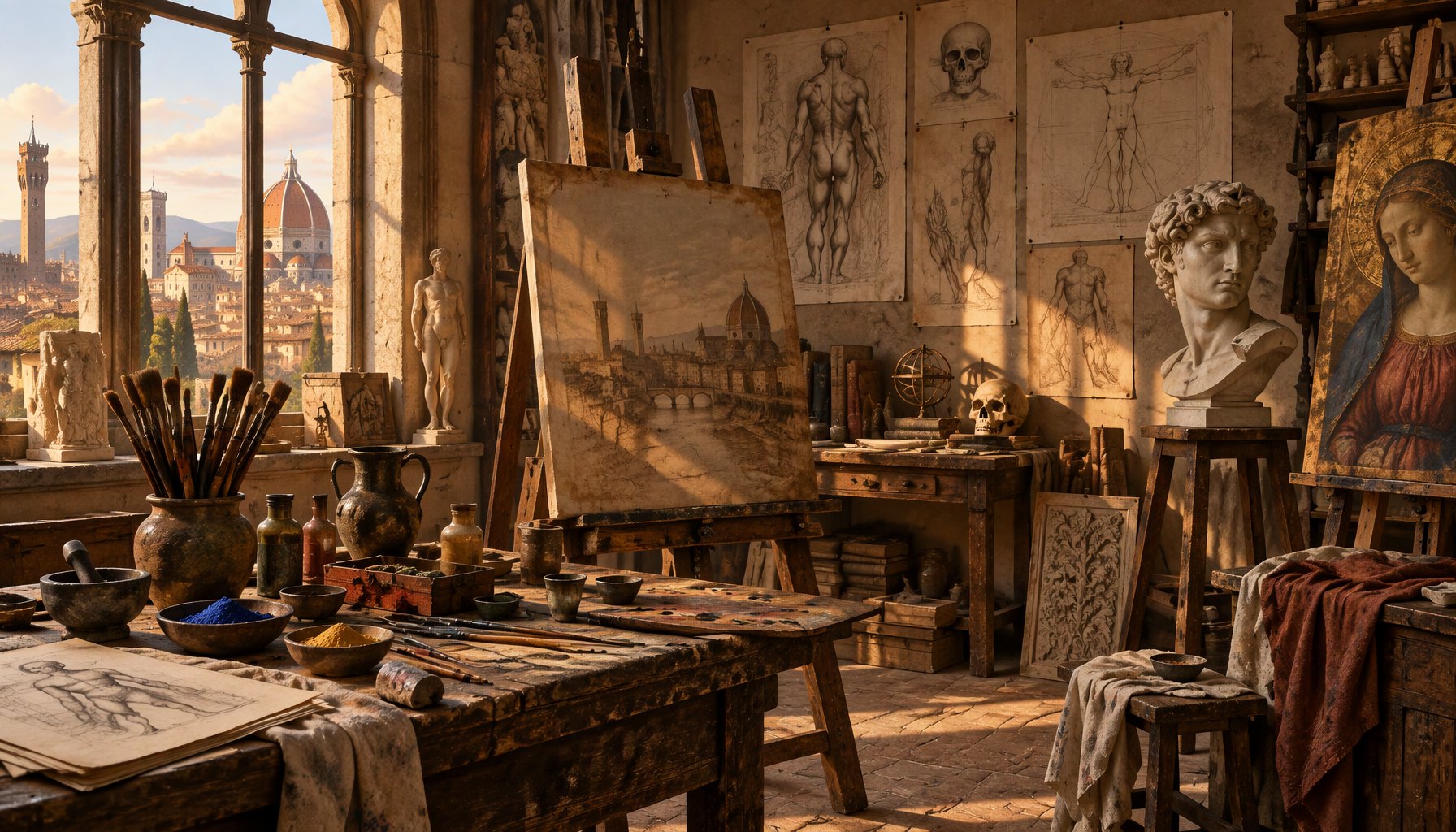
The Renaissance was a period of cultural and intellectual change that began in the cities of Italy in the 14th century and reached its peak in the 15th and 16th centuries. Cities such as Florence, Venice, Milan, Rome, and Naples became centers of trade, finance, and art. Wealth from trade and banking allowed nobles and the church to fund artworks and research.
The term "Renaissance" means "rebirth," referring to the renewed interest in the culture of ancient Greece and Rome. However, the Renaissance was not just a revival of the past. Artists and thinkers developed new ideas about humanity, nature, and knowledge that would shape the modern world.
Humanism
Humanism was the intellectual core of the Renaissance. Humanists studied classical works, including literature, history, philosophy, and rhetoric. They believed that education and virtue could shape a better human. Francesco Petrarca is often considered the father of humanism because of his interest in classical texts.
Humanism did not reject religion but emphasized the importance of worldly life and human potential. Thinkers like Pico della Mirandola wrote about human dignity and the ability to achieve great things. These ideas influenced art, education, and politics throughout Europe.
Florence and the Medici
Florence became one of the most important centers of the Renaissance. The Medici family, wealthy from banking, became patrons of art and science. Cosimo de' Medici supported the construction and collection of manuscripts, while Lorenzo de' Medici, known as Lorenzo the Magnificent, supported artists such as Botticelli and Michelangelo.
Competition among cities also drove cultural development. Venice built maritime power and rich art, while Milan and Rome became centers of political and church power. Rulers used art and architecture to display their wealth, power, and legitimacy.
Art and Perspective
Renaissance art was marked by attention to proportion, anatomy, and perspective. Filippo Brunelleschi developed linear perspective and designed the dome of Florence Cathedral, an impressive technical achievement. Masaccio used perspective and light to create realistic space in paintings.
Leonardo da Vinci, Michelangelo, and Raphael became the most famous figures of this period. Leonardo studied anatomy, flight, and technique, while Michelangelo created the statue of David and the paintings in the Sistine Chapel. Raphael combined harmony and clarity in his paintings. Their works show a fusion of observation, imagination, and technical skill.
Science and Discovery
The Renaissance also drove changes in science. Scientists began to rely on observation and experimentation, not just the authority of ancient texts. Andreas Vesalius corrected the understanding of human anatomy through dissection, while Nicolaus Copernicus proposed that the Earth orbits the Sun.
Leonardo da Vinci made sketches of machines, anatomy, and natural phenomena. Although many of his ideas were not published in his time, his notes show a broad curiosity. Changes in science did not happen overnight, but the Renaissance paved the way for the scientific revolution of the 17th century.
Printing
The invention of printing with movable type by Johannes Gutenberg around 1450 transformed the spread of knowledge. Previously, books had to be copied by hand and were very expensive. With printing, books became cheaper and more widely available, allowing ideas to spread quickly.
Printing helped spread classical texts, humanist works, and later religious reform writings. Italian cities like Venice became important publishing centers. The impact of printing was enormous for education, literacy, and intellectual debate across Europe.
The Renaissance Beyond Italy
By the 16th century, Renaissance ideas had spread to northern Europe. Humanists like Erasmus developed critiques of the church and society, while artists like Albrecht Dürer combined Italian techniques with local traditions. The Northern Renaissance was also closely tied to the Protestant Reformation.
In England, William Shakespeare wrote dramas reflecting an interest in humanity, power, and fate. In France and Spain, art and literature also flourished. The Renaissance became a diverse European phenomenon, not just an Italian movement.
Legacy
The Renaissance left a legacy of art, architecture, and ideas that live on today. The works of Leonardo, Michelangelo, and Raphael became standards of beauty and skill. Humanist ideas about human dignity and the importance of education remain relevant in modern discussions.
However, historians also remind us that the Renaissance was not a uniform or entirely new period. Many medieval traditions continued, and the benefits of the Renaissance were not felt by everyone. Nevertheless, the period remains one of the foundational cultures of the modern world, a bridge between the ancient world and the world we know today.
Discussion
Comments
Comments are reviewed by an editor before they appear. Include sources when correcting facts.
No comments yet. Be the first to respond to this article.