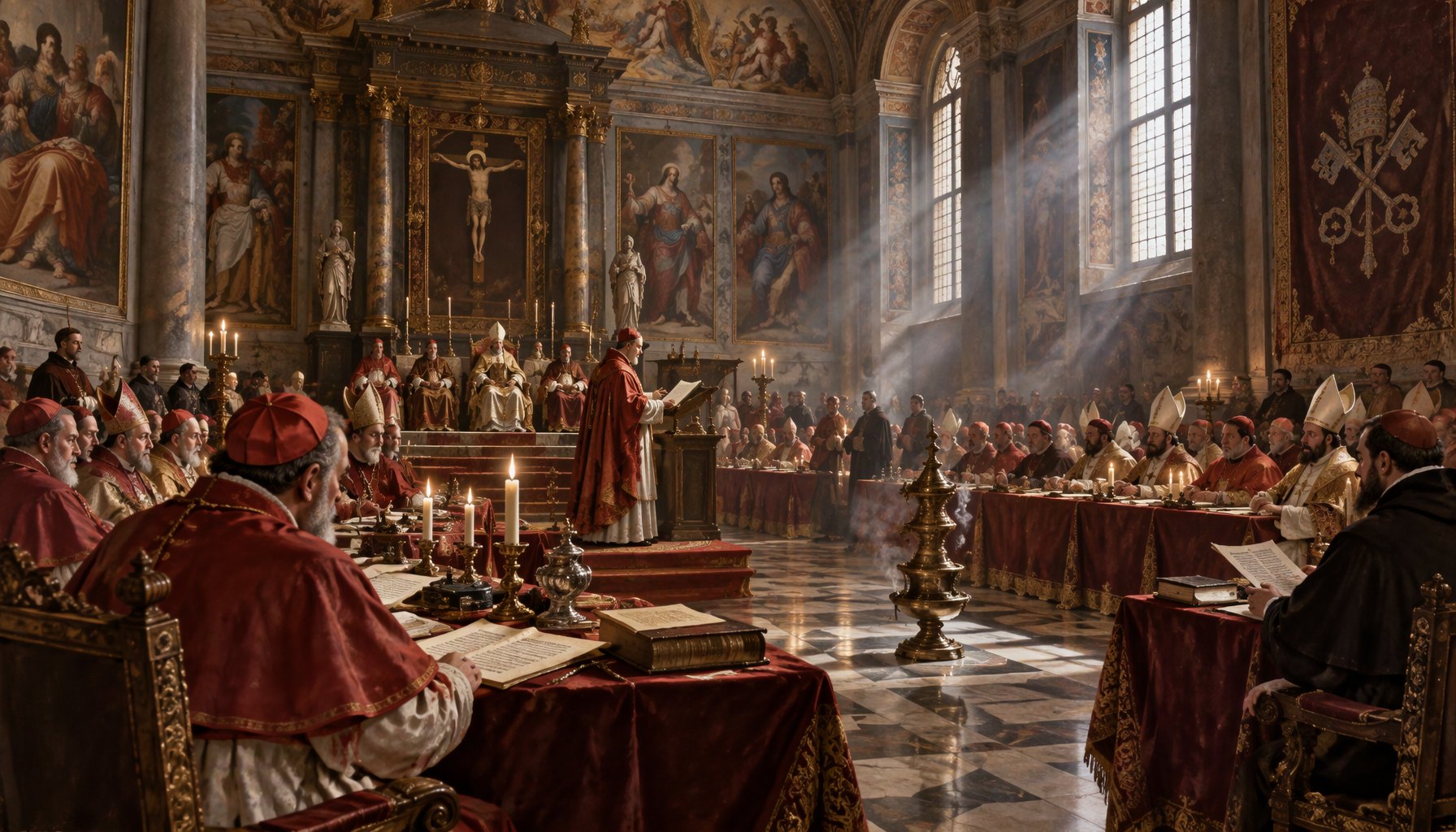
Background of the Reformation
In the early 16th century, criticism of the Catholic Church grew in Europe. Martin Luther, in 1517, protested against the sale of indulgences and subsequently developed a theology that challenged the authority of the Pope. The Reformation movement spread to Germany, Switzerland, the Netherlands, and other regions. Some rulers supported the reform for political and economic reasons.
The Catholic Church faced two challenges simultaneously: addressing abuses within the church and formulating theological responses to Protestant teachings. An ecumenical council was seen as a way to make collective decisions. After several failed attempts, Pope Paul III successfully convened a council in Trent in 1545.
Why Trent
Trent is located in what is now northern Italy, but at the time was within the Holy Roman Empire. The location was chosen as a compromise between the Pope and Emperor Charles V, who wanted the council to be held in a German territory. Trent was also relatively close to Italy, allowing the Pope to influence the proceedings of the council.
The council took place in three periods: 1545–1547, 1551–1552, and 1562–1563. The first period discussed doctrine and the Bible; the second period was disrupted by political conflicts; the third period completed the disciplinary reforms and several sacraments. There were a total of 25 sessions.
Holy Scripture and Tradition
In 1546, the council established that Holy Scripture and church tradition are equally authoritative. This decision rejected the Protestant principle of "sola scriptura," which placed the Bible as the sole authority. The council also designated the Latin Vulgate as the authentic version of the Bible for church use.
The decision about the Bible did not mean the church rejected the study of the original languages. Catholic scholars continued to study Greek and Hebrew. However, the council asserted that the interpretation of the Bible must be within the church community and not left to individual interpretation alone.
Justification and Sacraments
In 1547, the council discussed the doctrine of justification, which was one of the main points of disagreement with Luther. The council affirmed that justification occurs through the grace of God working through faith and charity, as well as through the sacraments. This decision rejected the idea that humans are justified by faith alone without works.
The council also affirmed the seven sacraments: baptism, confirmation, the Eucharist, penance, anointing of the sick, holy orders, and matrimony. Each sacrament was explained theologically and regulated in church practice. This decision became the foundation for the modern Catholic teaching on the sacraments.
Disciplinary Reform
In addition to doctrine, the council took steps to address abuses within the church. One important decision was the obligation for bishops to reside in their dioceses and visit their congregations regularly. The practice of buying and selling church offices and the abuse of indulgences were criticized and restricted.
The council also ordered the establishment of seminaries to educate future priests. Previously, priestly education was often unstandardized and dependent on local traditions. With seminaries, the church sought to ensure that priests had adequate theological knowledge and discipline.
Marriage and Mass
In 1563, the council issued a decree on marriage known as Tametsi. The decree stated that marriage must be conducted in the presence of a pastor and two witnesses to be valid. This rule aimed to prevent secret marriages and strengthen church control over marriage.
The council also reaffirmed the teaching of the mass as a sacrifice, which was rejected by Protestants. After the council, Pope Pius V in 1570 established the Tridentine Mass, which subsequently became the dominant liturgical form in the Catholic Church for centuries. This liturgical change was part of the effort to standardize church practices.
Closing and Reception
The Council of Trent was closed on December 4, 1563. Its decisions were later approved by Pope Pius IV in 1564. The implementation of these decisions was not always easy as some Catholic rulers wanted to maintain control over their local churches. However, overall, the council provided clear direction for the post-Reformation Catholic Church.
After the council, the church published the Roman Catechism in 1566, the Roman Breviary in 1568, and the Roman Missal in 1570. The Index of Forbidden Books was also updated. These steps formed what is later called the era of the Counter-Reformation, although the term itself has debated nuances.
Legacy
The Council of Trent is one of the most influential councils in the history of the Catholic Church. Its decisions shaped doctrine, liturgy, priestly education, and church administration for centuries. Many changes introduced in the 20th century, including liturgical reforms after the Second Vatican Council, refer back to the decisions of Trent.
For historians, Trent shows how a large institution responds to crisis with internal reform and assertion of identity. The council did not resolve the schism with Protestants, but it succeeded in strengthening the Catholic Church and providing it with a framework to face the modern world.


Discussion
Comments
Comments are reviewed by an editor before they appear. Include sources when correcting facts.
No comments yet. Be the first to respond to this article.