The World After the War
In the early 1950s, many Asian and African countries had just gained independence from colonial rule. They faced two superpowers, the United States and the Soviet Union, which were competing in the Cold War. The newly independent nations did not always want to align with either bloc, and many rejected the formation of military pacts in their regions.
The Korean War, the nuclear arms race, and racial issues around the world reinforced the awareness that Asian and African countries needed to cooperate. Colonialism had not yet completely disappeared, especially in Africa and Southeast Asia. This spirit of solidarity became the backdrop for the idea of an interstate conference.
The Idea of the Conference
In 1954, the leaders of Ceylon, India, Indonesia, Pakistan, and Burma met in Colombo, Sri Lanka. The meeting, known as the Colombo Conference, discussed economic and political cooperation. From this meeting emerged the idea of a broader conference for Asian and African countries.
Indonesia offered to host the event. Bandung was chosen as the location because the city had adequate facilities and was symbolic as a city of the independence struggle. Invitations were sent to around thirty countries, with considerations of geography, politics, and balance of power. Israel was not invited, and South Africa did not attend due to its apartheid policy.
Bandung, April 1955
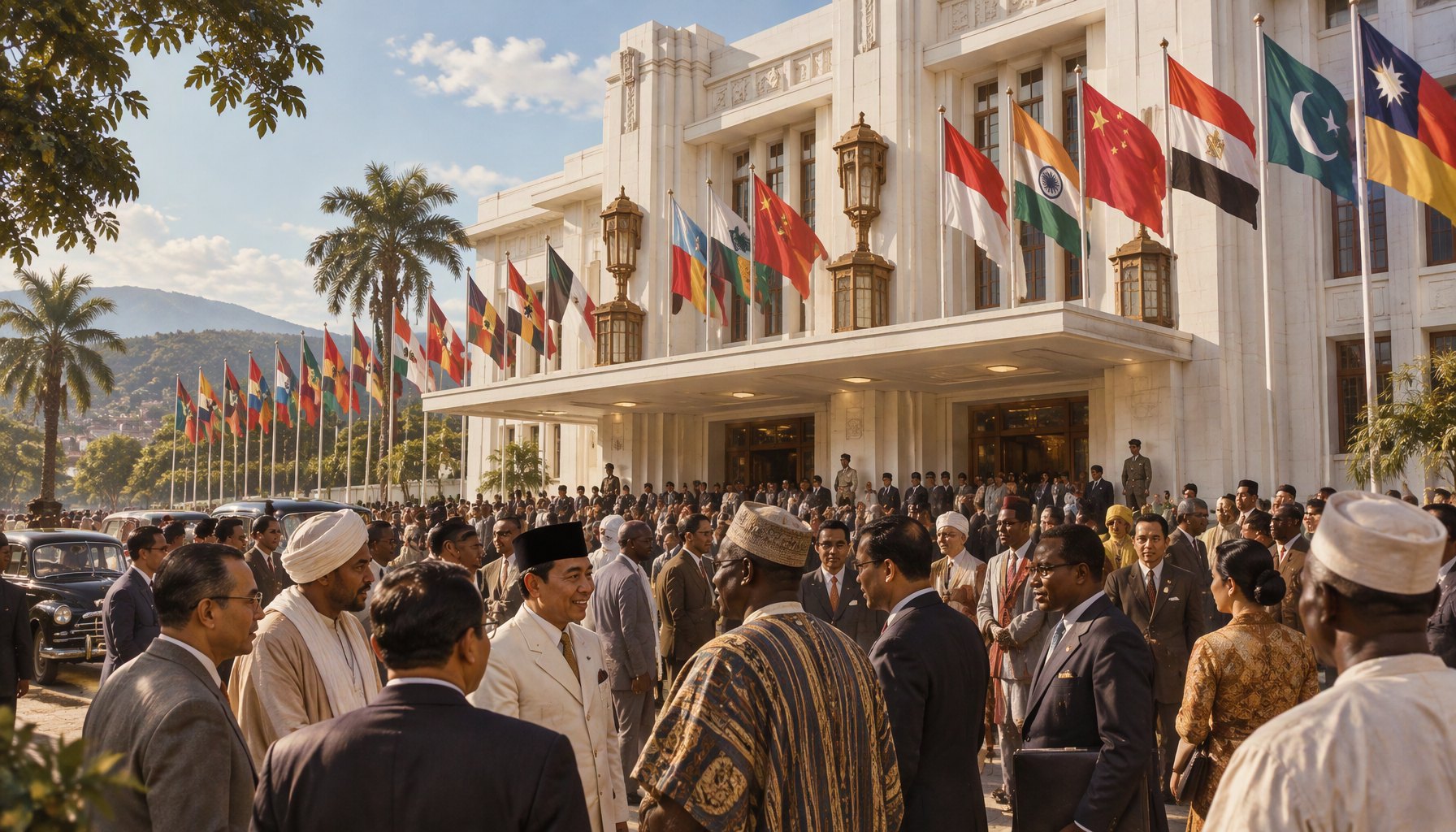
The conference took place on April 18–24, 1955, at the Gedung Merdeka in Bandung. A total of 29 countries attended, with around 340 delegates and more than 1,500 journalists from various countries. The flags of the participating countries were displayed along the streets, and the city became the center of world attention.
President Sukarno opened the conference with a speech titled "Let a New Asia and a New Africa be Born." He emphasized the importance of solidarity, anti-colonialism, and peace. The speech became one of the most famous in the history of Indonesian diplomacy and provided inspiration for delegates from newly independent countries.
The Ten Principles of Bandung
The conference produced the Ten Principles of Bandung, ten principles that emphasized respect for sovereignty and territorial integrity, recognition of racial and national equality, non-intervention in the affairs of other countries, and the peaceful settlement of disputes. The principles also rejected the use of force and called for economic and cultural cooperation.
Reaching an agreement was not easy because the participants had different interests. Pro-Western countries, neutral countries, and communist countries had to compromise. The role of Chinese Premier Zhou Enlai was crucial in easing tensions and finding formulations acceptable to all parties.
Key Figures of the Conference
The conference was attended by several important figures, including Sukarno, Jawaharlal Nehru of India, Gamal Abdel Nasser of Egypt, Zhou Enlai of China, U Nu of Burma, and Norodom Sihanouk of Cambodia. Their presence made Bandung a stage for a new generation of Asian and African leaders.
Nehru emphasized the importance of neutrality and peace, while Nasser brought the spirit of anti-colonialism and Pan-Arabism. Zhou Enlai tried to present China as a country willing to cooperate, although many participants were still suspicious of Beijing's ambitions. These differences did not prevent the issuance of a joint statement.
The Role of Indonesia
Indonesia played a central role as the host and initiator. Foreign Minister Sunario and Prime Minister Ali Sastroamidjojo were involved in complex diplomatic preparations. The Indonesian government provided accommodation, transportation, and security for the delegates, despite budget constraints.
For Indonesia, the conference was a testament to the diplomatic capabilities of a ten-year-old nation. Sukarno used the forum to promote a vision of a world free from colonialism and bloc pressures. The success of Bandung strengthened Indonesia's position in international politics at the time.
Political Legacy
The Bandung Conference inspired the Non-Aligned Movement, which was formed in 1961 in Belgrade. The principles of Bandung also influenced the anti-colonial struggle in Africa, including the independence movements in Algeria and South Africa. The term "Third World" was later used to describe countries not aligned with the Western or Eastern blocs.
However, the solidarity of Bandung did not last without problems. The Vietnam War, the India-Pakistan conflict, and the Sino-Soviet split tested the unity of Asian and African countries. Nevertheless, the conference remains a milestone in the history of South-South diplomacy and cooperation among developing countries.
Bandung Today
The Gedung Merdeka in Bandung is now the Museum of the Asian-African Conference. Every year, the event is commemorated as a symbol of solidarity and independence. In 2015, the 60th anniversary of the Asian-African Conference was attended by leaders from various countries, and the spirit of Bandung was reaffirmed in the face of new global challenges.
In a world facing inequality, climate change, and geopolitical competition, the Ten Principles of Bandung remain relevant as a framework for dialogue. Its greatest legacy is not just the documents, but the idea that small and newly independent countries can speak with a united voice on the world stage.


Discussion
Comments
Comments are reviewed by an editor before they appear. Include sources when correcting facts.
No comments yet. Be the first to respond to this article.