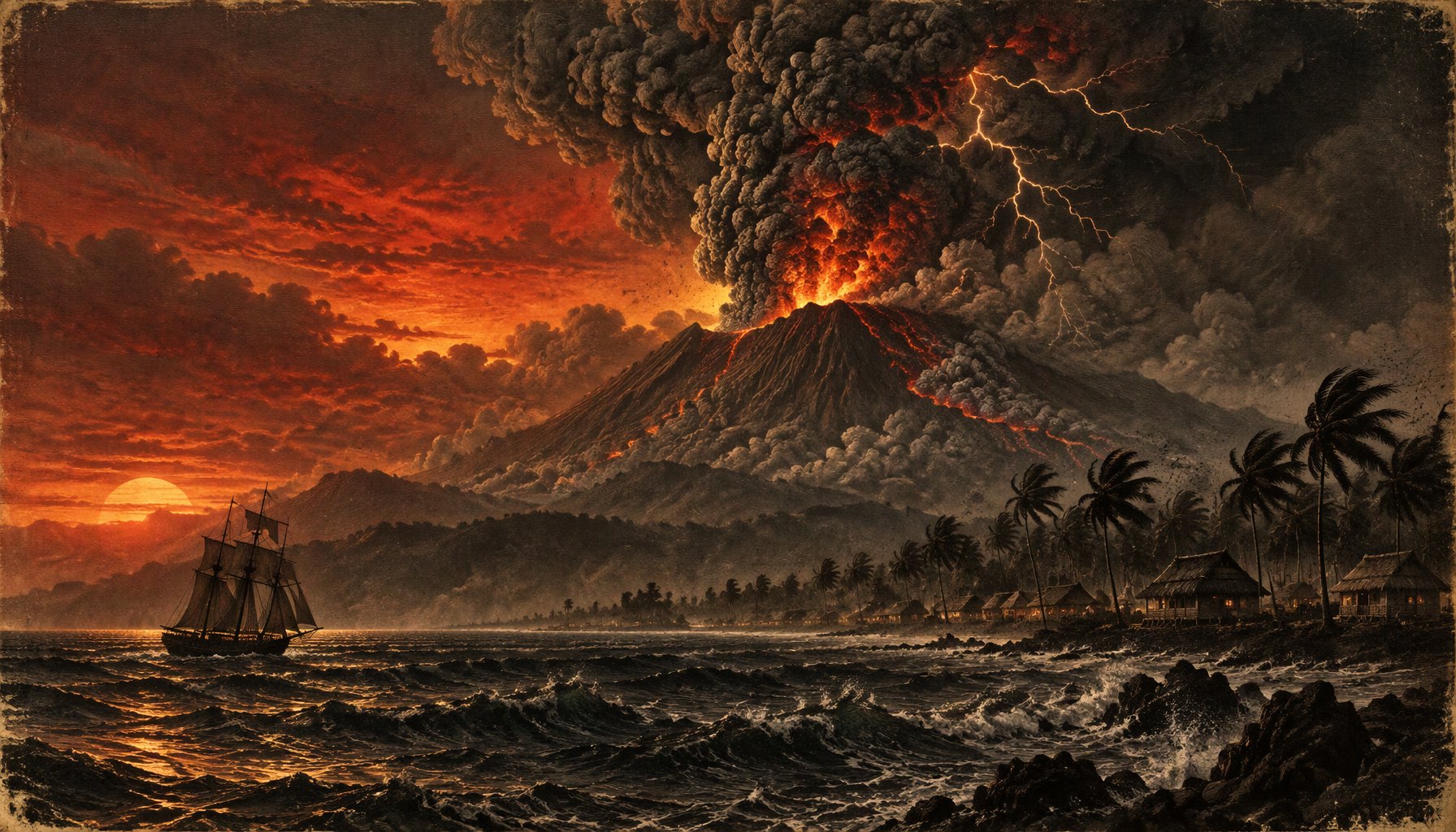
Mountains in Sumbawa
Mount Tambora is located on Sumbawa Island, part of eastern Indonesia. Before 1815, the mountain was estimated to be about 4,300 meters high. The local people lived from agriculture, trade, and marine products. The Sultanates of Tambora and Bima ruled the area, while the colonial powers of the Dutch and the British competed in the Indonesian archipelago.
In early April 1815, signs of volcanic activity began to appear. On April 5, an eruption occurred, releasing ash and a roaring sound. The local residents evacuated, but many did not realize that a larger eruption was coming.
10–11 April 1815
The main eruption occurred on 10 and 11 April. The explosion was heard hundreds of kilometers away, including in Batavia, Makassar, and Ternate. A tall column of ash rose into the atmosphere. Around the mountain, the sky became completely dark for several days, and ash covered the roofs of houses until they collapsed.
The eruption destroyed most of the mountain's body. The caldera formed had a diameter of about six kilometers and a depth of more than one kilometer. The height of the mountain drastically decreased to about 2,850 meters. Pyroclastic flows and tsunamis triggered by the eruption killed many people along the coasts of Sumbawa, Bali, and Lombok.
Casualties and Local Destruction
It is estimated that around 71,000 people died in Sumbawa, Bali, and Lombok due to the eruption and its direct impacts. Many deaths occurred afterward due to starvation, disease, and water source damage. Some historians estimate the total number of victims, including indirect victims in other regions, could exceed 100,000 people.
The eruption also destroyed local culture. In 2004, archaeological excavations uncovered the remains of a settlement buried in ash, including human skeletons and household items. The site is often referred to as the "Pompeii of the East" because it provides a glimpse into life before the disaster.
Ash Covering the Atmosphere
The Tambora eruption injected a large amount of sulfur dioxide into the stratosphere. The gas turned into sulfate aerosols that reflected sunlight back into space. As a result, global temperatures dropped by about 0.4 to 0.7 degrees Celsius for several years.
Its effects were felt far from Indonesia. In 1816, Europe and North America experienced unusually cold weather. Snow fell in the summer, crops failed, and food prices soared. The year is known as the Year Without a Summer.
Crop Failure and Unrest
In Europe, continuous rain damaged wheat and potatoes. In North America, snow and frost killed corn crops. In China, floods and extreme weather worsened famine. Many families lost their livelihoods, and migration waves increased.
In several European cities, bread prices skyrocketed and food riots erupted. Governments faced pressure to regulate food supplies. This social impact shows that volcanic eruptions in the Indonesian archipelago can influence political stability in other parts of the world through climate and trade chains.
Cultural and Scientific Footprints
The cold and dark weather in 1816 became the backdrop for the creation of several famous literary works. Mary Shelley was at Villa Diodati, Switzerland, with Byron and Polidori when storms and rain forced them to stay indoors. It was there that the idea for Frankenstein developed, although its direct connection to Tambora remains contextual, not a single cause.
The Tambora eruption became one of the important events in the study of historical climate. Scientists use temperature records, crop reports, and polar ice cores to reconstruct its impacts. Modern climate models also use Tambora as a benchmark to understand the effects of volcanic aerosols on Earth's temperature.
Lessons from Tambora
Indonesia is located in the Pacific Ring of Fire with many active volcanoes. The Tambora eruption reminds us that geological disasters can have far-reaching impacts beyond the surrounding area. Preparedness, risk mapping, and early warning systems are very important.
However, the history of Tambora also shows the resilience of communities. The people of Sumbawa rebuilt their lives after the destruction. The name Tambora is now remembered not only as an erupting mountain but also as evidence of the close relationship between the Earth, climate, and human civilization.

Discussion
Comments
Comments are reviewed by an editor before they appear. Include sources when correcting facts.
No comments yet. Be the first to respond to this article.