Forgotten Warning
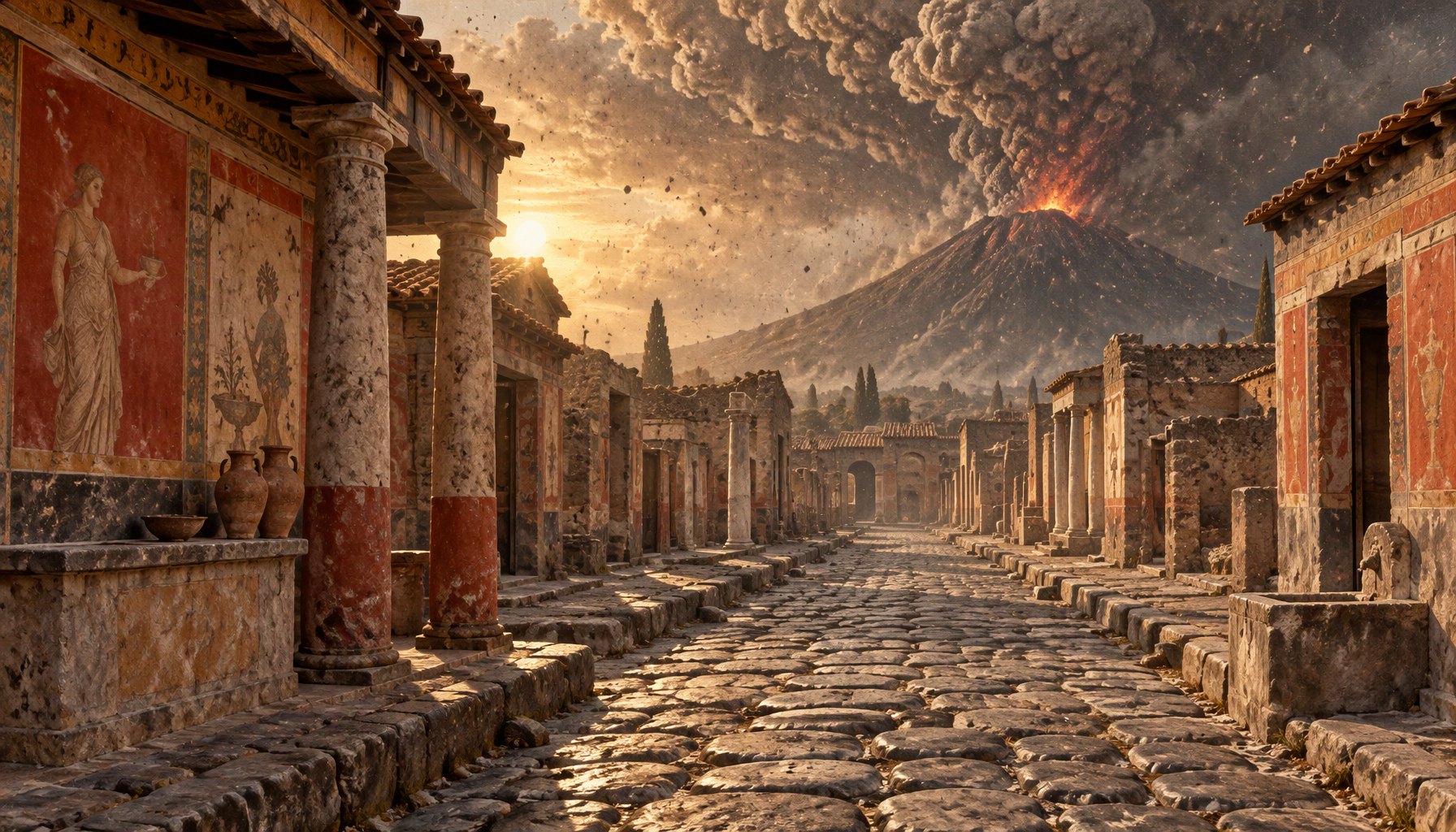
Pompeii is located in Campania, southern Italy, about 23 kilometers from Naples. The city grew as a trading and port center at the mouth of the Sarno River, thriving on olive oil, wine, and seafood. In the first century AD, Pompeii had a population of about 11,000 to 15,000 people, with a forum, temples, market, public baths, and an amphitheater capable of accommodating almost all residents.
To its north rises Mount Vesuvius. The Romans considered it an ordinary mountain; vineyards grew abundantly on its slopes. There is no record that the local inhabitants realized the mountain was an active volcano, although scholars such as Strabo had mentioned volcanic signs in the area.
Forgotten Warning
On February 5, 62 AD, a great earthquake shook Campania and damaged many buildings in Pompeii. The inhabitants rebuilt houses, temples, and markets. Some structures were still under repair when the next disaster struck seventeen years later. That earthquake was indeed a warning that the ground beneath the city was moving.
Pliny the Younger, who witnessed the event from Misenum, wrote letters to the historian Tacitus several decades later. His correspondence became the most important eyewitness testimony of the eruption, including the story of his uncle, Pliny the Elder, who died in Stabiae while attempting to rescue others.
Eruption in 79 AD
The eruption began with a burst of pumice and ash into the air, forming columns tens of kilometers high. Wind carried volcanic material southward, showering Pompeii. Roofs began to collapse under the weight of ash. Some residents fled, but many remained inside their homes or sought shelter in cellars.
The exact date of the eruption remains debated. Most classical sources cite August 24, but archaeological finds such as fruit and a grill still containing food suggest a fall date, around October or November. This debate does not alter the conclusion that the event occurred in 79 AD.
Pyroclastic Waves
The most lethal phase occurred when the eruption column collapsed and sent pyroclastic flows—a mixture of hot gas and volcanic material—traversing the slopes at speeds of hundreds of kilometers per hour. These flows destroyed buildings and burned or suffocated anyone in their path. Herculaneum, a city on the western side of the mountain, was affected first and buried under volcanic mud that later hardened.
Pompeii was buried under layers of pumice and ash several meters thick. The city vanished from the map for almost 1,700 years. The name Pompeii survived only in ancient records and inscriptions, while its location gradually faded from memory.
Human Casualties
The number of fatalities was never known precisely. It is estimated that thousands of people died in Pompeii, Herculaneum, and surrounding settlements. To date, more than a thousand corpses have been found in Pompeii, most of them uncovered during 19th- and 20th-century excavations. Many victims were found in cellars, where they sought protection from the ash rain.
In Herculaneum, hundreds of skeletons were found in a boat shed on the shoreline. They appear to have been waiting for a sea evacuation that never came. This discovery provides a chilling glimpse of the final hours of the cities at the foot of Vesuvius.
Birth of Modern Archaeology
Systematic excavations began in the 18th century under Bourbon rule. In the 1860s, Giuseppe Fiorelli introduced a technique of pouring plaster into the cavities left by human and animal bodies that had decayed in the ash. This method produced casts of the victims' bodies at the time of death, including their expressions and final positions. Fiorelli's method became the standard in disaster archaeology.
Pompeii also provides unparalleled evidence of everyday Roman life: bread still baked in ovens, wall graffiti, medical instruments, food remnants, and even erotic paintings that were once hidden from the public. No other Roman city has been preserved with such detail.
Lessons on Vulnerability
Vesuvius remains active. About three million people now live in the Naples area and its surroundings, including in the most dangerous red zone. The Italian government has evacuation plans, but volcanologists continue to warn that the next major eruption is only a matter of time. Pompeii serves as a reminder that a seemingly eternal city can be destroyed in hours.
The legacy of Pompeii is not just about death, but about life. From small kitchens to gladiator arenas, the city shows how ordinary people in the Roman Empire worked, ate, traded, and worshipped. That is why Pompeii remains one of the world's most important archaeological sites.
Discussion
Comments
Comments are reviewed by an editor before they appear. Include sources when correcting facts.
No comments yet. Be the first to respond to this article.