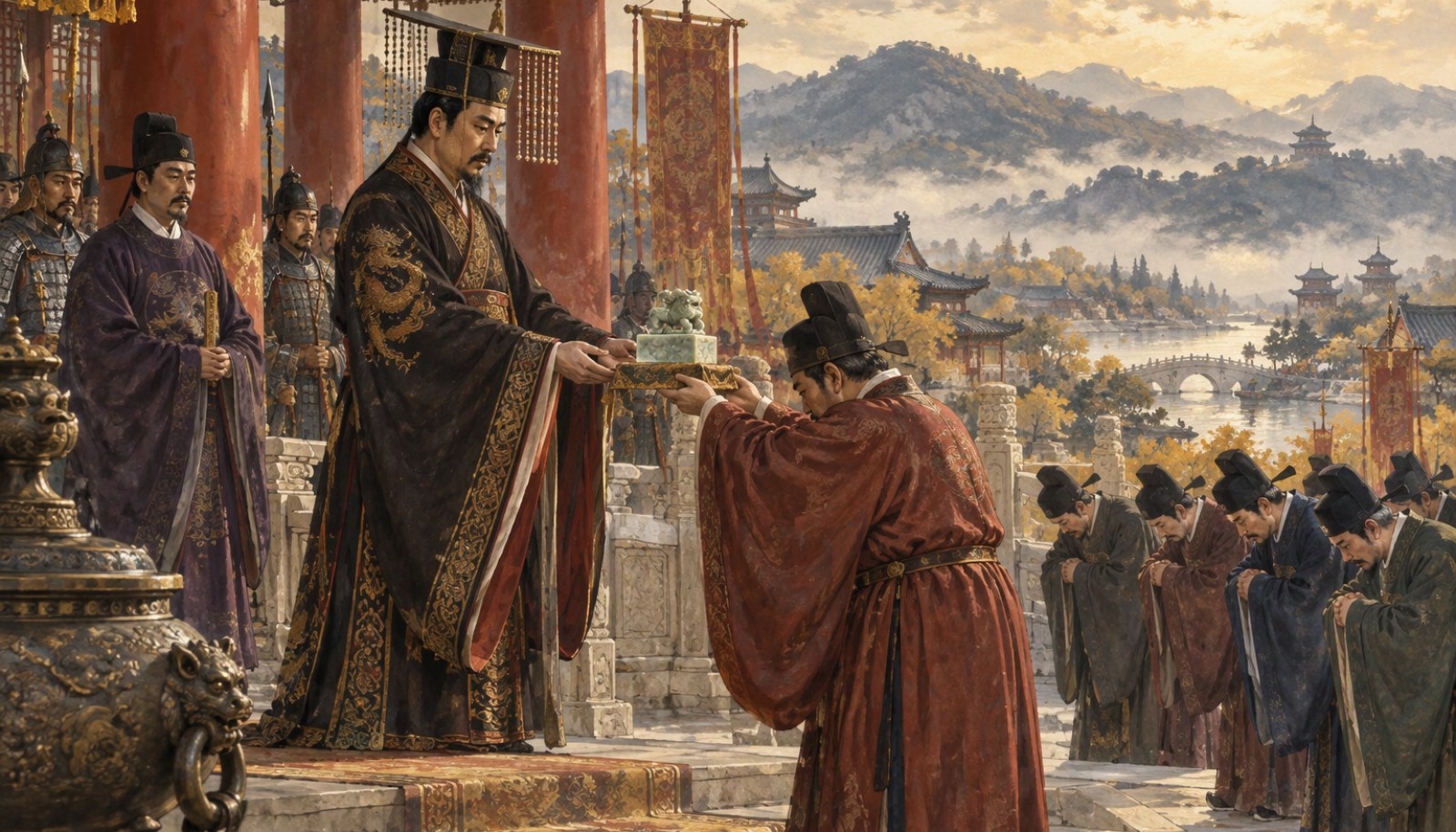
In 937, Xu Zhigao, the minister who controlled the government of the state of Wu, received the throne from Yang Pu, the last emperor of the dynasty. He established a new state named Qi, and two years later changed its name to Tang, calling himself Li Bian. The move marked the establishment of Southern Tang, one of the Ten Kingdoms that lasted nearly four decades in southern China.
Wu and the Power of the Xu Family
Wu grew from the power of Yang Xingmi, a general who controlled the lower reaches of the Yangtze River at the end of the Tang Dynasty. In 902 he received the title Prince of Wu from the weakening Tang court, and after the Tang collapsed in 907 the region became one of the Ten Kingdoms. Its government center was in Guangling, now Yangzhou.
Li Bian was born in 888 in Xuzhou. He lost his parents at a young age, then was adopted by Yang Xingmi and given the name Xu Zhigao. After Yang Xingmi died in 905, he became the adopted son of Xu Wen, a general who took over the government of Wu. It was in this environment that he grew as an officer and official.
Xu Wen controlled the Wu court for more than two decades while maintaining Yang Pu as the official ruler. When Xu Wen died in 927, Xu Zhigao succeeded in overcoming Xu Wen's sons and took over the position of regent. From then on, the important decisions of Wu were in his hands, not in the hands of the emperor.
The Road to the Throne
Xu Zhigao strengthened his position by placing trusted people in military and financial positions. He also embraced scholars and civil officials tired of interstate conflict, making his government seen as more orderly compared to the military regimes around him.
In 937, Yang Pu handed over the throne through an official ceremony. Xu Zhigao took the title of emperor and named his country Qi, with the capital in Jinling, now Nanjing. The transfer of the government center from Yangzhou to Jinling marked the beginning of a new dynasty that sought to distance itself from the legacy of the Yang and Xu families.
Historians call this event a usurpation because power shifted from the Yang family to the Xu family through political pressure. However, the process used the common abdication procedure of the Five Dynasties period: a letter of surrender, a court ceremony, and an honorary title for the former ruler. In this way, the transfer of power was wrapped as a legitimate dynastic change.
Establishment of Southern Tang
In 939, Xu Zhigao changed the name of his country to Tang and took the name Li Bian. He claimed to be a descendant of the Tang imperial family, although his blood relationship could not be proven. This claim was important because the name Tang still had great prestige, and many people in southern China viewed the dynasty as a symbol of order and culture.
The government of Li Bian tried to revive Confucian rituals and education. He attracted scholars from the war-torn northern regions, repaired the administration, and promoted agriculture and trade in the Yangtze Valley. This policy helped him build legitimacy after the sensitive transfer of power.
In foreign affairs, Li Bian tended to avoid large-scale wars. He chose to strengthen the borders and maintain trade relations with neighboring countries such as Wuyue and Min. This cautious attitude gave him time to build the economy, although it did not resolve old rivalries in the area.
Reign of Emperor Liezu
After his death in 943, Li Bian was given the temple name Liezu. He was succeeded by his son, Li Jing, who faced military pressure from the Later Zhou Dynasty. The war from 955 to 958 forced Southern Tang to surrender territories north of the Yangtze River and acknowledge the power of Zhou, a blow from which it never fully recovered.
Li Jing moved the capital to Nanchang in 961 and died the same year. The throne passed to Li Yu, the last ruler who was better known as a poet than as a king. In 975, Song forces captured Jinling and ended Southern Tang.
Legacy
Although short-lived, Southern Tang left a strong cultural footprint. Its palaces and cities became centers of poetry, painting, and printing, while Li Bian's policies provided a foundation for the stability of the southern region. Its story also became an example of how new rulers used the symbols of the old dynasty to legitimize their power.



Discussion
Comments
Comments are reviewed by an editor before they appear. Include sources when correcting facts.
No comments yet. Be the first to respond to this article.