Stone Circles at Salisbury Plain
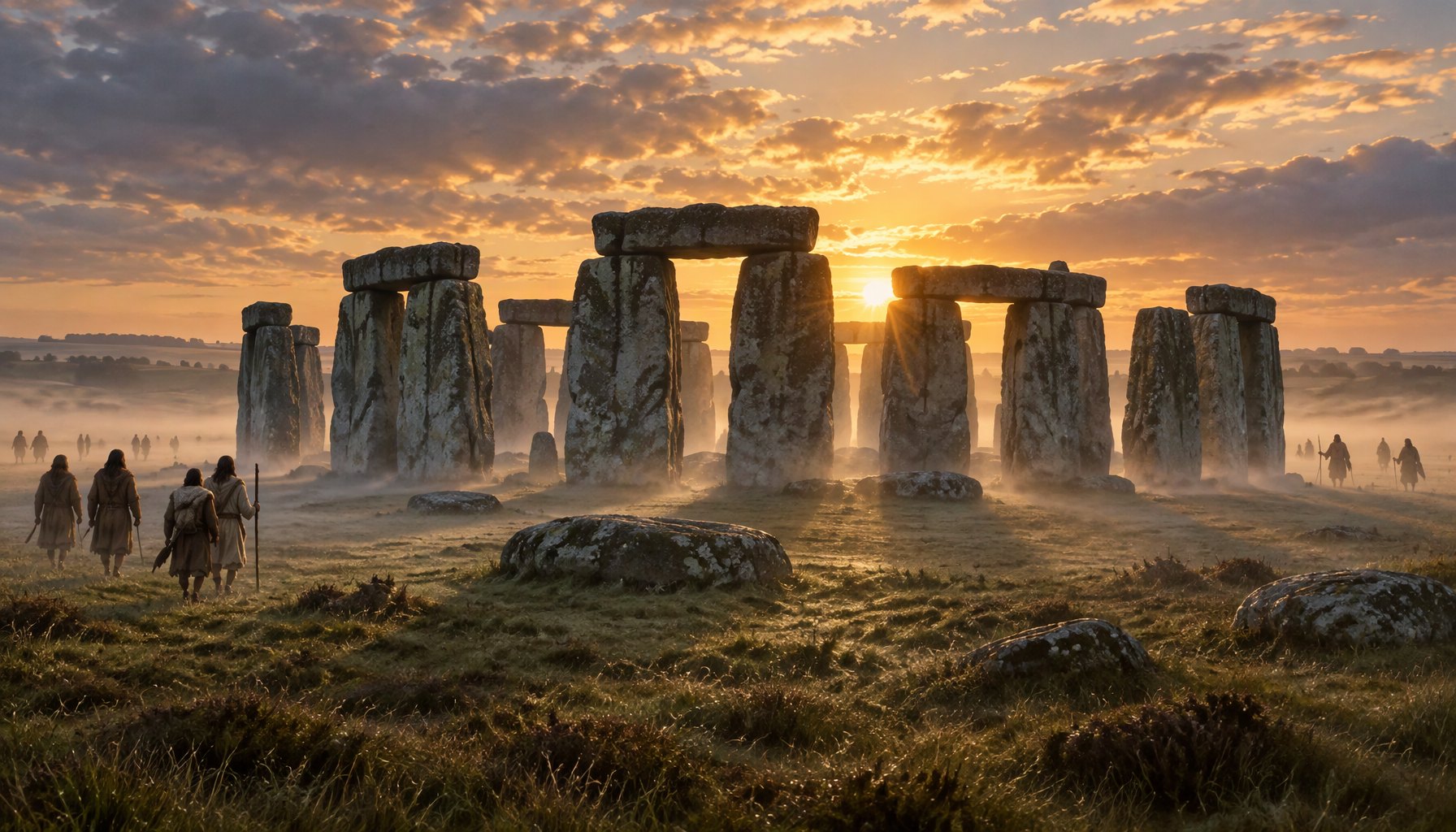
On the Salisbury Plain in Wiltshire, southern England, stands a stone circle that has been a symbol of mystery for centuries. Stonehenge consists of large stones arranged vertically and horizontally, forming a circle with a trilithon structure in the center. The site is one of the most famous prehistoric monuments in the world.
The structure visible today is the result of several construction phases spanning over a thousand years, not a single project. The early phase began around 3000 BCE, while the large stone arrangement known today was built around 2500 to 2000 BCE. Each generation added, modified, or dismantled certain parts.
Construction in Several Phases
The earliest phase consisted of a circular ditch and holes called Aubrey Holes, possibly used for burials or rituals. In the following phase, small bluestones were erected in a double circle. Only then were the massive sarsen stones erected and arranged into the shape still visible today.
Archaeologists have found evidence of human activity around the site, including stone tools, animal bones, and graves. The findings indicate that Stonehenge was not a standalone structure but part of a larger ritual landscape, with processional paths, ditches, and other sites around it.
Stones from Wales and Marlborough Downs
Two main types of stone were used at Stonehenge. Sarsen stones, weighing up to 25 tons, were taken from Marlborough Downs about 25 kilometers to the north. Bluestones, smaller and weighing 2 to 4 tons, originated from the Preseli Hills in Wales, about 240 kilometers away.
How the bluestones reached Salisbury Plain remains a major question. Some researchers suggest the stones were moved by humans using sledges, ropes, and boats. Others suggest they were carried by glaciers during the ice age. Recent evidence has not settled the debate, although the human transportation theory is more supported by the archaeological context.
Techniques for Lifting and Arranging the Stones
Sarsen stones were erected by digging holes for them, then raising them using ropes, levers, and possibly temporary wooden structures. Once upright, the stones were supported with small stones before the holes were backfilled. The lintel stones above were lifted using wooden scaffolding and placed on top of the upright stones.
Surprisingly, the lintel stone connections were made using carpentry techniques. The tops of the upright stones had protrusions, while the lintel stones had matching holes. The connections kept the structure stable. The stones were also shaped with stone hammers and tools made from deer antlers, showing high planning and skill.
Connection to the Sun
Stonehenge has a clear orientation towards the sun. At the summer solstice, the sun rises in line with the main entrance and certain stones. At the winter solstice, the sun sets visible through the trilithon arrangement. The orientation indicates that the site is related to the seasonal cycle and sun celebrations.
However, Stonehenge is not just a calendar. Researchers suggest the site was used for ceremonies marking seasonal transitions, community gatherings, and honoring ancestors. Animal bones found around the site indicate large feasts during certain seasons, especially at the winter solstice.
Who and Why?
There are no written records from the society that built Stonehenge. All knowledge about them comes from archaeology. The Neolithic inhabitants of England lived from farming, animal husbandry, and long-distance trade. They built megalithic monuments in various places, and Stonehenge is one of the most complex.
The theory that Stonehenge was built by druids or the Romans is not supported by evidence. Druids appear in Roman records long after Stonehenge was completed, and the Romans did not build it. Some modern theories link it to healing, an observatory, or a symbol of unity among communities, but none can be proven conclusively.
Ritual Landscape
Stonehenge does not stand alone. Around it are Durrington Walls, a large settlement that may have been the home of the builders or ritual participants. There is also the Avenue, a processional path connecting Stonehenge to the River Avon, as well as mound graves from various periods.
The landscape shows that Stonehenge was a center of social and spiritual activity involving thousands of people. Its construction and maintenance required cooperation among communities spread over a wide area. The site is evidence that Neolithic societies had sophisticated social organization and logistical capabilities.
Heritage and Threats
Stonehenge was designated a UNESCO World Heritage Site in 1986. Every year, millions of tourists visit the site, especially during solstice celebrations. Site management faces challenges balancing conservation, public access, and infrastructure development around it.
Plans to build a tunnel near Stonehenge have sparked long debates about the impact on the archaeological landscape. Archaeologists, local communities, and the government have differing opinions on the best way to protect the site. To this day, Stonehenge remains a symbol of the tension between heritage preservation and modern needs.

Discussion
Comments
Comments are reviewed by an editor before they appear. Include sources when correcting facts.
No comments yet. Be the first to respond to this article.