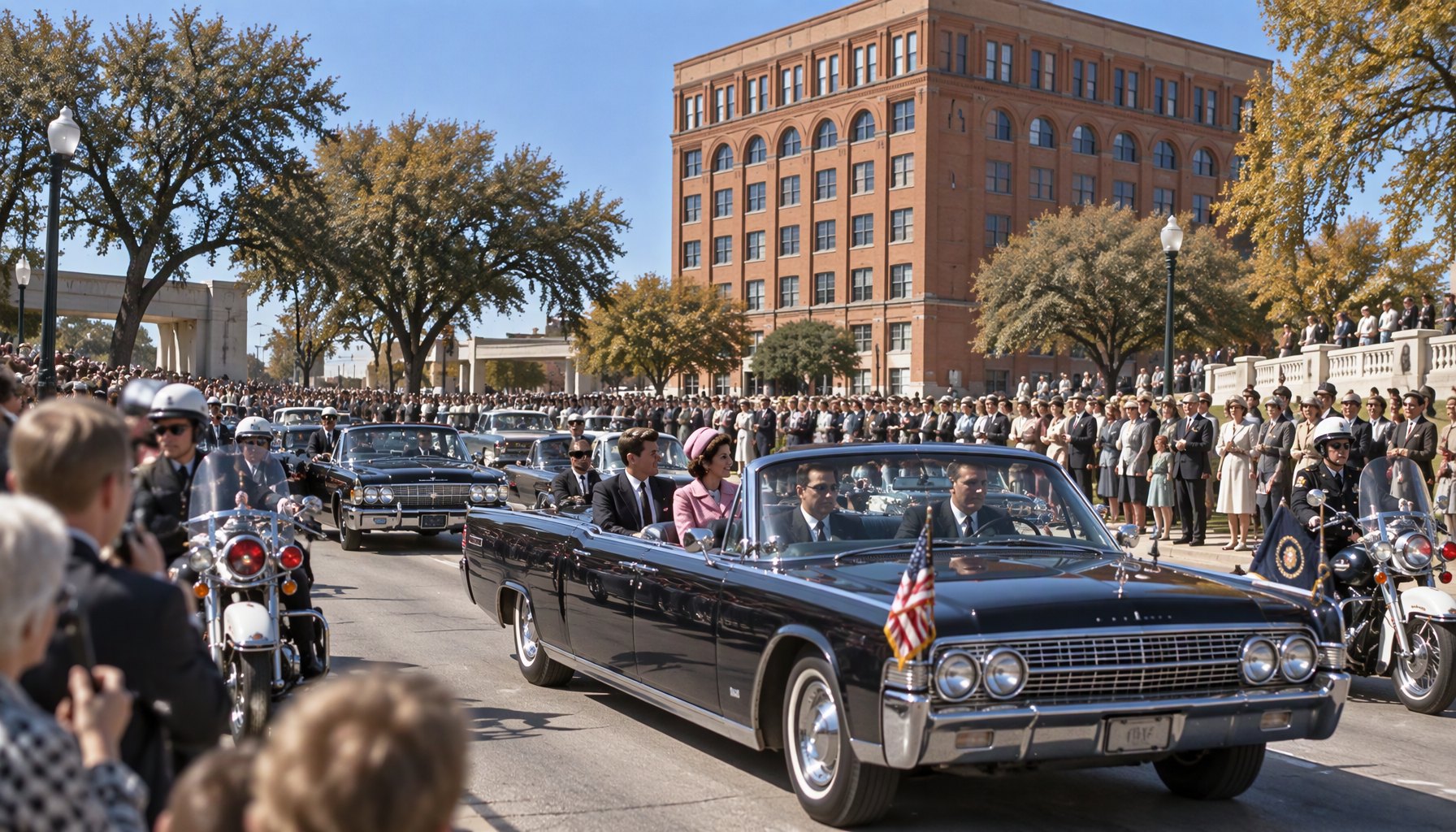
Dallas, 22 November 1963
President John F. Kennedy visited Dallas, Texas, as part of a political tour. He rode in an open convoy with Texas Governor John Connally and his wife. Thousands lined the route to downtown to see the president.
Around 12:30 p.m., as the convoy passed Dealey Plaza, gunfire was heard. Kennedy was shot in the neck and head. Connally was also wounded. The presidential car sped to Parkland Memorial Hospital, but Kennedy was declared dead shortly thereafter. America and the world were shocked.
Capture of Oswald
Within hours, police arrested Lee Harvey Oswald, a former Marine who worked at the Texas School Book Depository, a building near the shooting site. A rifle was found on the sixth floor of that building. Oswald denied involvement and described himself as a "patsy" or a scapegoat.
Two days later, while being transferred from the police station, Oswald was shot by Jack Ruby, a nightclub owner. Oswald died. His death in front of television cameras added another layer of mystery and left many questions unanswered directly by the main suspect.
Warren Commission
President Lyndon B. Johnson formed an investigative commission led by Chief Justice Earl Warren. The Warren Commission released its report in September 1964. Its conclusion: Lee Harvey Oswald acted alone, fired three shots from the sixth floor of the Texas School Book Depository, and there was no evidence of a conspiracy.
The commission also concluded that a single bullet passed through Kennedy's body and wounded Connally, later known as the "single-bullet theory." This theory became one of the most debated points because the bullet trajectory was considered implausible by some critics, even though commission supporters argued that the body positions explained the trajectory.
Criticism and Alternative Theories
Since 1964, many books and films have questioned the Warren Commission's conclusions. Oliver Stone's 1991 film "JFK" popularized the idea that the murder involved state actors, the military, or intelligence agencies. Various theories point to the CIA, FBI, Cuba, the Soviet Union, the mafia, or combinations of those groups.
However, those theories often lack strong direct evidence. Some rely on conflicting testimony, photo and recording analyses, or political motives. To date, no alternative theory has reached consensus among historians and investigators.
1979 Committee
In 1979, the House Select Committee on Assassinations (HSCA) concluded that Kennedy was "possibly killed as a result of a conspiracy," although it could not identify conspirators. That conclusion was based, among other things, on audio recording analyses that suggested the possibility of a fourth shot.
However, that acoustic analysis was later questioned by other studies. The HSCA report remains significant because it shows that the official investigation did not entirely rule out the possibility of a conspiracy, even though the evidence was weak and controversial.
Released Documents
In 1992, the United States Congress passed the JFK Records Act, which ordered the release of government documents related to the murder. Since then, millions of pages of documents have been released, including in 2017 and 2021–2023. Those documents provide context about intelligence operations, ties to Cuba, and surveillance of Oswald.
Although many documents have been opened, some remain restricted or edited. No documents directly prove a major conspiracy, but those documents show how complex the Cold War context around the event was.
Physical Evidence and Recordings
The Zapruder film, a color amateur recording that captured the seconds of the shooting, is one of the most important visual evidences. Frame-by-frame analysis is used to estimate the timing and direction of the shots. However, interpretations of that recording vary among researchers.
Ballistic evidence, wound positions, and shooting reconstructions also become points of debate. Some experts conclude that the shots came from the school book building; others question the number of shots or their direction. Differences in methods and assumptions make a single conclusion difficult to achieve.
Legacy
Kennedy's assassination changed American politics. Public trust in government and intelligence agencies declined, and conspiracy theories became part of political culture. The event also spurred reforms in presidential security and the handling of classified information.
To this day, the JFK assassination remains one of the most famous mysteries of the 20th century. Official answers exist, but not everyone accepts them. The debate itself reflects how society treats authority, evidence, and historical narratives.
Discussion
Comments
Comments are reviewed by an editor before they appear. Include sources when correcting facts.
No comments yet. Be the first to respond to this article.