Chile Before 1973
In the 1960s, Chile had a relatively strong democratic tradition in Latin America. Political parties competed in elections, and the military generally stayed out of practical politics. However, the country also faced sharp social inequalities, particularly in land ownership and copper mining wealth.
In 1970, Salvador Allende, the candidate of the leftist coalition Unidad Popular, won the presidential election with the most votes but not an absolute majority. Congress then confirmed him as president. Allende's victory surprised conservative circles and the United States, which saw it as a threat of communism in the Western Hemisphere.
The Peaceful Road to Socialism
Allende promised to build socialism through democratic means, not armed revolution. His government nationalized copper mines, expanded land reform, raised wages, and expanded social programs. These policies were popular with workers and farmers but sparked opposition from landowners, foreign companies, and the middle class.
The nationalization of copper was particularly important because copper was Chile's main export. The U.S. government and American mining companies opposed the policy. Economic pressure began to be felt through falling copper prices, credit restrictions, and investment uncertainty.
Economic and Political Tensions
In 1972, Chile was hit by high inflation, shortages, and large-scale strikes, including a truckers' strike that paralyzed distribution. Opposition groups accused Allende of leading the country toward communist dictatorship, while his supporters accused the opposition of economic sabotage.
Polarization intensified. Street actions, clashes, and extreme rhetoric increased on both sides. The military began to get involved in political discussions, although some officers remained loyal to the constitution. The United States increased pressure through support for opposition media and anti-Allende political groups.
The Role of the United States
Declassified documents later showed that the United States tried to prevent Allende from taking power since 1970. Operation "Track I" attempted to influence Chile's Congress, while "Track II" supported military efforts to prevent Allende's inauguration. This involved contact with Chilean officers and resulted in the murder of General René Schneider, a military leader loyal to the constitution.
After Allende took power, the U.S. cut economic aid and supported opposition groups. President Richard Nixon is reported to have ordered that Chile's economy "be made to scream." However, the extent to which the U.S. was directly involved in the 1973 coup remains debated. Documents show political and economic support but do not prove that the U.S. ordered the coup.
The Coup of September 11, 1973
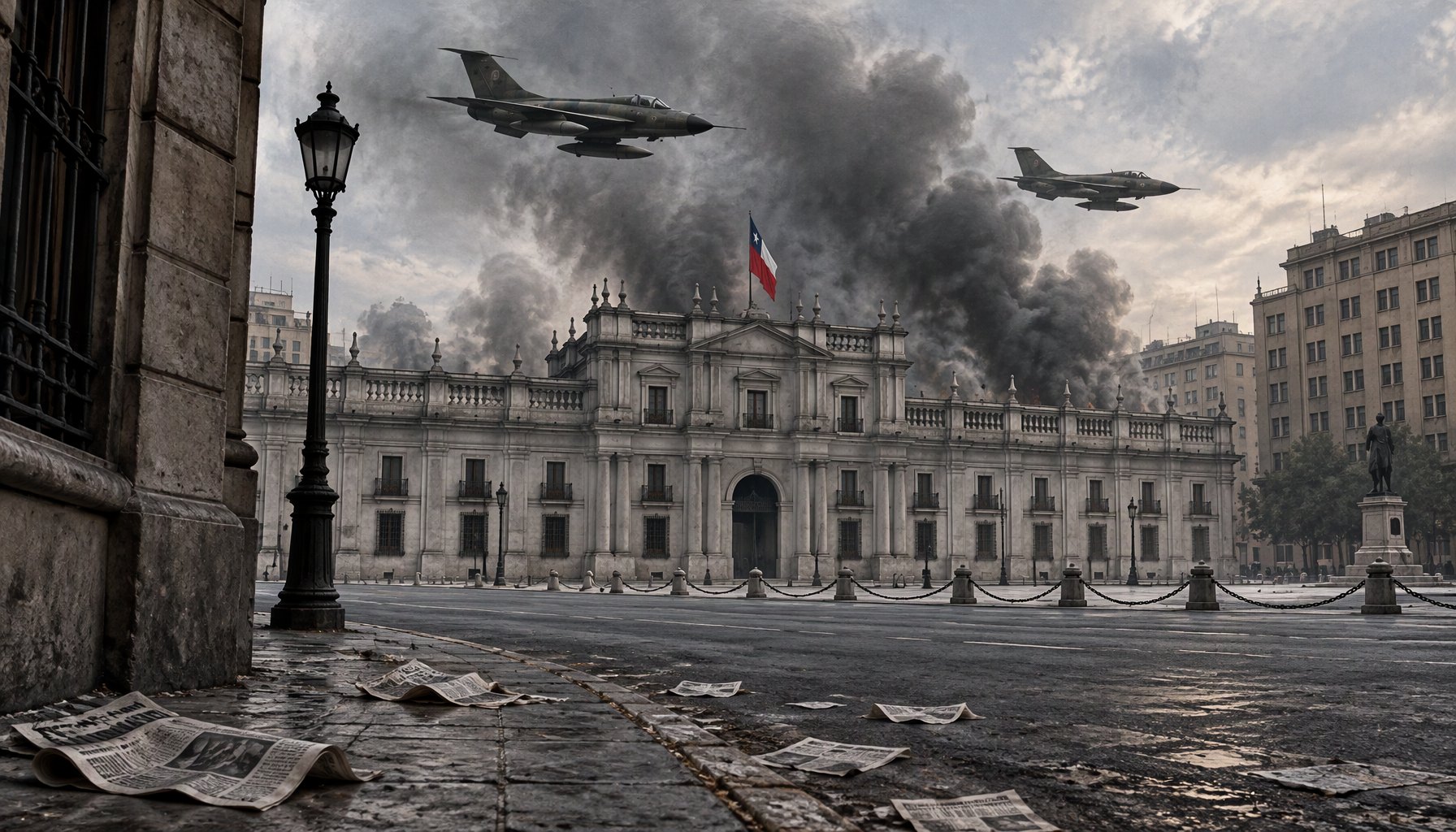
On the morning of September 11, 1973, Chile's armed forces launched a coup. Planes bombed La Moneda Palace, and Allende delivered his final speech from inside the palace. He died that day. A forensic examination in 2011 concluded that his death was caused by a self-inflicted gunshot wound, although political debate about the context continues.
General Augusto Pinochet led the military junta that dissolved Congress, suspended the constitution, and imposed a state of emergency. Thousands of Allende's supporters were arrested, and many were tortured or killed. Political parties were banned, and universities and media were tightly monitored.
The Pinochet Dictatorship
The Pinochet regime lasted until 1990. The Rettig Commission, formed after the transition to democracy, concluded that more than 3,000 people were killed or disappeared due to political repression. The Valech Commission later recorded around 28,000 victims of torture and political detention.
The regime was also involved in Operation Condor, a network of cooperation among South American dictators to hunt political opponents abroad. Chile's economy underwent radical market reforms but also faced a crisis in 1982. Pinochet built an image as a guardian of stability, while human rights violations continued.
Declassification and Debate
Since the late 1990s, U.S. documents about Chile have been partially declassified. A 2000 CIA report acknowledged that the agency supported the coup and knew about human rights violations. These documents strengthened criticism of U.S. policy during the Cold War.
However, historians still debate the relative weight of internal and external factors. Some emphasize domestic polarization, economic crisis, and the actions of Chile's own military. Others emphasize U.S. pressure, the role of multinational corporations, and support for the opposition. A complete picture is complex and cannot be reduced to a single cause.
Legacy
In 1988, Pinochet held a plebiscite to extend his rule and lost. Democratic presidential elections were held in 1989, and civilian government returned in 1990. The transition was cautious, with the legacy of Pinochet's constitution still influencing Chilean politics today.
Chile later built memory museums and memorial sites at former torture centers. Debates about Allende, the coup, and Pinochet still divide society. Chile's story is a lesson about the fragility of democracy, geopolitical pressure, and the cost of unchecked political polarization.

Discussion
Comments
Comments are reviewed by an editor before they appear. Include sources when correcting facts.
No comments yet. Be the first to respond to this article.