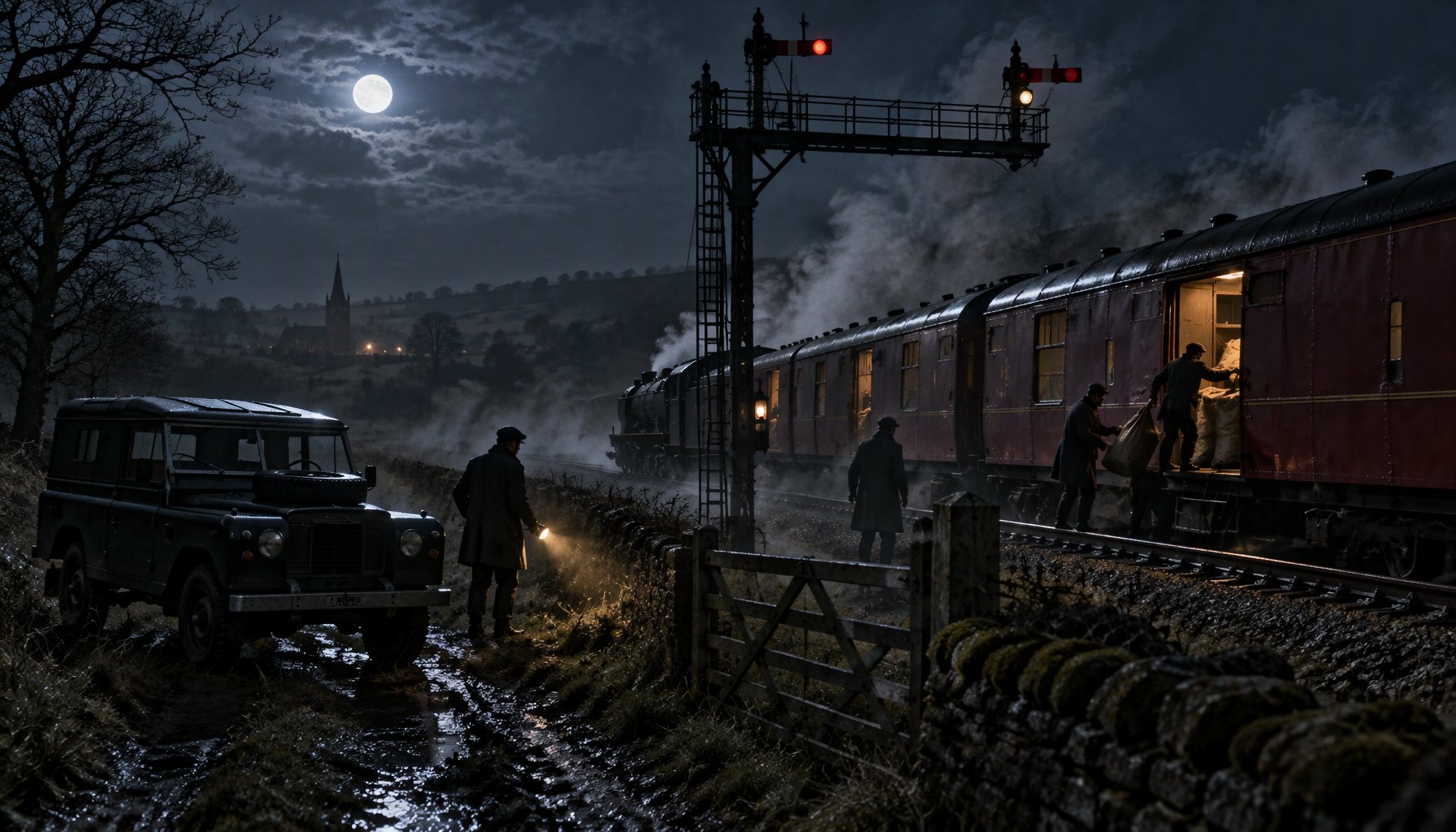
Night Mail Train
On 8 August 1963, the night mail train departed from Glasgow for London. The train carried letters and parcels, including bags of cash in large amounts. The money was used for banking and business purposes in London, and its value reached about £2.6 million, a huge sum at the time.
The mail train was an attractive target because it carried cash and ran on a predictable schedule. However, the train was also guarded and equipped with security procedures. The robbers needed a highly detailed plan to stop it in the middle of the night without attracting attention.
Plan at the Farm
The gang of robbers was led by Bruce Reynolds, an experienced criminal. They consisted of about fifteen people with various skills, including drivers, thieves, and people who understood the train signalling system. They rented Leatherslade Farm in Buckinghamshire as a hideout and operational base.
Their plan was to alter the train signals so that it would stop at the chosen location. They also prepared vehicles for escape and a place to divide the money. Over several weeks, they observed the train schedule and gathered information about the route and security procedures.
8 August 1963
At the early hours of 8 August, the robbers carried out the plan. They stopped the train at Sears Crossing bridge by faking a red signal. The driver, Jack Mills, noticed something was wrong and attempted to investigate, but he was attacked and injured. The robbers then separated the carriage carrying the money and moved the bags into their vehicles.
The operation proceeded relatively quickly, although not entirely smooth. The robbers fled with about £2.6 million in cash. They then gathered at Leatherslade Farm to split the proceeds and plan their escape. Their trail, including fingerprints and abandoned items, became crucial evidence for the police.
Loot and Escape
The loot was divided among the perpetrators and other helpers. Some of the money was hidden, and some was used for escape. The robbers tried to eliminate traces by burning equipment and cleaning the site, but they left many clues on the farm.
Police discovered Leatherslade Farm after receiving reports of suspicious activity. Inside were fingerprints, plates, bottles, and a Monopoly board used to pass the time. The fingerprints on the Monopoly board became one of the pieces of evidence linking the suspects to the place.
The Hunt
The robbery became a major news story in the UK and worldwide. Police launched a large-scale operation to capture the perpetrators. The public provided information, and the media followed every development. Some of the robbers were apprehended within weeks, while others fled abroad.
The investigation uncovered a network of people aiding the robbers, including the farm owner and those hiding the money. Police also found some of the hidden cash in various locations. However, most of the loot was never recovered, and some of the perpetrators remained free for years.
Trial and Punishment
In 1964, several of the perpetrators were tried and sentenced to severe prison terms, some reaching 30 years. The judge emphasized that the robbery involved violence against the driver and was a serious crime.
The sentences became some of the harshest in the history of British crime at the time. Some of the perpetrators later attempted to escape from prison. Ronnie Biggs, one of the robbers, escaped in 1965 and lived in Brazil for decades. He returned to the UK in 2001 and was re‑imprisoned before being released in 2009 on health grounds. His escape story made him a popular media figure.
Escape and End
Some of the other perpetrators also fled and lived in hiding. Bruce Reynolds was captured in 1968 after returning to the UK. He later wrote a book and became a commentator on the case. Some of the robbers led quiet lives after being released, while others remained involved in crime.
Jack Mills, the injured driver, never fully recovered and died a few years later. His family lamented that public attention focused more on the robbers than on the victim. The story illustrates how media and popular culture can romanticize crime.
Legacy
The Great Train Robbery prompted changes in money transport and mail train security procedures. Companies and the government increased security, reduced the amount of cash transported, and strengthened coordination with police. The case became a lesson about the vulnerability of transport infrastructure.
To this day, the event remains part of British popular culture. Films, books, and documentaries continue to tell the story of the robbers. However, behind the legend, there are wounded victims, affected families, and a crime that is not entirely romantic.

Discussion
Comments
Comments are reviewed by an editor before they appear. Include sources when correcting facts.
No comments yet. Be the first to respond to this article.