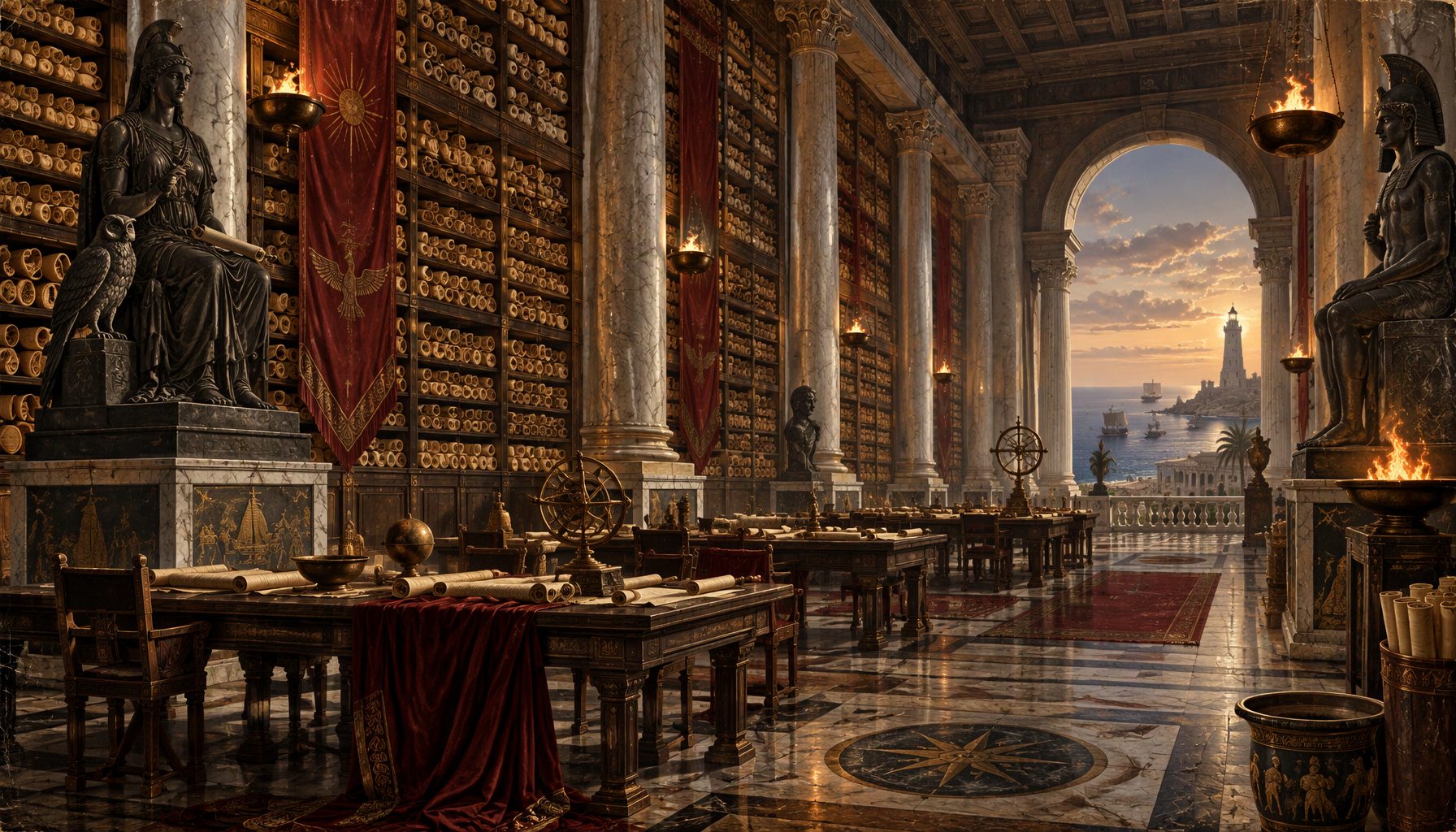
The City Built to Become a World Center
Alexandria was founded by Alexander the Great in 331 BC on the shores of the Mediterranean, Egypt. After Alexander died, his general Ptolemy took over Egypt and began a dynasty that made the city a center of power, trade, and knowledge. It was in this city that a project was born whose basic idea was simple yet extraordinarily ambitious: to gather copies of all the world’s written works known at the time.
This library was not a single building standing alone. It was part of the Mouseion, a research institute dedicated to the Muses, the goddesses of art and science. Scholars working there received salaries from the royal treasury, food, and lodging. Thus, the library functioned like a modern research center: a place where manuscripts were stored, compared, edited, and debated.
Manuscript Collection Policy
Ptolemy I Soter and his successors, especially Ptolemy II Philadelphus, supported aggressive manuscript collection. Ancient sources say that ships moored at Alexandria’s harbor were searched for books, and their manuscripts were copied before being returned. There is also a story, recorded by the medical writer Galen, about Ptolemy III borrowing official manuscripts of Aeschylus, Sophocles, and Euripides from Athens with a large silver pledge, then keeping the originals and returning the copies.
The collection included Greek literature, philosophy, medicine, mathematics, astronomy, geography, and translations of Egyptian and Near‑Eastern works. Thus the library was not merely a book repository but also a translation and editing engine that brought together different intellectual traditions.
The Librarians and Major Works
The names of some of the library’s directors are still recorded. Zenodotus of Ephesus, believed to have been the first, worked on editing Homer’s manuscripts and marking lines considered interpolations. Callimachus of Cyrene compiled the Pinakes, a catalog that organized authors and works by genre. That catalog is regarded as one of the foundations of library science.
Eratosthenes, who led the library in the mid‑3rd century BC, used that collection to calculate the Earth’s circumference. By comparing the angles of shadows in Syene and Alexandria, he obtained a surprisingly accurate figure close to the true size. These stories show that the library’s value lay not only in the number of scrolls but in the works born from comparison and critique of manuscripts.
The Decay That Spanned Centuries
There is no single event that can be called the “burning of the Library of Alexandria.” Its destruction was gradual and its causes remain debated. In 48 BC, when Julius Caesar was involved in a civil war in Alexandria, fire from ships burned at the harbor spread to part of the city; some ancient sources say that part of the library also burned, others do not.
In 272 AD, the battle between Roman forces and Zenobia’s supporters damaged the palace area where the library stood. Later sources mention the institution’s decline, the relocation of the collection, and the loss of royal support. The story that Caliph Umar ordered the library’s burning in 642 AD only appears in much later sources, and many historians regard it as legend rather than a record of an event.
What Remains and Its Lessons
Today there is no surviving building of the library that can be confirmed. What remains are traces in other writers’ works, catalog fragments, and the stories of scholars who worked there. The uncertainty about the library’s end is itself a lesson: knowledge does not vanish in one night, but diminishes when the institution that preserves it loses funding, stability, and the people willing to copy and scrutinize texts.
The Library of Alexandria remains a reference because of its idea: that the world’s knowledge deserves to be collected, translated, and passed on. That idea has endured far longer than its buildings.
Discussion
Comments
Comments are reviewed by an editor before they appear. Include sources when correcting facts.
No comments yet. Be the first to respond to this article.