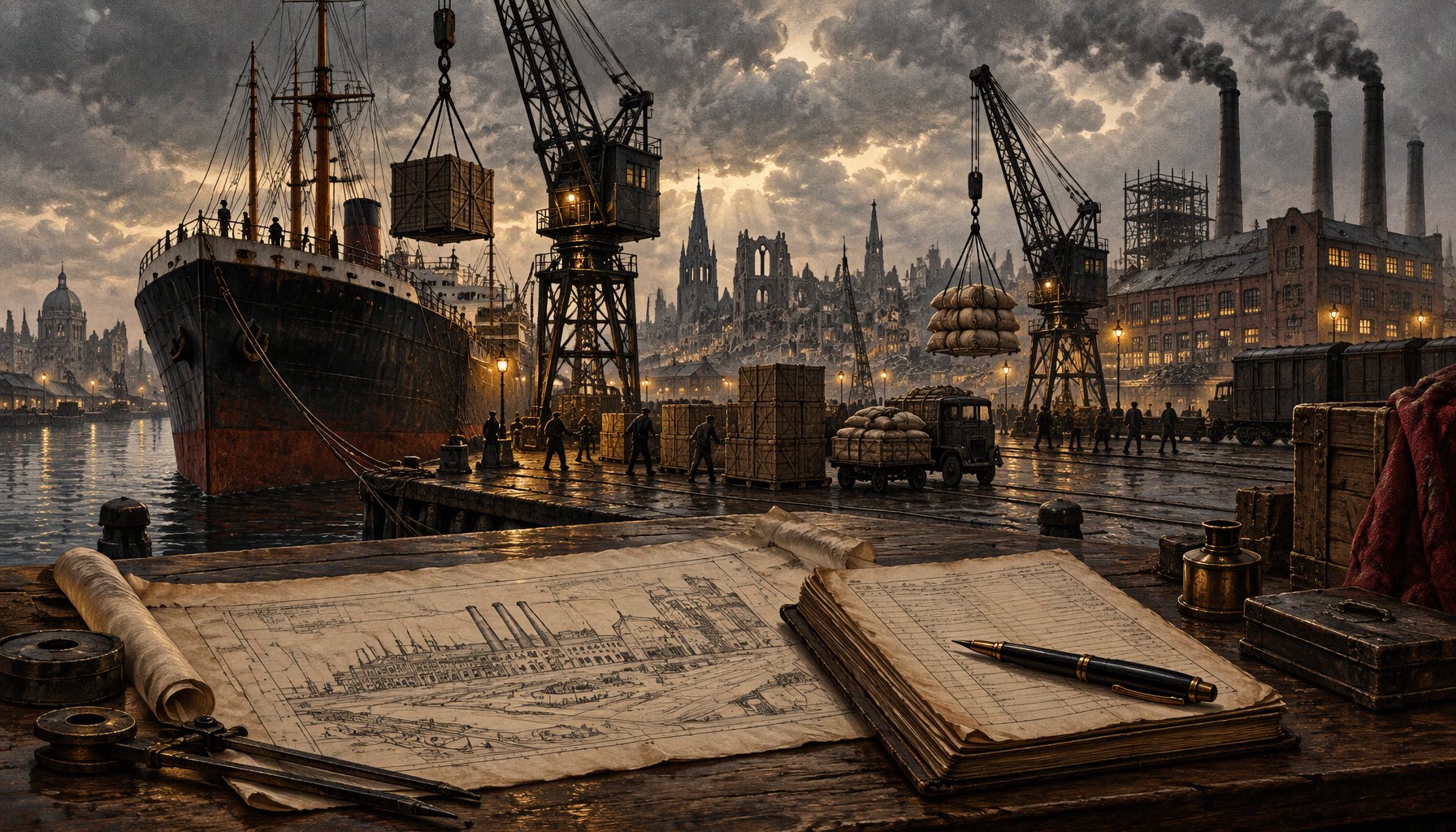
Europe in Ruins
In 1945, most of Europe was devastated. Cities were bombed, railway lines were damaged, factories ceased operation, and millions of people lost their homes. The harsh winter of 1946–1947 worsened the food and fuel crisis. In Germany, industrial production fell far below pre‑war levels.
This created political instability. Communist parties gained support in several countries, especially in France and Italy. The United States government feared that poverty and despair would open the door to Soviet influence in Western Europe.
Harvard Speech
On June 5, 1947, Secretary of State George C. Marshall delivered a speech at Harvard University’s commencement ceremony. He stated that the United States was ready to help Europe’s economic recovery, but emphasized that European countries must cooperate to develop a joint plan. The aid, he said, was not a cure for “individual countries separately,” but for the entire continent.
The speech did not immediately name the program. The term “Marshall Plan” appeared later and was widely used by the media. Its main idea was simple: provide large amounts of economic aid so that Europe could purchase goods, rebuild industry, and stabilize its currency.
Soviet Rejection
In July 1947, European representatives were invited to Paris to discuss the aid plan. The Soviet Union sent Foreign Minister Vyacheslav Molotov, but he rejected the requirement for transparency and multilateral cooperation. The Soviets viewed the program as an American intervention and barred the Eastern European countries under its influence from participating.
Some countries such as Czechoslovakia were initially interested, but were later forced to follow the Soviet line. The communist coup in Czechoslovakia in February 1948 heightened tensions. Thus the Marshall Plan accelerated the division of Europe into two blocs.
How the Aid Worked
The official program was called the European Recovery Program and ran from 1948 to 1952. The United States channeled aid in the form of goods, loans, and grants. Recipient countries established the Organisation for European Economic Co‑operation (OEEC) to coordinate the use of aid and reduce trade barriers.
The total value of aid was about 13 billion dollars, a huge amount at the time. Aid was primarily given in the form of goods such as food, fuel, machinery, and raw materials. Recipient governments sold those goods domestically and stored the proceeds in local funds to finance development projects.
Economic Recovery
By 1952, industrial production in the recipient countries had surpassed pre‑war levels. Economic growth increased, inflation was controlled, and intra‑European trade expanded. The Marshall Plan helped provide initial capital, but it did not work alone. Domestic reforms, military aid, and global trade recovery also played roles.
West Germany was included as a recipient in 1949 after the country’s formation. This decision was important because German industry became the engine of European growth. For the United States, the aid also opened markets for its goods and strengthened political allies in Europe.
Historical Debate
Several historians assess the Marshall Plan as highly successful in rebuilding Europe and preventing the spread of communism. Other historians, such as Alan Milward, emphasize that Europe’s recovery had begun before the large aid flowed, and that European nations used the aid to strengthen their own national economic policies.
Other criticism points out that the program was not politically neutral. Aid was given with the condition of cooperation, and countries that rejected the American line received nothing. Therefore the Marshall Plan was a combination of economic solidarity and Cold War strategy.
Legacy
The Marshall Plan became a model for many subsequent development aid programs. Its idea that political stability requires economic stability was widely accepted. However, its scale and context are difficult to replicate: Western Europe had industry, skilled labor, and established institutions before the war.
In Europe, the program is remembered as part of the effort to rebuild the continent after the devastation. In the United States, it became an example of how a great power uses economic aid as a diplomatic tool. The debate over its impact will continue, but its imprint on post‑war European architecture cannot be denied.


Discussion
Comments
Comments are reviewed by an editor before they appear. Include sources when correcting facts.
No comments yet. Be the first to respond to this article.