Searching for the Northwest Passage
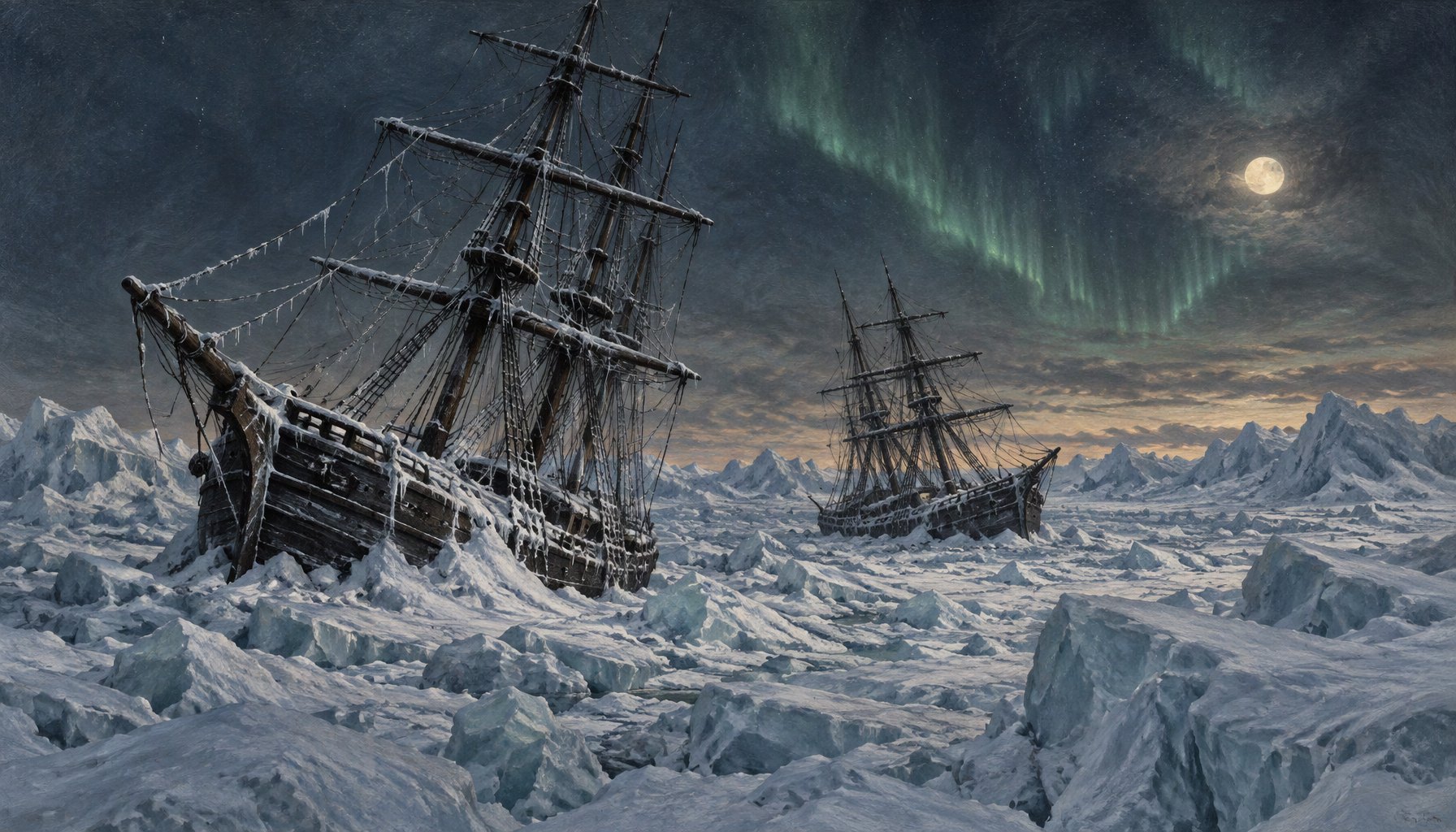
In the 19th century, England competed to discover the Northwest Passage, a shipping route from the Atlantic to the Pacific through the Canadian Arctic archipelago. The route was expected to accelerate trade to Asia and become a maritime pride. After several failed expeditions, the Royal Navy decided to send a large expedition with two of the most modern ships of the time.
HMS Erebus and HMS Terror were bomb ships reinforced with hulls and equipped with new technology, including steam engines, heating systems, and canned food supplies. Their commander, Sir John Franklin, was an experienced officer who had previously led a land expedition in the Arctic. This expedition was considered one of the best prepared in the history of English exploration.
Departure in 1845
The expedition departed from Greenhithe, England, on May 19, 1845, with 134 people, including Franklin and the second captains of the ships, Francis Crozier and James Fitzjames. They sailed through Baffin Bay and were last seen by a whaling ship in Baffin Bay in July 1845. After that, not a single member of the expedition returned to Europe.
The ships spent their first winter on Beechey Island. There, three crew members were buried in 1846: John Torrington, John Hartnell, and William Braine. Their graves were later found in a preserved condition by freezing temperatures, providing valuable clues about the health of the crew in the early stages of the expedition.
Trapped in Ice
After leaving Beechey Island, the ships sailed south to Victoria Strait and King William Island. In September 1846, Erebus and Terror were trapped in ice near King William Island and never moved again. Franklin died on the ship on June 11, 1847, according to records later found at Victory Point.
The note, written in April 1848, mentioned that 24 people had died, including Franklin, and the remaining 105 planned to leave the ship and walk south to the Back River. The message became the last evidence left by the expedition on land.
Decades of Search
Concern over the disappearance of the expedition triggered one of the largest search operations in history. More than twenty expeditions were sent from England and the United States between 1848 and 1859. Most failed to find victims, but they mapped a large area of the Arctic and found the first evidence of the expedition's existence.
In 1854, explorer John Rae heard Inuit testimony about a group of white men dying south of King William Island, as well as signs of cannibalism. In 1859, Francis Leopold McClintock's expedition found the Victory Point note, an abandoned boat, and several artifacts. The testimony and findings confirmed that the entire expedition ended in death.
Evidence of Cannibalism
In 1981, anthropologist Owen Beattie and his team exhumed graves on Beechey Island and examined bones found on King William Island. Some bones showed signs of cutting, breaking, and heating, consistent with cannibalism practices in survival situations. The discovery sparked intense public debate but is now widely accepted by researchers.
The cause of the mass death is still debated. Beattie proposed the hypothesis of lead poisoning from canned food, while other research shows that tuberculosis, pneumonia, and malnutrition played a major role. Recent research also highlights the extreme weather conditions in 1847–1848 that worsened starvation and disease.
Discovery of Shipwrecks
For more than a century, the location of Erebus and Terror became one of the greatest mysteries of the Arctic. In September 2014, an expedition supported by the Canadian government discovered the wreck of HMS Erebus in Wilmot and Crampton Bay, near King William Island. The discovery was announced by Prime Minister Stephen Harper and welcomed as a historic achievement.
Two years later, in September 2016, the wreck of HMS Terror was found in Terror Bay, about 100 kilometers from Erebus. Both ships are now protected as heritage sites, and archaeological dives continue to uncover artifacts and details of the crew's lives. Many of the items found are still in good condition due to the cold and fresh water.
The Legacy of the Franklin Expedition
The story of Franklin became a legend in English and Canadian culture. More than a hundred books, poems, and films have been made about the expedition. Franklin's name is immortalized on straits, bays, and various places in the Arctic. For the Inuit community, this story is also part of the oral history of foreigners crossing their land.
The Franklin expedition revealed the limits of human knowledge and technology in the 19th century, as well as the price to be paid in exploration. The discovery of the shipwrecks in the 2010s did not fully solve the mystery, but provided answers to questions that had persisted for nearly two centuries: where the ships ended up.

Discussion
Comments
Comments are reviewed by an editor before they appear. Include sources when correcting facts.
No comments yet. Be the first to respond to this article.