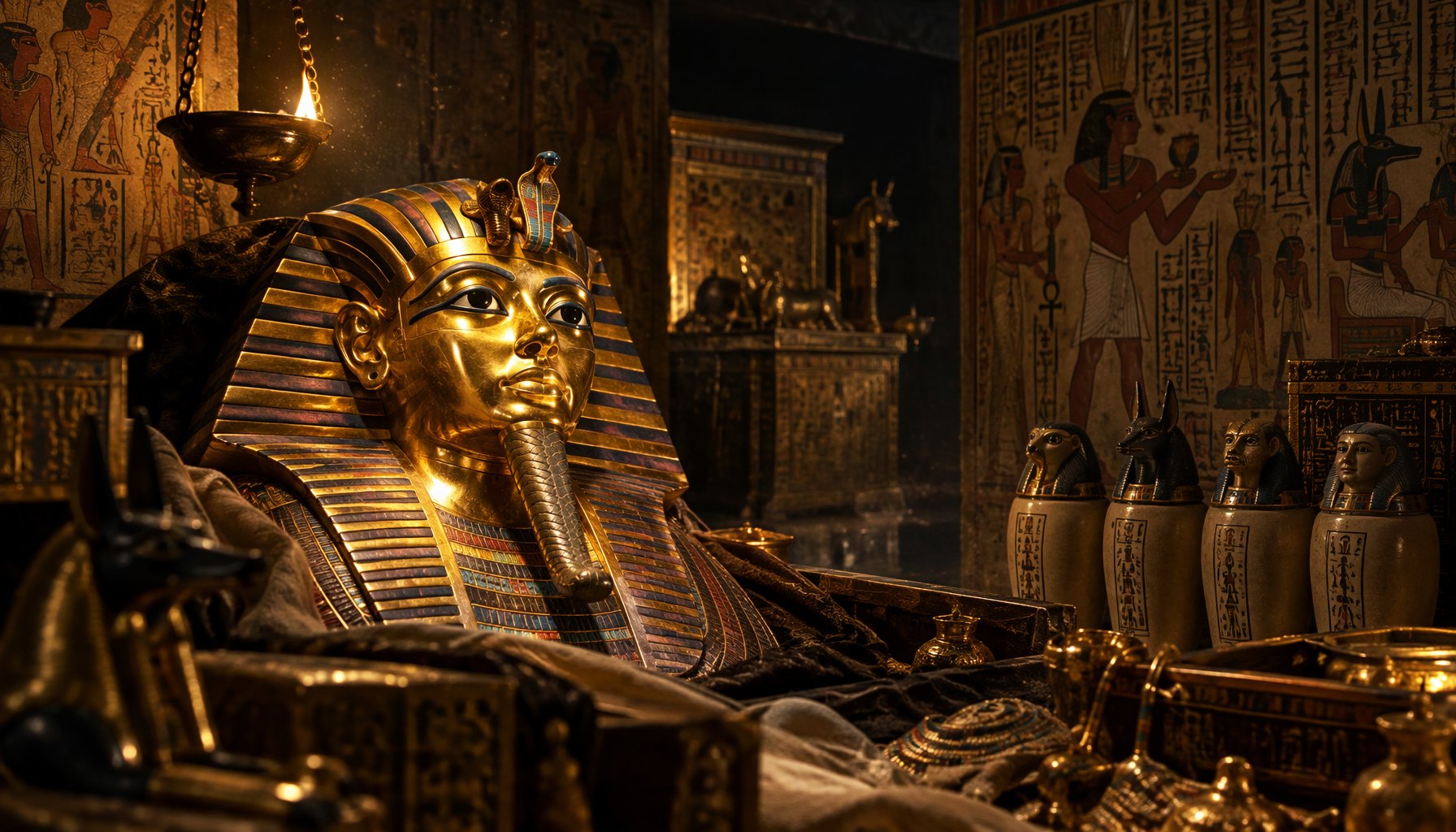
Almost Intact Tomb
On November 4, 1922, Howard Carter discovered a staircase leading to a tomb that was later given the number KV62 in the Valley of the Kings. Tutankhamun's tomb was almost untouched by robbers, although there were signs of attempted break-ins in ancient times. Inside, there were thousands of artifacts, including the iconic golden mask of Ancient Egypt.
The discovery sparked a global wave of interest in Egypt. However, behind the grandeur of the tomb, darker questions were hidden: why did the pharaoh who ascended to the throne as a child die at around the age of 19? There are no Egyptian records that explain the cause of his death in detail.
First Examination
When the mummy was examined in 1925, Carter's team found damage to the skull and face. This damage initially raised suspicions of violence, but was later explained as a result of mummy handling and embalming. At that time, examination technology was still limited, so many questions could not be answered.
For decades, the theory of murder became popular in the media. Stories about blows to the head, fights, or palace intrigues captured the public's imagination. However, without strong forensic evidence, these theories were more based on speculation than data.
2005 CT Scan
In 2005, an Egyptian team led by Zahi Hawass performed a CT scan on Tutankhamun's mummy. The scan produced much more detailed three-dimensional images than previous X-rays. The team concluded that there was no evidence of head trauma sufficient to cause death directly.
The CT scan found a broken bone in the left leg, which may have occurred before or around the time of death. The team also noted bone disease and possible complications. However, they could not confirm whether the broken bone was the cause of death, a result of an accident, or occurred after death.
DNA Testing and Malaria
In 2010, a research team led by Hawass published the results of DNA analysis and bone examination in the journal JAMA. The research involved several mummies of the royal family. The results showed that Tutankhamun was related to the mummies examined and suffered from various health conditions.
The team found malaria parasites in Tutankhamun's body, as well as signs of bone disease and foot abnormalities. They suggested that the combination of malaria and health problems that weakened the body could cause death, especially if accompanied by a broken bone. However, the research also received methodological criticism from some scientists.
Theory of a Chariot Accident
Some researchers suggest that Tutankhamun died as a result of an accident, such as falling from a chariot or being run over. Ancient Egypt used horse-drawn chariots in war and hunting, and a young king might have been involved in risky activities. The broken leg bone and other injuries were considered to support this scenario.
However, there is no direct evidence of such an accident. The royal chariots were found in the tomb, but there are no records linking them to the king's death. Without documentation, the theory of an accident remains a possibility, not a conclusion.
Murder: Thin Evidence
The theory of murder often appears in popular books and documentaries. One version states that Tutankhamun was killed by a high official or family member due to political rivalry. However, the forensic evidence supporting murder is not strong. Damage to the skull, once considered evidence of a blow, is now largely explained as post-mortem damage.
What is more likely is death from disease or health complications in a young king with a weak body. However, because the mummy has been examined several times with different methods, and because the condition of the mummy is not perfect, a definite answer is still difficult to obtain.
Curses and Media
The deaths of several people associated with the tomb excavation gave rise to the legend of the "curse of Tutankhamun". The media of the time popularized stories of pharaonic revenge. However, statistical analysis shows that the age and cause of death of the expedition members were not unusual for the time.
The legend of the curse more reflects popular culture than historical evidence. Nevertheless, the story helped make Tutankhamun the most famous pharaoh in the world, although his reign was short and his influence in Egyptian history was relatively limited.
What Remains a Mystery
To this day, the exact cause of Tutankhamun's death is unknown. Various theories—malaria, infection, accident, congenital disease, and murder—have supporters, but none can be proven absolutely. The limitation of evidence and the condition of the mummy are the main obstacles.
This mystery, in fact, shows how archaeology works: not just finding answers, but testing possibilities with the available evidence. Tutankhamun may not have left a record of his death, but his body itself is a source that continues to be re-examined by science.



Discussion
Comments
Comments are reviewed by an editor before they appear. Include sources when correcting facts.
No comments yet. Be the first to respond to this article.