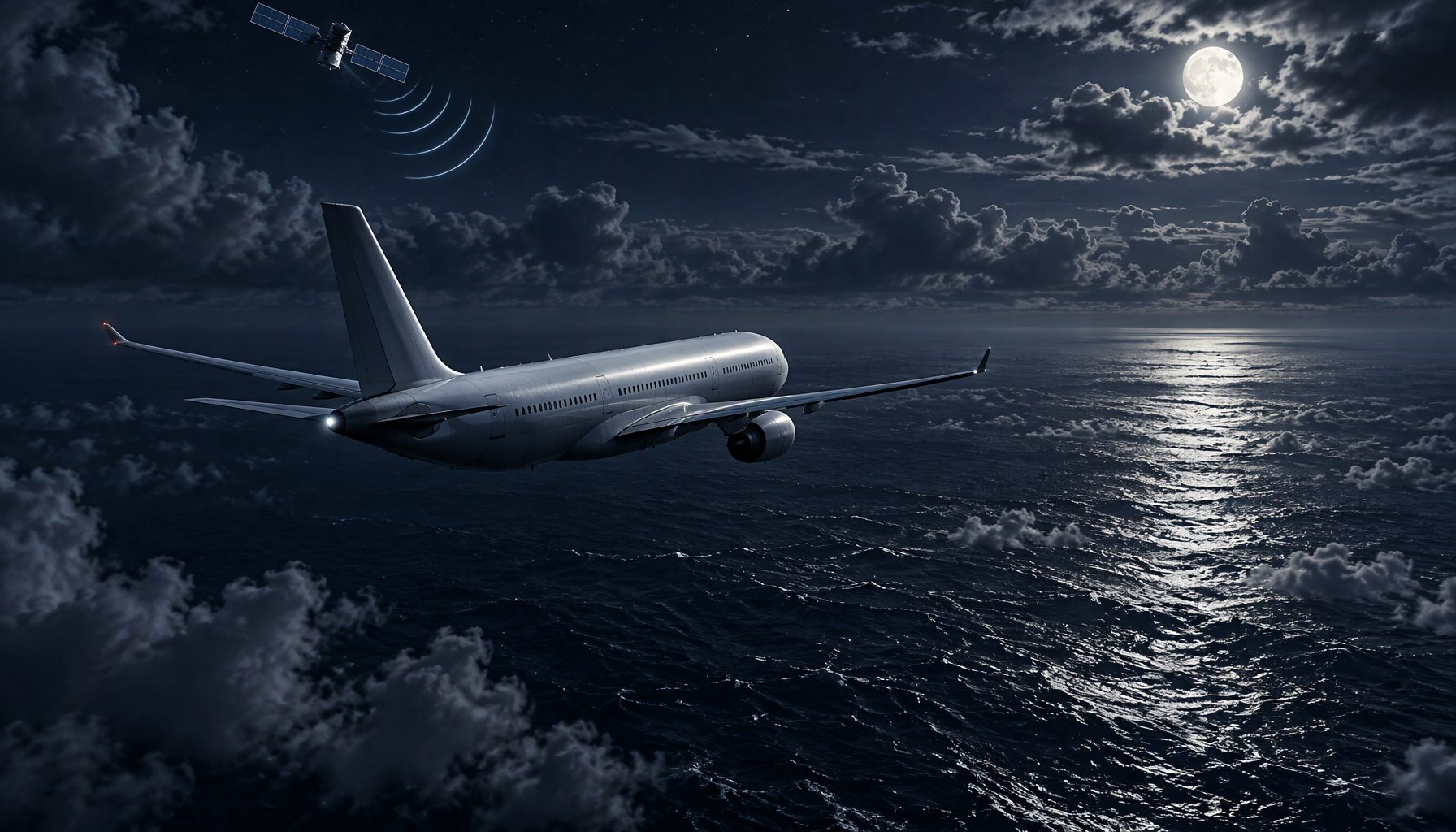
Night Flight
On March 8, 2014, Malaysia Airlines Flight MH370 took off from Kuala Lumpur bound for Beijing at 00:41 local time. The Boeing 777-200ER carried 227 passengers and 12 crew, totaling 239 people. The captain of the aircraft was Zaharie Ahmad Shah, while the co-pilot was Fariq Abdul Hamid.
The flight initially proceeded normally. The aircraft climbed to cruising altitude and crossed the South China Sea. At 01:19, the crew made the last contact with Malaysian air traffic control. Shortly afterward, the aircraft's transponder stopped transmitting signals, and the aircraft disappeared from secondary radar screens.
Loss of Contact
No distress call was received. The aircraft turned west from the planned route, crossing the Malaysian Peninsula, then moved towards the Malacca Strait. Malaysian military radar tracked the aircraft briefly, but no immediate action was taken to intercept it. After that, the aircraft left radar range.
Examination showed that the ACARS system, which automatically sends maintenance data, stopped functioning before the last voice contact. The sequence of events raised questions about whether the system was shut down intentionally or due to technical failure. To this day, there is no definitive answer.
Satellite Signals
Although radar lost the aircraft, Inmarsat communication satellites continued to receive automatic "handshake" signals from the aircraft's system. The signal did not contain location data, but the time and angle of signal arrival could be used to estimate the aircraft's position. Doppler analysis produced a series of arcs over the Indian Ocean.
The last ping was received at 08:11 Malaysian time. Based on this data, investigators concluded that the aircraft moved south and ended up in the southern Indian Ocean, far from the normal flight path. The area is vast, deep, and wavy, making the search very difficult.
Ocean Search
The search began in the South China Sea and the Malacca Strait, then shifted to the Indian Ocean. Australia led the underwater search operation in an area of about 120,000 square kilometers. Research vessels towed sonar and autonomous underwater vehicles to map the ocean floor.
In 2017, the official search was halted after failing to find the aircraft's wreckage. In 2018, private company Ocean Infinity conducted a new search in a wider area under a "no find, no fee" scheme. This search also failed to find the main wreckage. New efforts continue to be proposed but have not yielded results.
Debris in the Indian Ocean
In July 2015, a part of the aircraft's wing was found on Réunion Island, a French territory in the Indian Ocean. The part, called a flaperon, was later confirmed to be from MH370. The discovery was the first physical evidence confirming that the aircraft ended up in the Indian Ocean.
Since then, more than twenty pieces believed to be from the aircraft have been found on the east coast of Africa, Madagascar, Mauritius, and surrounding areas. Some of them have been officially confirmed. Analysis of ocean currents and organisms attached to the debris helped estimate the drift path, but did not indicate the exact location of the main wreckage.
Circulating Theories
Various theories have been put forward to explain the disappearance of MH370: hijacking, intentional action by the pilot, cockpit fire, depressurization, system malfunction, to conspiracy claims. The captain's personal flight simulator was found to have a route similar to the aircraft's path, but it was not enough to prove intent.
Malaysian investigators stated that there is no strong evidence of mechanical interference, hijacking, or terrorist involvement. They also could not confirm whether the aircraft was deliberately controlled when it turned. Without the black box and the main wreckage, every theory remains inconclusive.
Official Report
The official Malaysian investigation report published in 2018 consists of hundreds of pages. The report concluded that the cause of the aircraft's disappearance could not be determined. However, the report highlighted weaknesses in air traffic control oversight, delayed response, and lack of inter-agency coordination.
The report also noted that the aircraft did not send distress signals and that the change in route was not detected in time. Recommendations were given to strengthen aircraft tracking, including periodic position monitoring and improved communication procedures. International regulations then pushed for stricter global tracking systems.
The Unfinished Mystery
More than a decade after the event, MH370 remains one of the greatest aviation mysteries in history. Victims' families continue to demand answers and clarity about the fate of their loved ones. Some families refuse to accept the conclusion that the aircraft ended up at sea without further explanation.
MH370 shows how easily a large aircraft can disappear in a vast and minimally monitored area. This case has driven improvements in tracking technology, but also left lessons about data limitations, search costs, and the need for transparency for victims' families.


Discussion
Comments
Comments are reviewed by an editor before they appear. Include sources when correcting facts.
No comments yet. Be the first to respond to this article.