Background of the Ottoman Empire
At the beginning of the 20th century, Armenians were a significant Christian community in the Ottoman Empire. They primarily lived in eastern Anatolia, Istanbul, and other regions of the empire. Relations between the Armenian community and the Ottoman government had long been tense, but the situation worsened after the Young Turk nationalist movement took power in 1908 and after the Ottoman Empire's defeat in the Balkan Wars.
When World War I broke out, the Ottoman Empire sided with Germany and Austria-Hungary. The Ottoman government faced threats on several fronts, including the Caucasian front against Russia. In a climate of war and fear of rebellion, the government began to view Armenian citizens as an internal threat.
24 April 1915
On 24 April 1915, Ottoman authorities arrested a large number of Armenian figures in Istanbul: intellectuals, community leaders, journalists, and activists. The arrests are often considered the beginning of the genocide. Many of them were later imprisoned, deported, or killed. The date of 24 April is now commemorated as Armenian Genocide Remembrance Day.
The arrest of community leaders is a pattern often seen in mass violence: by disabling leadership, the community becomes less able to organize resistance or seek help. Subsequently, actions against the Armenian population spread to other regions.
Deportation Laws
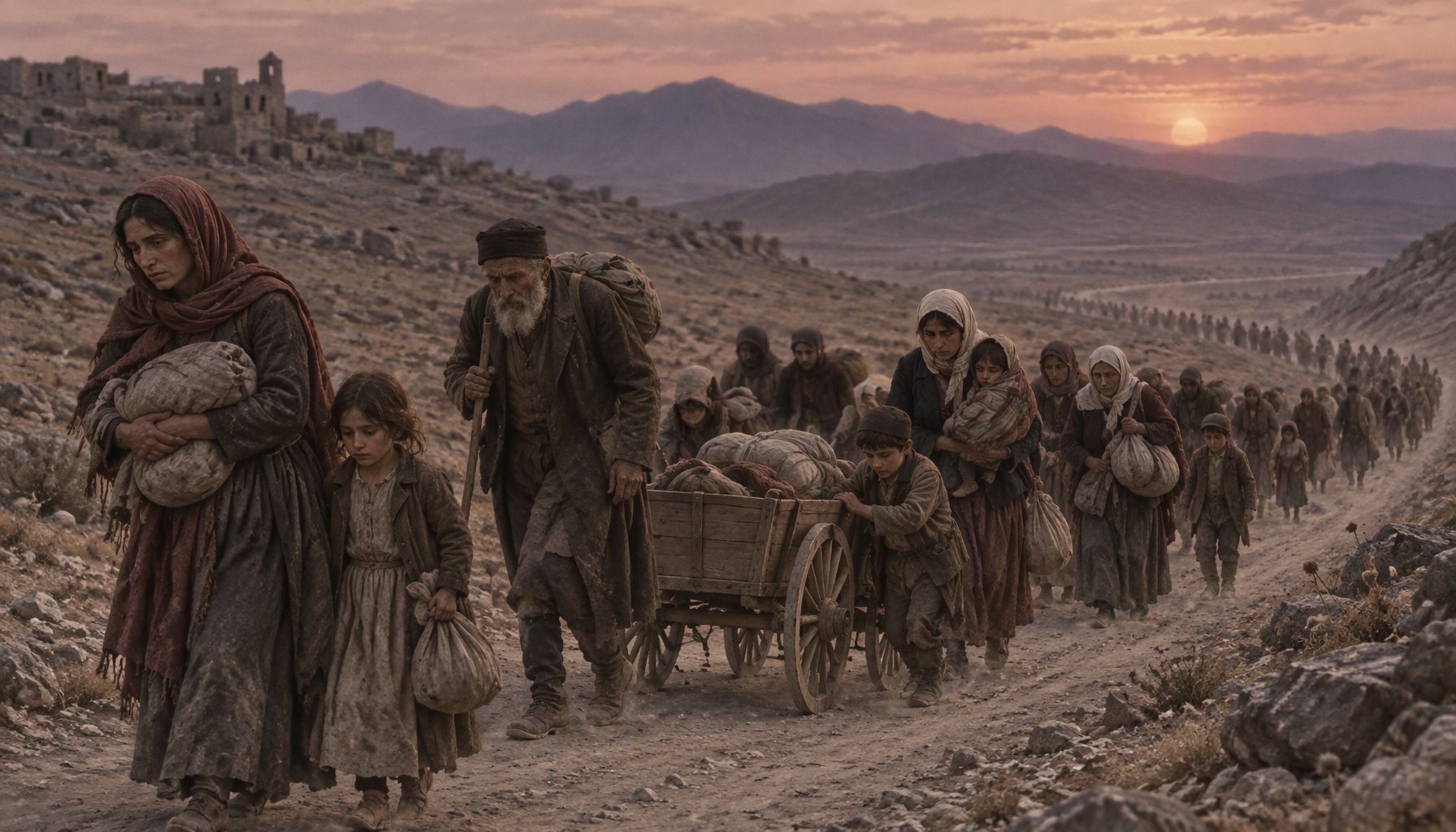
In May 1915, the Ottoman government enacted a law giving the military authority to relocate residents deemed suspicious. The law was used to deport Armenians from eastern Anatolia to southern regions, particularly the deserts of Syria and Mesopotamia. Deportations were carried out en masse, often with short notice and without adequate preparation.
The deportation journey took place under very poor conditions. Many people walked on foot in the heat, without sufficient food and water. Deportation groups were looted, beaten, or killed by armed groups and some local officials. Those who survived arrived at overcrowded camps lacking facilities.
Mass Deaths
The number of victims is still debated. Armenian historians and many international historians often cite figures around 1.5 million deaths, while official Turkish sources cite much smaller numbers. The difference in numbers is partly due to incomplete population records during the war, population movements, and the loss of archives.
Regardless of the numerical differences, there is broad consensus among historians that the event was a planned mass violence against Armenian civilians. Deportation, murder, starvation, and disease caused a very high number of deaths. The event also affected other Christian communities in the region, although the scale and form differed.
International Reaction During the War
In 1915, several diplomats and missionaries in the Ottoman region sent reports about deportations and killings. The governments of England, France, and Russia issued statements condemning the actions. However, international reaction during the war was limited, as the great powers were more focused on the progress of the war.
After the war, pressure emerged to prosecute the perpetrators. The post-war Ottoman government held trials against several officials, but the process was incomplete. Several key figures fled. The murder of Talaat Pasha in Berlin in 1921 by Soghomon Tehlirian became an event that highlighted the failure of justice and sparked debate about retribution.
The Term "Genocide"
The term "genocide" was coined by Polish-American lawyer Raphael Lemkin in 1944. Lemkin studied the atrocities against Armenians and Jews and sought to formulate a concept of crime that encompassed the destruction of groups. The 1948 UN Genocide Convention later included the term in international law.
The use of the term "genocide" for the events of 1915 has become a sharp political issue. Armenia and dozens of countries have recognized the event as genocide. Turkey officially rejects the term and refers to it as a war tragedy with victims on both sides. The debate involves identity politics, diplomatic relations, and collective memory.
Memory and Politics
For decades, the Armenian community in the diaspora has fought for recognition of the event. Monuments, museums, and memorial days have been established in various countries. Historians continue to study Ottoman, German, American, and Armenian archives to understand the mechanisms of deportation and decision-making.
On the other hand, the Turkish government and some academics reject the genocide framing, although many Turkish historians themselves critically discuss the event. The debate shows that the history of mass violence is not only about the past but also about how a nation builds a narrative about itself.
Legacy
The Armenian Genocide has become an important reference in the study of mass violence, human rights, and international law. The event shows how war, nationalism, and fear can lead to policies that destroy minority communities. For the descendants of the victims, recognition is not just symbolic but part of justice and acknowledgment of suffering.
To this day, political debate about the term and responsibility continues. However, for many historians, the evidence of systematic deportation and mass death is sufficient to place the event as one of the great tragedies of the 20th century.
Discussion
Comments
Comments are reviewed by an editor before they appear. Include sources when correcting facts.
No comments yet. Be the first to respond to this article.