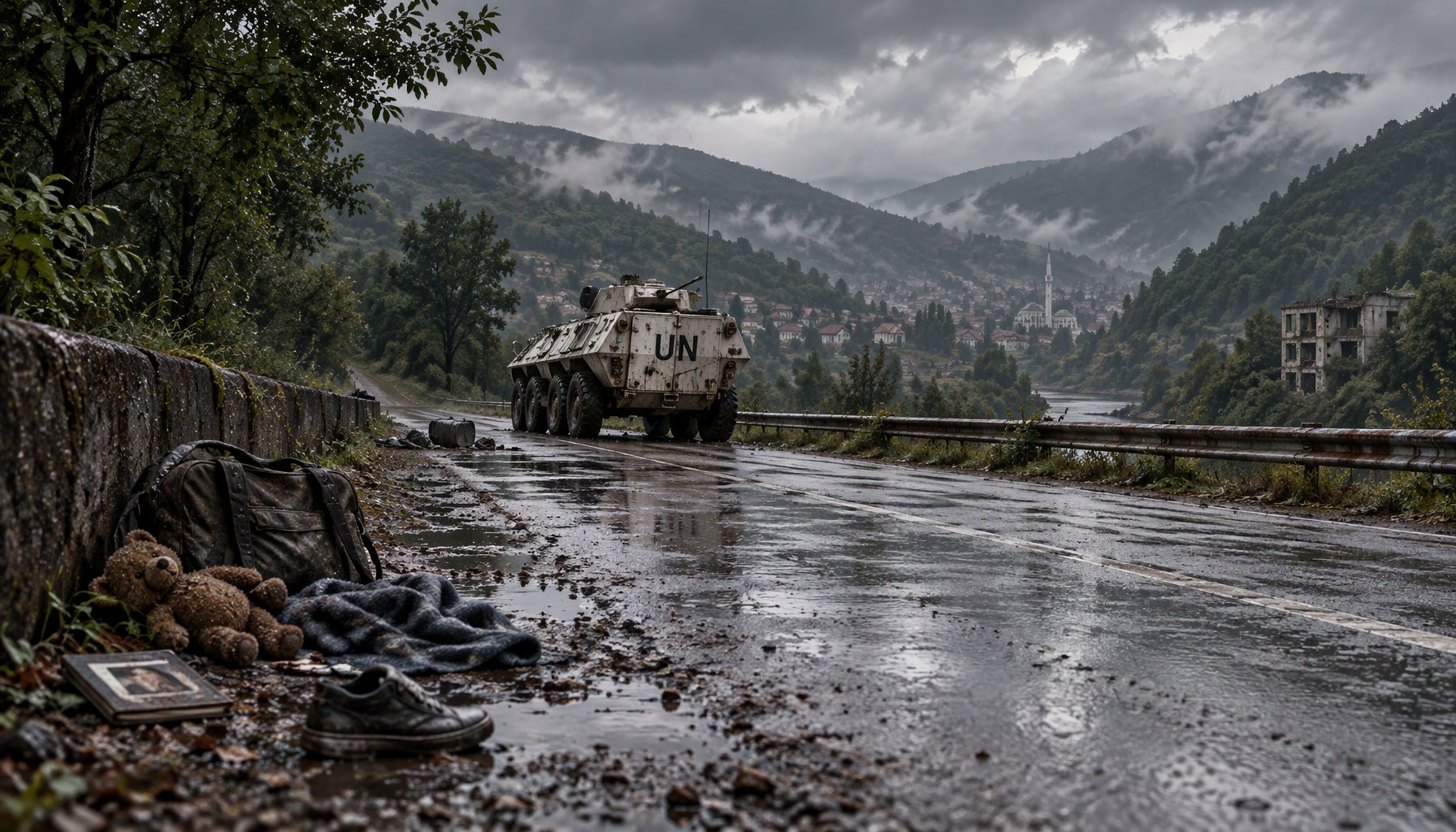
War in Yugoslavia
After Yugoslavia began to break apart in the early 1990s, war spread to Bosnia and Herzegovina. The republic had a mixed population: Bosniaks (Bosnian Muslims), Bosnian Serbs, and Bosnian Croats. In 1992, Bosnian Serb forces, with the support of the Yugoslav People's Army, seized large areas and besieged Sarajevo.
The international community responded by sending UN peacekeeping forces, UNPROFOR, and imposing an arms embargo. However, the mandate of the forces was limited and their strength was small. Various diplomatic efforts failed to stop ethnic cleansing and violence against civilians.
Fragile Safe Zones
In 1993, the UN Security Council declared Srebrenica and several other towns as "safe zones." Resolutions 819 and 836 promised protection for civilians. Srebrenica became a refuge for thousands of Bosniak refugees fleeing attacks in the surrounding area.
However, the safe zone did not have sufficient strength. The Dutch forces, Dutchbat, numbered only about 400 with light weapons. They did not have the mandate or capability to stop large-scale attacks. The inhabitants of Srebrenica lived in difficult conditions, with limited food aid and increasing fear.
July 1995
In early July 1995, Bosnian Serb forces under the command of Ratko Mladić launched an attack on Srebrenica. UN observation posts around the town fell one by one. On July 11, Mladić entered the town, and tens of thousands of residents fled to Potocari, the location of the Dutchbat base.
The UN requested air support, but the request was not immediately fulfilled. NATO jets only attacked a few targets and did not stop the advance of the Bosnian Serb forces. That night, about 20,000 to 25,000 refugees gathered in Potocari without adequate protection.
Evacuation and Separation
On July 12, buses began transporting women, children, and the elderly to areas controlled by the Bosnian government. However, men and teenagers were separated under the pretext of "interrogation." The separation marked the beginning of the disaster. Many families never saw their fathers, husbands, or sons again.
Some men and teenagers tried to escape through the forest to Tuzla. They walked for days in conditions of hunger and fear. Bosnian Serb forces chased and captured many of them. In various locations, prisoners were gathered and executed en masse.
Mass Murder
Killings took place in warehouses, schools, fields, and roadsides. One of the most well-known locations is Branjevo, where hundreds of prisoners were shot. The bodies were initially buried in mass graves, then moved to other graves to hide evidence when international investigations began.
The International Criminal Tribunal for the former Yugoslavia (ICTY) concluded that about 8,000 Bosniak men and boys were killed. The court also stated that the Srebrenica event was genocide. The International Court of Justice reinforced the characterization of genocide in its ruling in 2007.
Failed Response
The failure of Srebrenica became a scandal for the UN and the Dutch government. An official Dutch report in 2002 concluded that the forces and government did not provide adequate protection. The Dutch government resigned after the report was published.
After Srebrenica, NATO launched a more determined bombing campaign in August 1995. Military pressure brought the parties to the negotiating table. The Dayton Agreement was signed in November 1995, ending the war and dividing Bosnia into two entities within one country.
Justice and Remembrance
The ICTY prosecuted and sentenced several figures responsible. Ratko Mladić and Radovan Karadžić were sentenced to life imprisonment. The identification of victims was carried out through DNA analysis, and the bodies that were successfully identified were reburied at the Memorial Center in Potocari.
Every July 11, thousands of people gather to commemorate the victims. However, denial and revisionist politics still emerge in some parts of the Balkans. Debates about the number of victims and the nature of the event continue, although the court evidence is very strong.
Lessons
Srebrenica showed that safe zones without strength and clear mandates are only promises on paper. The failure also exposed the weakness of the UN system in dealing with mass violence that was quickly planned. The concept of the responsibility to protect was born partly from experiences like this.
For the families of the victims, legal justice does not erase the loss. However, official recognition, identification of bodies, and public remembrance provide a place for memory. Srebrenica remains a reminder of the price of the world's slowness when civilians are in danger.
Discussion
Comments
Comments are reviewed by an editor before they appear. Include sources when correcting facts.
No comments yet. Be the first to respond to this article.