Inscriptions Found in Other Cities
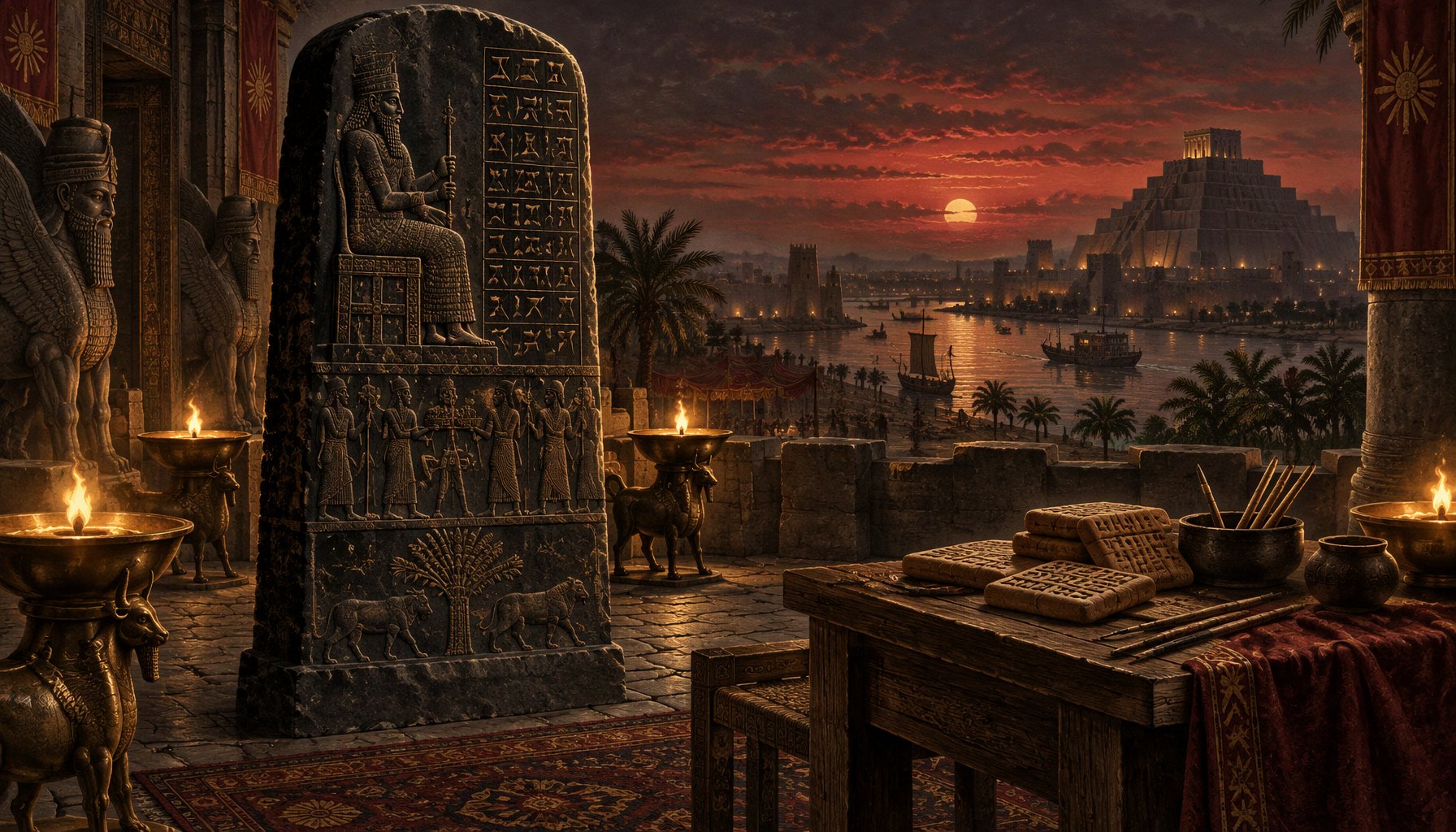
In December 1901, a French excavation team led by Jacques de Morgan worked in Susa, the ancient capital of Elam in southwestern Iran. Among the ruins, they discovered a dark stone inscription over two meters high, divided into three parts: a king's relief at the top, legal text in the body, and curses at the bottom. The inscription was later brought to the Louvre and became one of the most famous artifacts from the ancient Near East.
What made the discovery complex was its location. The inscription was made in Babylon, not Susa. Most likely, the Elamite king, Shutruk-Nahhunte, brought it as war booty in the 12th century BC when his army plundered Babylon. Thus, the document that is now an icon of Babylonian law survived because it was transported to another country.
Hammurabi and the Language of Justice
Hammurabi ruled Babylon around 1792–1750 BC. During his reign, Babylon grew from a small city on the banks of the Euphrates River into a power that dominated southern and central Mesopotamia. In the inscription, he refers to himself as a king chosen by the gods to uphold justice, protect the weak, and punish the wicked.
The language used is Akkadian in cuneiform script. The prologue mentions various cities and temples that he built or restored, while the epilogue contains curses for anyone who dares to alter, erase, or move the contents of the inscription. These curses were not mere decoration: in the ancient world, public texts often served as law, propaganda, and religious monuments simultaneously.
Almost Three Hundred Provisions
The main part of the inscription contains approximately 282 provisions, although some lines are damaged, so the exact number is debated. Its contents are not arranged like the articles in modern laws. The provisions are more like a collection of cases and legal consequences: what happens if someone steals, accuses another without evidence, damages irrigation channels, ignores debts, marries, divorces, adopts a child, or injures another person.
One of the most frequently quoted principles is the law of retribution, an eye for an eye and a tooth for a tooth. However, this principle did not apply equally to everyone. The law distinguished three main classes: awilum or free persons, mushkenum of lower status, and wardum or slaves. Fines and punishments varied according to the status of the perpetrator and the victim.
Layered Justice
For example, if a nobleman damages the eye of another nobleman, his punishment is the loss of his own eye. If he damages the eye of a person of lower status, he only has to pay a fine. If a doctor performs an operation and causes the death or loss of sight of a nobleman patient, his hands can be cut off; if his patient is a slave, he only has to replace the slave with another. Provisions like these show that justice in Babylon was tied to the social order, not equality before the law as understood in modern times.
The law also regulated prices and tariffs. There are provisions about the wages of craftsmen, the rental of ships, compensation for livestock, the responsibility of warehouse keepers, and the obligation of landowners who allow irrigation water to damage their neighbors' fields. From this, it can be seen that the text was not only about criminal law but also a tool to regulate the agrarian economy that depended on a network of canals.
Not the First Law
Hammurabi is often referred to as the first lawmaker, although this claim is not accurate. Previously, there was the code of Ur-Nammu from around 2100 BC, the code of Lipit-Ishtar from Isin, and the laws of Eshnunna. What makes the Code of Hammurabi special is its completeness and preservation: the text is preserved in one large inscription, plus many clay tablet copies used in scribe education.
These copies are important because they show that the legal text was not only displayed but also copied and studied. In Mesopotamian scribe schools, students practiced writing by quoting parts of the law. In this way, the idea of written rules spread far beyond the city of Babylon.
How the Law Was Enforced
The inscription does not explain the entire judicial process. From other documents, it is known that cases were brought before royal officials, city councils, or temples. Witnesses and written documents were very important. For certain cases that were difficult to prove, the river ordeal was known: the accused entered the river, and the result was considered a decision of the gods. This practice shows that Babylonian law was not entirely secular.
Therefore, modern historians reject the idea of reading the Code of Hammurabi as a law mechanically applied. The text is better understood as an official statement about the king's justice, a guide for judges, and a mirror of societal values. Not all the provisions within it may have been used in everyday practice.
Debated Legacy
For centuries, the inscription has influenced how people imagine the laws of the ancient Near East. However, some historians remind us not to draw a direct line from Hammurabi to modern human rights. There was no separation of powers, no parliament, and no idea that the king was subject to the same law.
Nevertheless, one idea has endured: that the rules of living together should be written, announced, and readable by anyone concerned. In a society that was largely illiterate, public inscriptions remained a sign that power claimed to be bound by justice. In the Louvre today, the stone from Susa continues to raise the same questions as when it was first carved: who is protected by the law, and who is outside its reach?



Discussion
Comments
Comments are reviewed by an editor before they appear. Include sources when correcting facts.
No comments yet. Be the first to respond to this article.