City Buried in Mud
In 1922, archaeologist R. D. Banerji traced a mound of earth on the banks of the Indus River, in the Sindh region which is now part of Pakistan. Beneath layers of mud and broken bricks, he found remnants of a neatly arranged city: straight streets, houses made of baked bricks, and water channels that were still recognizable. Large‑scale excavations were then led by John Marshall from the Archaeological Survey of India.
The name Mohenjo‑daro in Sindhi is often translated as “mound of the dead people.” This city is estimated to have flourished around 2600 to 1900 BCE and became one of the largest centers of the Indus Valley Civilization, alongside Harappa and Dholavira. In 1980, the site was designated as a UNESCO World Heritage Site.
City Designed Before It Was Discovered
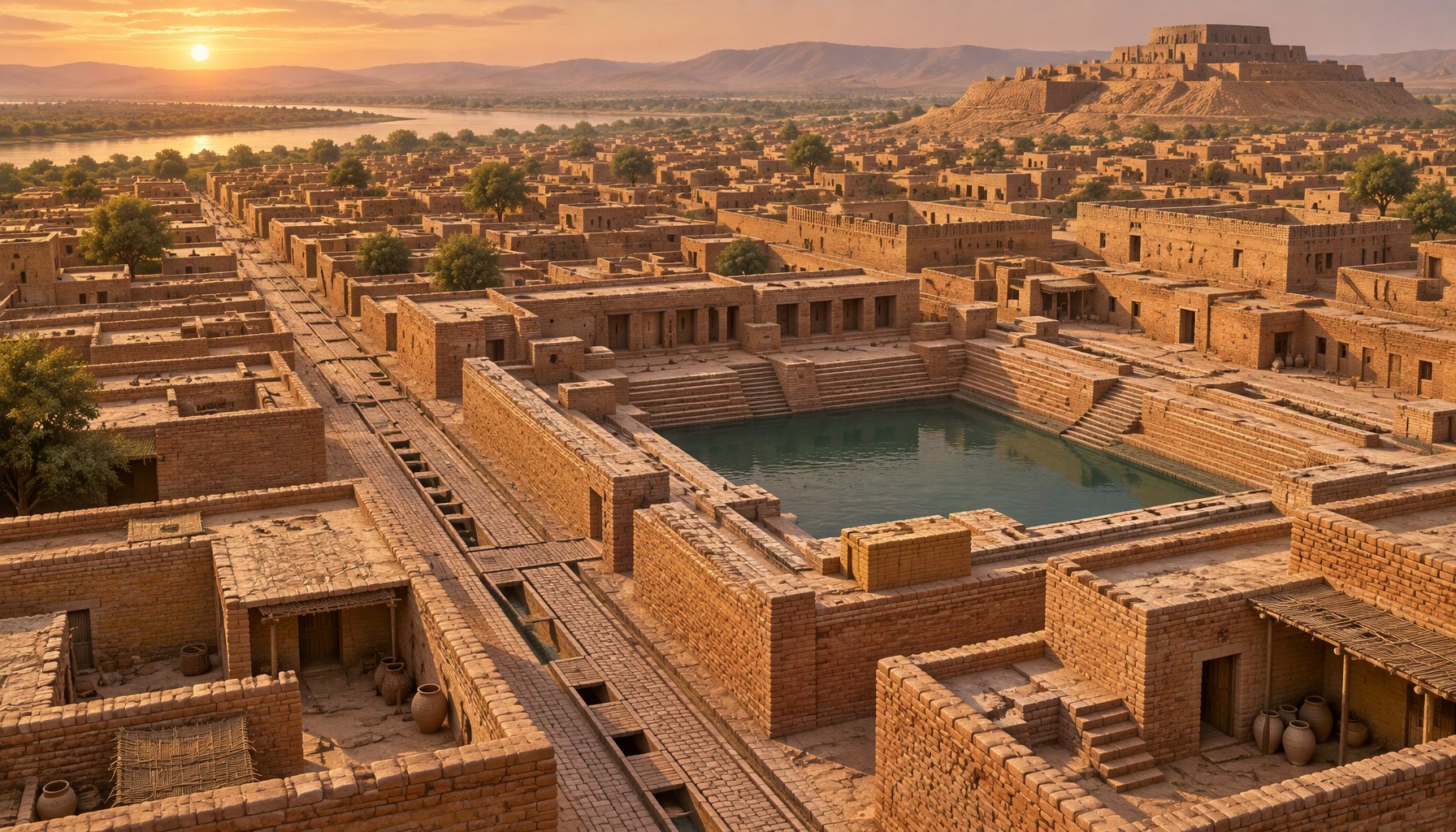
What most surprised researchers was not just the age of the city, but the level of its planning. Mohenjo‑daro was built on a network of streets that roughly followed cardinal directions. The main streets divided the city into large blocks, while smaller lanes connected the houses within them. Many houses were built from baked clay bricks, of uniform size, and arranged with nearly consistent thickness.
Each house typically had a well, a bathroom, and a drainage channel connected to the street drainage. The channel was lined with bricks and had inspection holes for cleaning. Not all ancient cities had such a system. Archaeologists concluded that cleanliness and water management were an important part of urban life, not merely a private matter.
Homes, Wells, and Everyday Life
Homes in Mohenjo‑daro were generally built around inner courtyards. The main door usually faced a small lane, not a main street, so household traffic was separated from public traffic. Inside the houses, remnants of food, weaving tools, kitchen utensils, and small objects were found, indicating a fairly prosperous everyday life.
The Great Bath, a bitumen‑coated brick pool in the part of the city often referred to as the “public event site” complex, is one of the most iconic buildings. Its function is uncertain; some researchers speculate that the pool was used for purification rituals, while others see it as part of a ceremonial complex. Nearby is a large building that Marshall called a granary, although its exact function remains debated.
Who Ruled?
Unlike Egypt or Mesopotamia, Mohenjo‑daro did not leave evidence of a king’s palace, a ruler’s tomb, or victory inscriptions. No large king statues, clear temples, or buildings standing out as a single center of power were found. This makes historians wonder how such a large city was governed.
Some researchers propose a collective governance model, such as a council of elders or a group of merchants regulating the city. Others emphasize the importance of kinship networks and local authority. Without readable script, that question remains unanswered. What is clear is that the uniformity of bricks, size, and urban layout indicates strong coordination at the community level.
Unresolved Writing
The Indus civilization left thousands of stone seals, pottery, and small objects with short signs. That writing has not been deciphered to this day. Unlike Egyptian hieroglyphs that could be aided by the Rosetta Stone, Indus writing lacks a known bilingual text, and most of its inscriptions are very short.
Those seals often depict animals such as bulls, elephants, rhinoceroses, and tigers, as well as a seated figure dubbed “Pashupati” by some researchers. The seals were likely used in trade to mark goods or trader identities. Without understanding the script, the message behind those images remains a mystery.
Trade with the Ancient World
Indus artifacts have been found at Mesopotamian sites, including Ur and Lothal, while Mesopotamian goods have been found in Indus cities. Long‑distance trade was conducted via ports such as Lothal in Gujarat and overland routes to Central Asia. The traded goods included carnelian beads, ivory, wood, and possibly textiles.
These trade relations show that Mohenjo‑daro was not an isolated city but part of a wide economic network. However, unlike Mesopotamia, which left royal records and contracts, the Indus left fewer texts, making its political history much harder to reconstruct.
Gradual Decline
Around 1900 BCE, Indus cities began to be abandoned. There is no evidence of large‑scale attacks or sudden destruction that explains the end of this civilization. Researchers suspect a combination of climate change, weakening monsoon, shift in the Ghaggar‑Hakra river flow, repeated flooding, and collapse of trade networks contributed to a gradual decline.
The inhabitants moved to smaller villages and eastward. Mohenjo‑daro itself slowly became buried and forgotten for thousands of years. When rediscovered in the 20th century, the city offered a picture of an advanced civilization in urban technology, though it left no easily readable traces of power.
Heritage and Threats
Mohenjo‑daro now faces threats not from conquerors, but from soil salinity, groundwater, flooding, and human activity. Salt levels damage ancient bricks, while the 2022 floods threatened the site. The Pakistani government and international agencies are making conservation efforts, but the challenge is great.
For the world, Mohenjo‑daro is a reminder that great civilizations can arise without the trace of a magnificent king. The city shows that urban planning, sanitation, and social cooperation existed long before modernity. Yet the unresolved script and the absence of political records keep its history open for new research.
Discussion
Comments
Comments are reviewed by an editor before they appear. Include sources when correcting facts.
No comments yet. Be the first to respond to this article.