War in the Far East
In February 1904, Japan launched a surprise attack on the Russian fleet at Port Arthur, starting the Russo-Japanese War. The two countries vied for influence in Manchuria and Korea. Russia had a far larger army and navy, but Japan had the advantage of closer bases, modern preparation, and more effective command.
After a series of land and sea battles, the Russian Pacific fleet was trapped at Port Arthur. The Russian government decided to send the Baltic Fleet, the largest remaining fleet, to take over maritime control. That voyage became one of the longest military cruises in history.
18.000-Mile Voyage
The Baltic Fleet departed from Libau in October 1904 under the command of Admiral Zinovy Rozhestvensky. They had to circumnavigate Africa because the Suez Canal was closed to Russian warships, passing through the Atlantic, then crossing the Indian Ocean. The journey of about 18.000 nautical miles took 7 months and depleted fuel and crew morale.
Along the way, the fleet faced engine problems, coal shortages, and diplomatic incidents. One of the most embarrassing incidents occurred at Dogger Bank in October 1904, when a Russian ship fired upon an English fishing vessel they mistook for a Japanese torpedo boat. The incident almost triggered a war with Britain.
Admiral Togo Waiting
Japan had already anticipated the arrival of the Russian fleet. Admiral Heihachiro Togo, commander of the Combined Fleet, chose the Tsushima Strait as the ambush point. The narrow strait between Korea and Japan was the shortest route to Vladivostok, Russia's destination port. Togo trained his crew intensively and leveraged speed and long-range artillery advantages.
The Japanese fleet consisted of modern warships built in Britain, including Mikasa, Togo's flagship. The Russian fleet was larger in number, but comprised a mix of old ships, untested new vessels, and crews exhausted after months at sea.
May 27, 1905
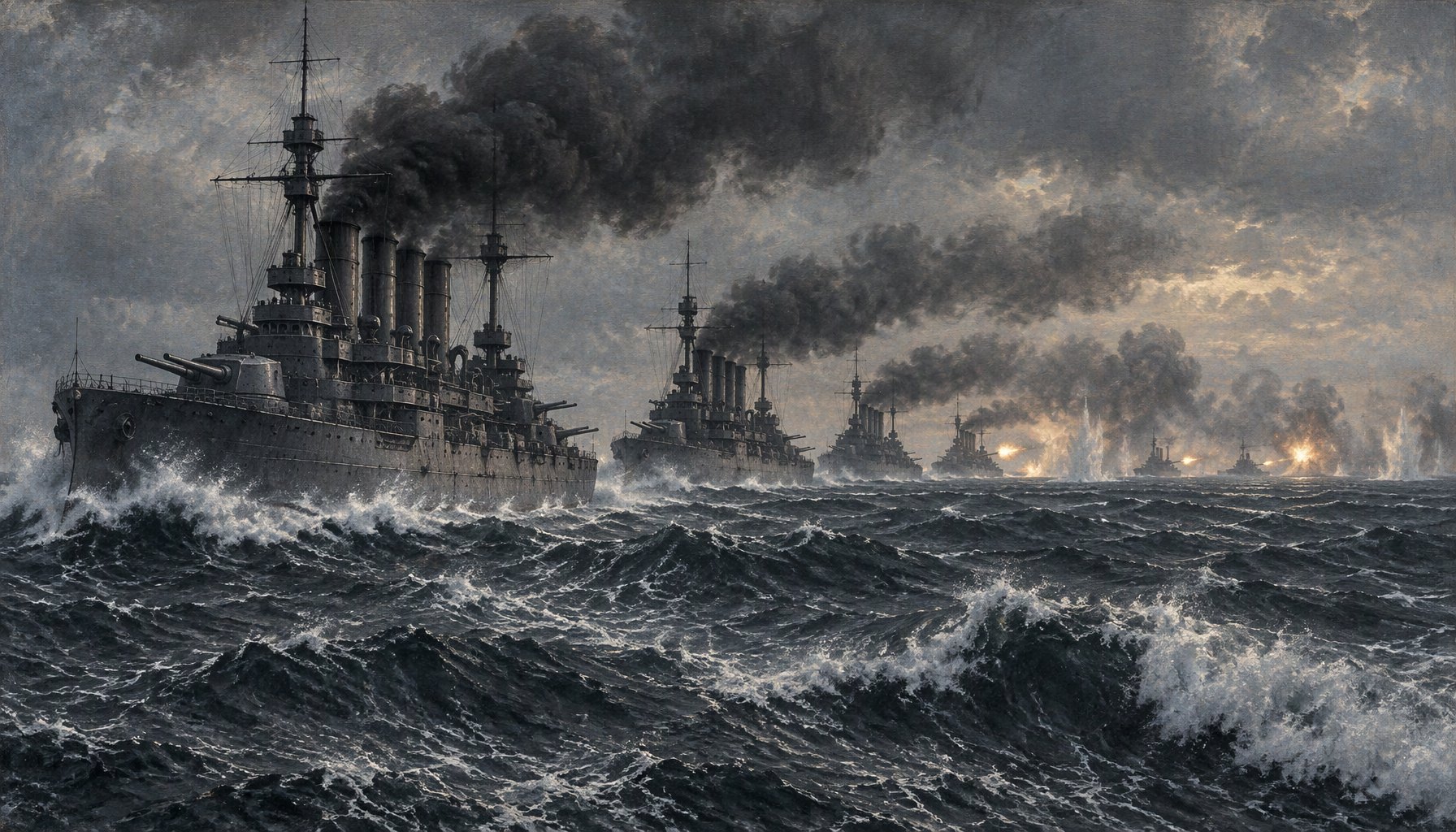
On the morning of May 27, a Japanese scouting ship found the Russian fleet near Tsushima. Togo moved immediately and, by noon, began a bold maneuver: turning his fleet in front of the Russian fleet to form a “T”. The maneuver was risky because the Japanese ships were at risk of being easy targets, but it succeeded in positioning all Japanese artillery facing the Russian line.
Within a few hours, Russian ships were struck in rapid succession. Fires broke out on many vessels, formations broke apart, and command lost control. By nightfall, part of the Russian fleet attempted to flee north, but Japan continued to pursue them with torpedoes and close-range fire.
Destruction of the Fleet
On May 28, the remnants of the Russian fleet surrendered or were sunk. Eight Russian warships sank, some were captured, and only a few light vessels managed to reach Vladivostok. Rozhestvensky was wounded and taken prisoner. On the Japanese side, losses were far smaller: three torpedo boats sank and about 100 sailors were killed, compared to thousands of casualties on the Russian side.
That victory was almost total. Within two days, Russia's Far Eastern naval power practically vanished. The event marked the first time in modern history that an Asian nation defeated a European power in a major naval battle.
Peace and Global Impact
The defeat at Tsushima forced Russia to accept mediation by the United States. The Portsmouth Treaty was signed in September 1905, with Russia ceding influence in South Korea and southern Manchuria to Japan. President Theodore Roosevelt received the Nobel Peace Prize for his role as mediator.
The impact of Tsushima extended beyond East Asia. Japan's victory inspired anti-colonial movements in Asia and altered perceptions of European superiority. In Russia, the military defeat worsened the political crisis and became one of the triggers of the 1905 Revolution. In naval strategy, this battle became a required study on force concentration, training, and the importance of logistical range.
Legacy of Tsushima
For Japan, Tsushima became a symbol of naval superiority and accelerated Japan's rise as an imperial power. However, that victory also planted the seeds of ambition that would later lead Japan into the Pacific War. For Russia, Tsushima exposed the weaknesses of the Tsarist regime.
Today, the Tsushima Strait remains an important shipping lane and a memorial site for both countries. The wreckage of Russian warships still lies scattered on the strait's seabed, serving as a silent witness to one of the most decisive naval battles in modern history.
Discussion
Comments
Comments are reviewed by an editor before they appear. Include sources when correcting facts.
No comments yet. Be the first to respond to this article.