Europe on the Eve of 1517
At the beginning of the 16th century, the Catholic Church held immense influence in Western Europe. The Pope wielded both spiritual and political power, while bishops and monks managed vast territories and great wealth. However, criticism of corruption, nepotism, and abuse of power had long been voiced by various groups.
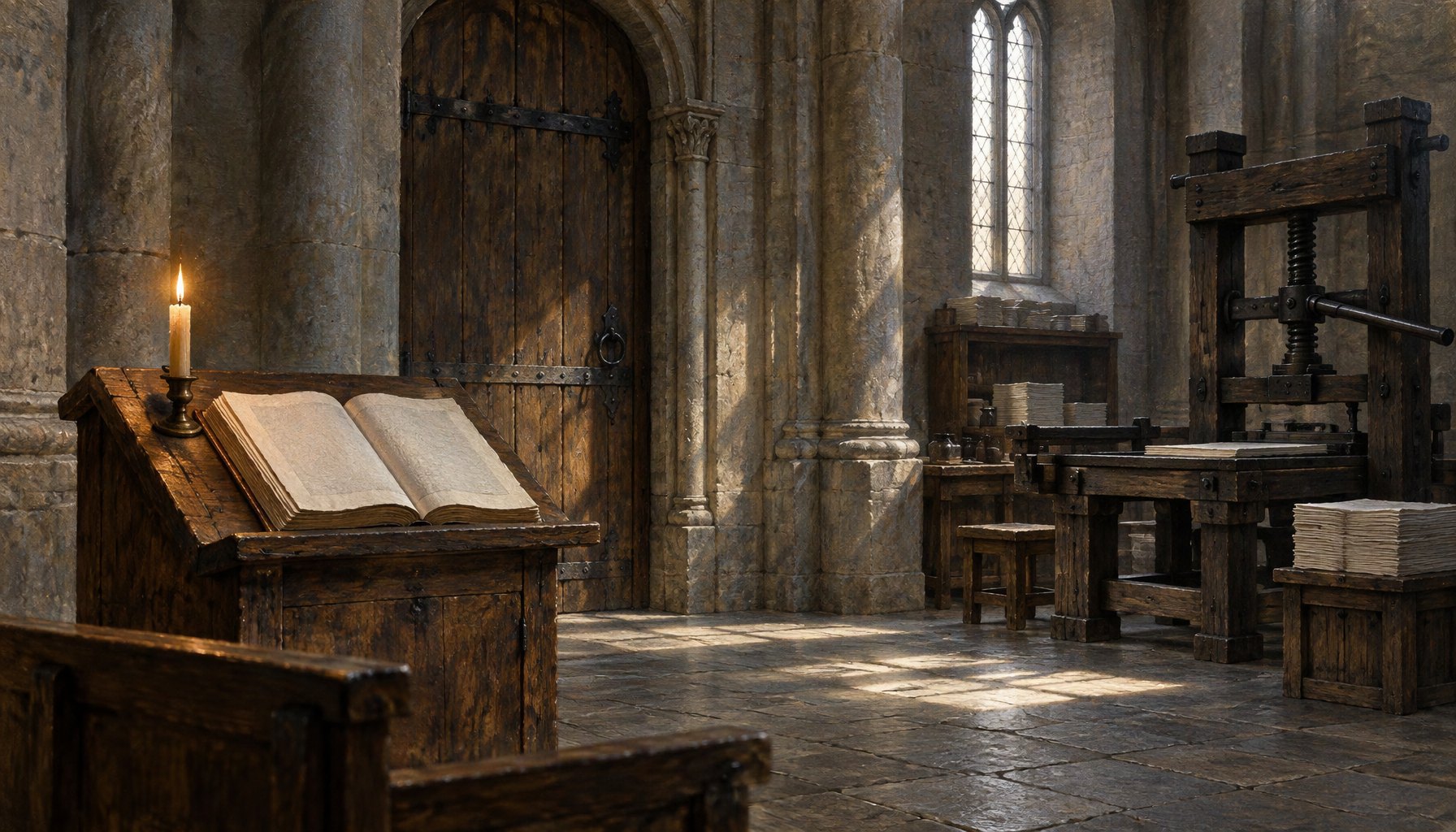
European society was also changing. Trade flourished, cities grew, and the printing press, invented by Johannes Gutenberg in the mid-15th century, made books cheaper and easier to disseminate. New ideas could spread faster than ever before, crossing national borders and the oversight of authorities.
Indulgences and Johann Tetzel
The immediate catalyst for the Reformation was the practice of indulgences. In the Church's doctrine at the time, indulgences were a temporary reduction of punishment for sins that had already been forgiven. However, the practice was often misused to raise funds, including for the construction of St. Peter's Basilica in Rome.
In 1517, a Dominican monk named Johann Tetzel sold indulgences in Germany with a slogan that angered many, as if payment could free souls from purgatorial fires. Martin Luther, a theology professor at the University of Wittenberg, deemed the practice a deviation from Christian teaching and a devaluation of true repentance.
The 95 Theses
On October 31, 1517, Luther sent a letter to the Archbishop of Mainz protesting the sale of indulgences. According to tradition, he also nailed his 95 theses to the door of the Castle Church in Wittenberg, although historians still debate whether this event actually occurred. What is certain is that the theses were quickly printed and distributed throughout Germany.
The 95 theses did not directly call for a separation from the Church. Luther still hoped for internal reform and theological discussion. However, his critical tone was sharp, and his ideas about grace and repentance resonated with many who were dissatisfied with the Church's practices.
Confrontation with Rome
Rome's reaction was swift. Luther was summoned to explain his views, and a series of theological debates ensued. In 1521, he was brought before the Diet of Worms, a meeting of the leaders of the Holy Roman Empire. In the presence of Emperor Charles V, Luther refused to recant his teachings unless proven wrong by the Bible and sound reason.
After the Diet of Worms, Luther was declared an outlaw and excommunicated. However, he received protection from Frederick the Wise, the ruler of Saxony, who hid him in Wartburg Castle. There, Luther translated the New Testament into German, a work that greatly influenced the development of the German language and literacy.
The Spread of the Reformation
The Reformation spread rapidly thanks to the printing press and the support of local rulers who saw an opportunity to reduce Rome's influence. In Switzerland, Huldrych Zwingli and later John Calvin developed their own reform traditions. In England, Henry VIII broke away from Rome for political and personal reasons, although his theological changes differed from Luther's.
This movement also sparked social and political conflicts. The German Peasants' War of 1524–1525 mixed economic demands with reform ideas, and Luther condemned the violence of the peasants. Religious wars between Catholic and Protestant rulers erupted in various regions, causing casualties and destruction.
The Peace of Augsburg, 1555
After decades of conflict, the Peace of Augsburg in 1555 established the principle that the ruler of a territory could determine the religion of its people, known as cuius regio, eius religio. The agreement gave political legitimacy to Lutheranism, but it did not resolve all disputes and did not include Calvinism.
The Protestant Reformation did not end in 1555. Religious conflicts continued until the Thirty Years' War in the 17th century, which ended with the Peace of Westphalia in 1648. However, 1555 marked a significant point when Europe acknowledged that religious division could no longer be avoided.
The Legacy of the Reformation
The Reformation transformed the religious landscape of Europe and the world. The Catholic Church undertook internal reforms at the Council of Trent, while Protestantism evolved into various denominations. Emphasis on the Bible in everyday language promoted literacy and education in many regions.
The Reformation also influenced modern politics. Ideas about individual conscience, limiting church power, and the relationship between religion and the state became part of political debate in Europe. To this day, Luther's legacy can be seen in Protestant traditions, in modern German language, and in how Western society understands religious freedom.


Discussion
Comments
Comments are reviewed by an editor before they appear. Include sources when correcting facts.
No comments yet. Be the first to respond to this article.